Generative AI has moved beyond experimentation. Enterprises are now exploring how to embed AI into customer operations, software development, knowledge management, marketing, finance, supply chains, and other core business functions. However, moving from an impressive AI demo to a reliable enterprise capability requires more than selecting a model or deploying a chatbot.
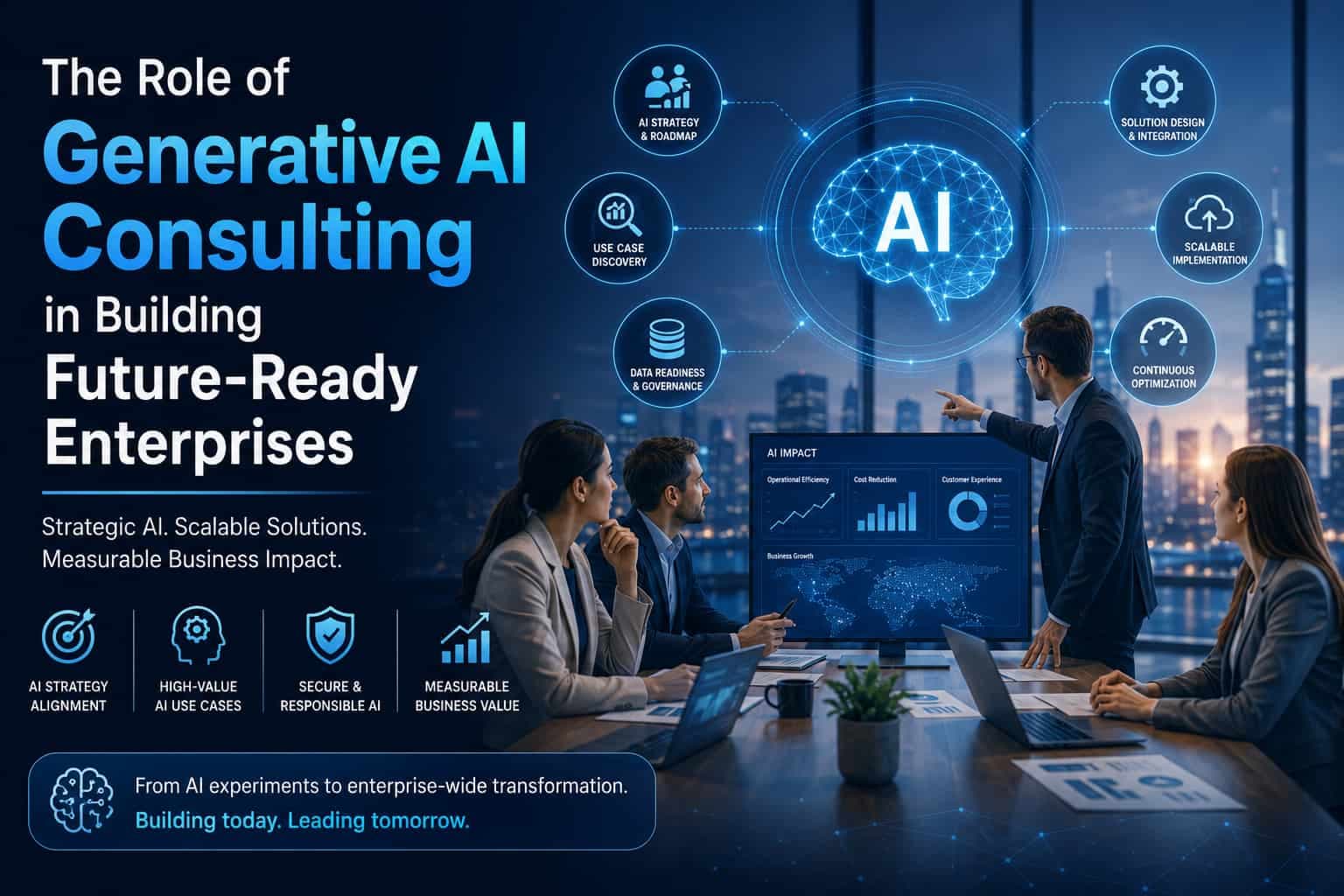
This is where generative AI consulting becomes strategically important. The right consulting approach helps organizations identify valuable AI use cases, assess technical readiness, establish governance, integrate AI with existing systems, and create a roadmap for measurable business outcomes.
For enterprises looking to remain competitive as AI capabilities evolve, the objective is no longer simply to “use AI.” It is to build an AI foundation that can adapt as technologies, customer expectations, and business requirements change.
Why Enterprises Are Moving Beyond AI Experimentation

Early generative AI initiatives often begin with individual teams experimenting with public AI tools, internal assistants, content generation, or coding copilots. These experiments can demonstrate the technology's potential, but they rarely provide a complete path to enterprise adoption. DashMinds Analytics helps organizations move from isolated AI experiments to structured, scalable enterprise AI initiatives by aligning use cases with business objectives, data requirements, integration needs, security, and governance. Organizations are now asking more practical questions: Which AI use cases should we prioritize? How can we integrate AI with existing systems? What data and infrastructure are required? How can we measure business value and scale successful pilots? DashMindsAnalytics supports this transition through generative AI consulting, enterprise AI strategy, data engineering, and AI implementation services.
- Which AI use cases can deliver measurable business value?
- How can sensitive company data be protected?
- How should AI integrate with existing applications?
- How can AI outputs be monitored and evaluated?
- What governance framework should be established?
- How can successful pilots be scaled across departments?
These questions require a structured AI strategy rather than isolated experimentation. Enterprise generative AI initiatives increasingly need to align technology investments with business priorities, operational requirements, risk management, and long-term scalability.
The Challenges of Scaling Generative AI
Scaling generative AI across an organization introduces challenges that may not be visible during a small proof of concept.
Data Readiness
Generative AI applications depend heavily on the quality, accessibility, and security of enterprise data. Organizations may have information distributed across databases, documents, CRM systems, ERP platforms, cloud storage, and legacy applications. Before implementation, businesses need to understand which data sources should be connected, how information should be governed, and how access should be controlled.
Security and Privacy
Enterprise AI applications may process confidential customer, financial, employee, or operational information. Without appropriate controls, organizations can introduce data leakage, unauthorized access, or compliance risks. Security therefore needs to be considered during architecture and generative AI implementation, rather than added after deployment.
Integration Complexity
A standalone AI application can demonstrate value quickly. Integrating that application into existing enterprise workflows is significantly more complex. Generative AI solutions may need to interact with APIs, business applications, databases, identity systems, and workflow platforms. Effective integration determines whether AI becomes part of everyday operations or remains an isolated tool.
Governance and Reliability
AI-generated outputs require appropriate evaluation and oversight. Enterprises need processes for monitoring performance, handling inaccurate responses, controlling access, and maintaining human oversight where necessary. A mature AI governance framework helps establish policies around security, accountability, model usage, data handling, and ongoing monitoring.
How Generative AI Consulting Identifies High-Value Use Cases
One of the biggest mistakes organizations can make is adopting AI simply because a technology is available. A generative AI consulting partner can help evaluate opportunities based on business impact rather than technological novelty. A practical use-case assessment can consider:
- Business impact – Can the use case improve revenue, productivity, customer experience, or operational efficiency?
- Feasibility – Is the required data and technology infrastructure available?
- Risk – What security, regulatory, or operational risks could arise?
- Scalability – Can the solution be expanded to other teams or processes?
- Measurability – Can the organization establish meaningful KPIs?
Potential applications may include intelligent knowledge assistants, automated document processing, customer service support, software development assistance, sales enablement, research automation, and internal workflow optimization. The goal is to create a portfolio of AI use cases that supports business priorities.
Building a Practical Generative AI Implementation Roadmap
A successful enterprise AI program typically requires a phased approach.
1. Assess AI Readiness
Organizations should evaluate their existing technology environment, data architecture, security controls, skills, processes, and AI maturity.
2. Prioritize Use Cases
Potential applications should be ranked according to business value, technical feasibility, risk, and expected return.
3. Develop a Proof of Concept
A focused pilot allows the organization to validate technical performance and business assumptions before making larger investments.
4. Integrate With Enterprise Systems
Once the concept is validated, the solution can be connected to relevant applications, data sources, APIs, and workflows.
5. Deploy and Monitor
Production deployment requires monitoring, access controls, performance evaluation, security measures, and continuous improvement.
6. Scale Successful Solutions
High-performing applications can then be expanded across departments, business units, or additional use cases. This approach helps businesses reduce unnecessary investment while creating a controlled path toward enterprise-wide AI automation.
Measuring the ROI of Generative AI
AI investments should not be measured only by model performance or the number of users. Businesses should connect generative AI initiatives to measurable outcomes such as:
- Reduced manual processing time
- Improved employee productivity
- Faster customer response
- Lower operational costs
- Increased sales conversion
- Reduced software development effort
- Improved knowledge accessibility
- Higher customer satisfaction
For example, an enterprise knowledge assistant could be evaluated based on search time, employee adoption, response quality, and reduction in repetitive support requests. Establishing these measurements before implementation makes it easier to determine whether a generative AI initiative is producing meaningful business value.
Preparing for the Next Stage of Enterprise AI
Future-ready organizations should avoid building AI strategies around a single model, platform, or short-term trend. Instead, enterprises should develop flexible architectures that can adapt as models, AI agents, data platforms, and automation capabilities evolve. Organizations should also invest in:
- AI governance and responsible AI practices
- Secure enterprise data infrastructure
- Employee AI literacy and adoption
- Scalable AI architectures
- Continuous model evaluation
- Integration capabilities
- AI performance monitoring
- A clear enterprise AI roadmap
The rise of agentic AI, multimodal models, retrieval-augmented generation, and increasingly capable AI platforms will continue expanding what enterprises can automate and optimize. A flexible strategy allows organizations to adopt these capabilities without repeatedly rebuilding their technology foundation.
The Strategic Value of Generative AI Consulting
The role of generative AI consulting extends beyond recommending AI tools. It involves connecting business objectives with technology, data, implementation, governance, and measurable outcomes. For enterprises, this strategic perspective can help reduce fragmented experimentation and create a structured path from AI opportunity identification to production deployment. The organizations most likely to benefit from generative AI will not necessarily be those that adopt the most tools. They will be the ones that build the right capabilities, select the right use cases, manage risk effectively, and continuously improve how AI supports their business.
Frequently Asked Questions
1. What does generative AI consulting include?
Generative AI consulting can include AI strategy development, use-case identification, readiness assessment, solution architecture, technology selection, implementation planning, integration, governance, and AI optimization.
2. Why do enterprises need generative AI consulting?
Enterprises often need support connecting AI opportunities with business objectives, data infrastructure, security requirements, existing systems, and measurable ROI.
3. How can businesses identify the right generative AI use cases?
Organizations can evaluate potential use cases based on business value, technical feasibility, data availability, risk, scalability, and measurable outcomes.
4. How long does generative AI implementation take?
Implementation timelines vary depending on the complexity of the use case, data environment, integration requirements, security controls, and deployment scope. A focused pilot can generally be completed before broader enterprise scaling.
5. How can enterprises measure generative AI ROI?
ROI can be evaluated through metrics such as productivity gains, cost reduction, process efficiency, customer experience, revenue impact, adoption, and time saved.
Build a Future-Ready AI Strategy
Generative AI can become a powerful enterprise capability when it is supported by the right strategy, technology, data, governance, and implementation approach. If your organization is evaluating generative AI consulting, DashMindsAnalytics can help identify practical AI opportunities and develop a scalable path from experimentation to enterprise adoption. Explore your generative AI opportunities with DashMindsAnalytics and build an AI strategy designed for measurable, long-term business value.