Generative AI has rapidly moved from an emerging technology to a strategic priority for enterprises. Organizations across industries have experimented with AI-powered assistants, content generation, customer support tools, software development copilots, and knowledge management applications. However, many businesses are now facing a critical question: How can AI move beyond pilots and become an active part of business operations?
The next stage of enterprise AI is increasingly focused on AI agents that can reason, plan, use tools, access information, and execute multiple steps with limited human intervention. This shift is creating new opportunities for agentic AI consulting , helping organizations identify where autonomous workflows can deliver measurable value while maintaining appropriate security and human oversight.
Why Agentic AI Is Becoming an Enterprise Priority

Traditional AI applications typically respond to a specific request. A chatbot answers a question, a generative AI tool creates content, or a predictive model provides a recommendation. Agentic AI takes a broader approach. AI agents can interpret a business objective, break it into tasks, determine the actions required, interact with enterprise systems, and continue working through a process. Instead of simply generating an answer, an agent can potentially execute a workflow. DashMinds Analytics helps organizations explore agentic AI and intelligent automation solutions that connect AI agents with enterprise data, applications, and business workflows, creating opportunities to automate complex, multi-step processes while maintaining appropriate governance and operational controls. For enterprises, this creates opportunities to automate processes that previously required employees to move between multiple applications and make repeated decisions. The growing interest in agentic automation is therefore less about replacing individual tasks and more about redesigning how entire workflows operate.
Agentic AI vs. Traditional Generative AI
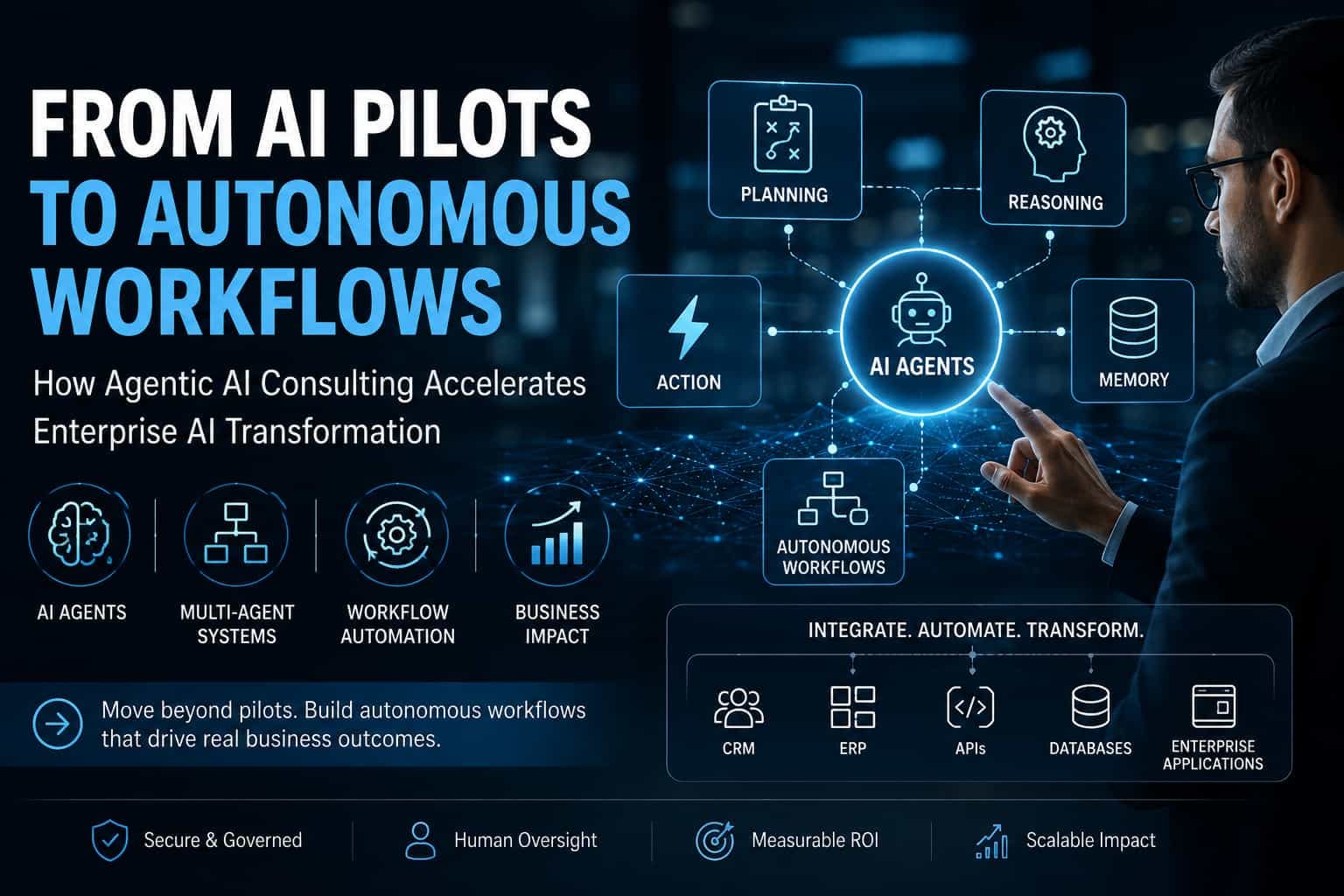
Traditional generative AI is primarily designed to generate outputs based on user prompts. It can summarize documents, draft emails, analyze information, generate code, and answer questions. Agentic AI builds on these capabilities by adding elements such as:
- Goal-oriented planning
- Multi-step reasoning
- Tool and API usage
- Memory or contextual information
- Workflow execution
- Decision-making within defined boundaries
- Interaction with enterprise systems
For example, a conventional AI assistant might summarize a customer complaint. An enterprise AI agent could potentially analyze the complaint, retrieve customer information from a CRM, determine the appropriate workflow, create a service ticket, notify the relevant team, and update the customer record. This distinction is important when organizations evaluate where AI can create operational value.
Where AI Agents Can Create Business Value
Not every business process needs autonomous AI. The strongest opportunities are generally workflows that are repetitive, information-intensive, rule-driven, and involve multiple systems.
Customer Service
Enterprise AI agents can assist with customer inquiries, retrieve information, classify requests, recommend actions, and initiate approved service workflows.
Sales Operations
AI agents can support lead qualification, research prospects, update CRM records, prepare follow-ups, and coordinate sales activities.
Finance
Potential applications include invoice processing, financial document analysis, exception identification, and workflow coordination.
IT Operations
AI agents can help investigate incidents, analyze logs, create tickets, recommend remediation steps, and coordinate routine operational tasks.
Supply Chain
Agents can monitor relevant information, identify exceptions, coordinate actions, and support procurement or inventory workflows.
Software Development
AI agents can support coding, testing, documentation, debugging, and other stages of the software development lifecycle. The objective should not be maximum autonomy. It should be appropriate autonomy where the technology can safely improve speed, efficiency, and consistency.
How Enterprises Should Identify Agentic AI Use Cases
A common mistake is starting with the technology rather than the business problem. Organizations considering agentic AI consulting should begin by mapping high-friction workflows and identifying processes where employees spend significant time gathering information, making repetitive decisions, and moving data between systems. A practical evaluation framework can consider:
- Business impact: How much time, cost, or revenue is associated with the workflow?
- Process complexity: Does the process contain multiple steps or systems?
- Data availability: Can the agent access the information required to complete its tasks?
- Risk level: What could happen if an automated decision is incorrect?
- Integration readiness: Can the agent securely interact with existing systems?
- Human oversight: Where should employees review or approve actions?
- Scalability: Can the workflow be expanded after successful implementation?
This approach helps enterprises prioritize realistic AI use cases rather than launching disconnected experiments.
Connecting AI Agents to the Enterprise Technology Stack
Autonomous workflows cannot operate effectively in isolation. Enterprise AI agents may need to connect with CRM platforms, ERP systems, databases, APIs, workflow engines, communication tools, document repositories, and other enterprise applications. DashMindsAnalytics helps businesses integrate AI capabilities with their existing technology ecosystem to create connected, scalable, and efficient enterprise workflows.
For example, an AI agent supporting sales operations might need to retrieve account information from a CRM, obtain product information from a database, access pricing through an API, prepare a proposal, and record the interaction. This makes integration a critical part of AI implementation. Organizations should establish secure interfaces and permissions that define exactly what an agent can access and which actions it is authorized to perform.
Security, Governance, and Human Oversight
Greater autonomy also creates greater responsibility. Organizations deploying enterprise AI agents need governance frameworks covering data access, authentication, authorization, monitoring, auditability, model behavior, and escalation procedures. Human oversight is particularly important for high-impact decisions. Instead of allowing an agent to perform every action independently, enterprises can establish approval thresholds. For example, an agent may be allowed to classify a customer request and prepare a response automatically, while requiring human approval before issuing a refund above a defined value. This creates a balance between automation and accountability. AI governance should therefore be designed alongside the workflow rather than treated as a final compliance step.
How Agentic AI Consulting Helps Move From Pilot to Production
Many enterprise AI initiatives struggle to progress beyond proof of concept because the pilot does not address integration, governance, scalability, or operational ownership. An agentic AI consulting approach can help organizations create a structured path from experimentation to production. This may include:
1. AI Readiness Assessment
Evaluate data, infrastructure, processes, security, skills, and existing AI capabilities.
2. Use-Case Prioritization
Identify workflows where autonomous AI can deliver meaningful business value.
3. Agent Architecture
Design how agents, models, tools, data sources, and enterprise systems will interact.
4. Controlled Pilot
Test the selected workflow under defined performance, security, and governance requirements.
5. Enterprise Integration
Connect the solution with CRM, ERP, APIs, databases, and other required applications.
6. Production Deployment
Introduce monitoring, access controls, human approval mechanisms, and operational processes.
7. Continuous Optimization
Measure performance and refine workflows as business requirements and AI capabilities evolve. This structured approach allows enterprises to scale successful multi-agent systems and autonomous workflows without treating every AI initiative as an isolated project.
Measuring ROI and Scalability
Enterprise AI investments should be evaluated using business metrics rather than novelty or model performance alone. Useful measurements can include:
- Processing time reduction
- Employee productivity
- Cost per transaction
- Workflow completion time
- Error rates
- Customer response times
- Revenue contribution
- Employee adoption
- Automation rate
- Human intervention rate
Organizations should also consider the cost of running AI agents, including model usage, infrastructure, integration, monitoring, and ongoing maintenance. A successful autonomous workflow should demonstrate measurable improvement while remaining economically and operationally sustainable at scale.
Building an Enterprise AI Strategy for the Next Stage
The move toward autonomous workflows requires more than deploying AI agents. Enterprises need a broader enterprise AI strategy that connects technology investments with business priorities. Organizations should establish a roadmap covering AI use cases, data readiness, architecture, governance, workforce adoption, integration, security, and measurement. They should also design for flexibility. AI models, agent frameworks, and automation technologies will continue to evolve. A modular architecture can make it easier to adopt improved capabilities without rebuilding the entire technology foundation. The organizations that benefit most from agentic AI will be those that combine innovation with disciplined implementation.
Frequently Asked Questions
1. What is agentic AI consulting?
Agentic AI consulting helps organizations identify, design, implement, integrate, govern, and scale AI-agent-based workflows aligned with business objectives.
2. How is agentic AI different from generative AI?
Generative AI primarily produces content or responses from prompts, while agentic AI can use models to plan and execute multi-step tasks, interact with tools, and complete defined workflows.
3. What business processes are suitable for AI agents?
Processes involving repetitive tasks, multiple systems, structured decisions, information retrieval, and clearly defined workflows are often good candidates for AI-agent automation.
4. Are AI agents completely autonomous?
Not necessarily. Enterprises can define different levels of autonomy and require human approval for sensitive or high-impact actions.
5. How can businesses measure the ROI of agentic AI?
ROI can be evaluated using metrics such as time savings, productivity, operating costs, error reduction, workflow completion rates, customer experience, and revenue impact.
Moving From AI Pilots to Autonomous Business Workflows
Agentic AI represents an important evolution in enterprise automation. The opportunity is not simply to deploy more AI tools but to create intelligent workflows that can coordinate information, applications, and actions around specific business objectives. For organizations evaluating this transition, agentic AI consulting can provide the strategic and technical framework needed to move from experimentation toward secure, measurable, and scalable implementation. Is your organization ready to move beyond AI pilots? Talk to DashMindsAnalytics about identifying high-value agentic AI use cases and building autonomous workflows aligned with your business goals.