How Agentic AI Consulting Helped Automate a Complex Multi-Step Enterprise Workflow
Client Situation
A representative enterprise was managing a complex operational workflow that depended heavily on employee coordination. Staff members had to gather information from multiple business systems, review requests, apply business rules, make decisions, communicate with relevant stakeholders, and update records across platforms. The organization had already explored AI tools and traditional automation, but much of the end-to-end process remained manual. Leadership wanted to determine whether the workflow could become a controlled agentic automation opportunity without creating unnecessary security, governance, or operational risk.
Challenge

The workflow involved multiple decisions rather than a simple sequence of predefined tasks. Employees frequently needed to interpret information, determine the next action, request additional details, and adapt when exceptions occurred. This created several challenges:
- Information was distributed across enterprise systems.
- Decisions depended on context and changing workflow conditions.
- Communications and record updates required coordination.
- Existing processes lacked a unified view of workflow status.
- Scaling automation required stronger AI governance and oversight.
The organization needed a path toward AI workflow automation that could handle complexity while remaining controllable.
Traditional automation is effective when workflows follow predictable rules. However, this process required information gathering, reasoning across multiple inputs, dynamic task sequencing, and exception handling.
DashMindsAnalytics identified the workflow as a potential agentic AI use case because AI agents could be designed to perform specialized tasks, share context, and coordinate actions within defined boundaries.
Rather than replacing existing systems, the goal was to add an intelligent orchestration layer capable of determining the next appropriate action.
DashMindsAnalytic's Agentic AI Approach
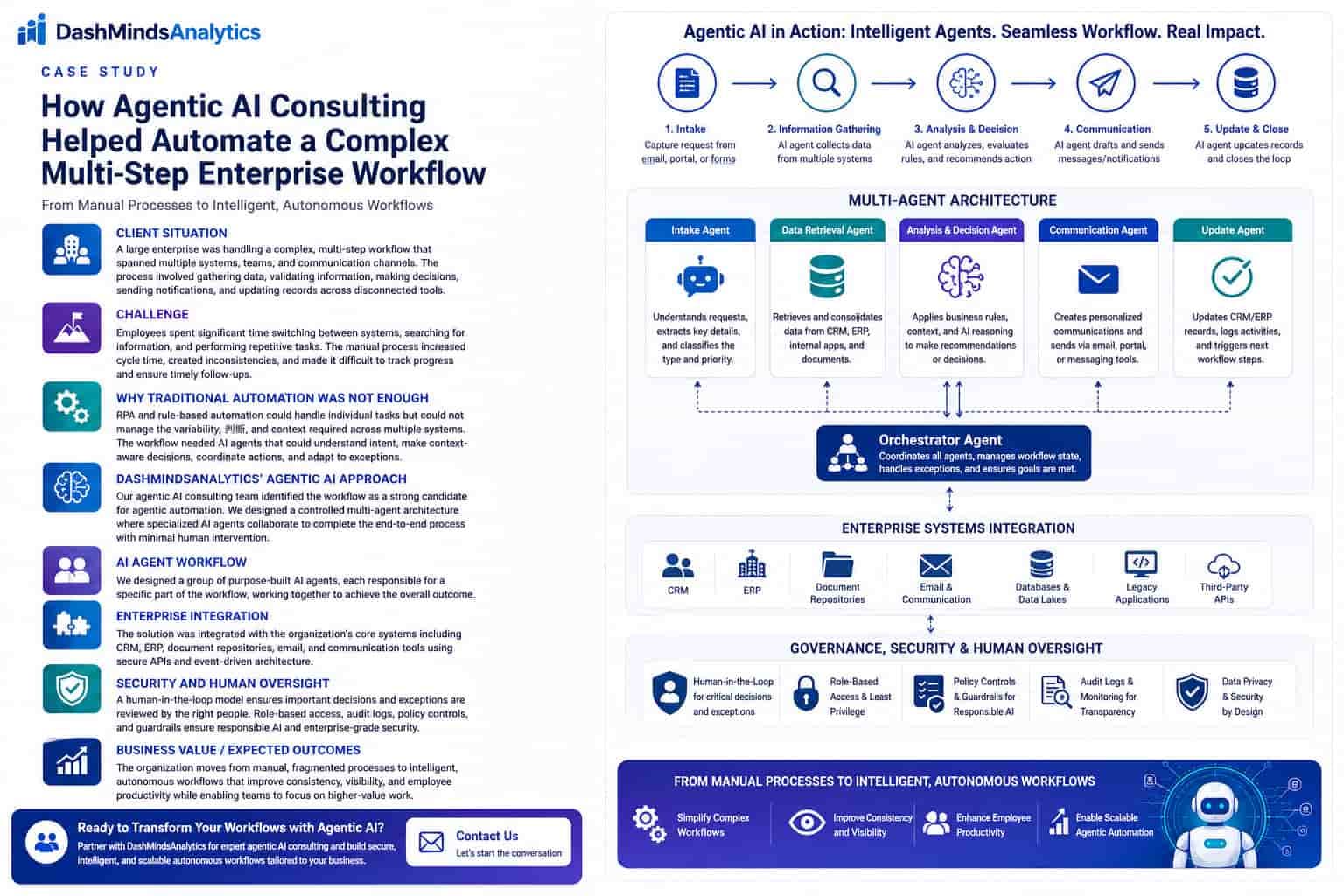
Through agentic AI consulting, DashMindsAnalytics assessed the workflow, mapped decision points, identified system dependencies, and defined where autonomous AI agents could operate safely.
The proposed approach used a controlled architecture that could include specialized AI agents for:
- Gathering and validating information
- Interpreting requests and workflow context
- Applying approved business rules
- Preparing communications
- Triggering approved actions
- Updating enterprise records
- Escalating exceptions to human reviewers
For more complex requirements, these capabilities could operate as a governed multi-agent system, coordinated by an orchestration layer.
AI Agent Workflow
The workflow began when a request or business event triggered the process. An AI agent collected relevant information through approved API integration with enterprise applications. Specialized agents could then evaluate the available context and determine the next step. Where confidence, policy requirements, or business rules required human judgment, the workflow paused for a human-in-the-loop process. Once approved, the appropriate agent could initiate communications, trigger downstream actions, and update relevant records. This model allowed the organization to explore autonomous AI agents without granting unrestricted autonomy.
Enterprise Integration
A core part of the design was integrating AI agents with the systems employees already used. This could include CRM/ERP integration, internal databases, workflow platforms, document repositories, and communication tools. The architecture defined approved APIs, access permissions, data boundaries, and logging requirements. This enabled agentic capabilities to work across systems while preserving enterprise controls.
Security and Human Oversight
DashMindsAnalytics incorporated responsible AI, security, and AI governance considerations from the beginning. Agents could operate with role-based permissions, limited action scopes, monitoring, audit trails, and escalation rules. Sensitive decisions or high-impact actions could require human approval before execution. This combination of automation and oversight helped create a more controlled path from experimentation to production.
Business Value / Expected Outcomes
A successful agentic AI implementation could help reduce manual coordination, improve workflow visibility, accelerate information handling, and create a more consistent process across systems. Measurable outcomes could include [reduction in manual effort], [improvement in workflow completion time], [fewer handoffs], and [improved process visibility], depending on the selected workflow and implementation scope.
More importantly, agentic AI consulting provided a structured framework for identifying where autonomy creates value—and where human control remains essential.

Have a technical challenge worth discussing?
Our practice leads are happy to talk through your specific situation with no sales pitch required.
Talk to an Expert →