Artificial intelligence has become a strategic priority for enterprises, but moving from an AI proof of concept to a production-ready solution remains a significant challenge. Organizations may successfully demonstrate what an AI model can do, yet struggle to integrate it into everyday operations, achieve employee adoption, manage risk, or generate measurable business value. The problem is often not the AI technology itself. It is the gap between AI strategy and execution.
Successful AI implementation services help businesses bridge that gap by connecting business objectives, data, technology, integration, governance, deployment, and continuous optimization. Understanding the most common implementation mistakes can help enterprises build AI solutions that deliver sustainable operational impact.
Why Enterprise AI Projects Struggle After the Pilot Stage

AI pilots are designed to prove that something is technically possible. Production systems have a different requirement: they must work reliably within real business environments. A pilot may use a limited dataset, a controlled environment, and a small group of users. Production deployment introduces enterprise security requirements, legacy systems, data quality issues, compliance obligations, user adoption challenges, performance requirements, and ongoing maintenance. DashMinds Analytics helps organizations bridge the gap between AI experimentation and production deployment by addressing data readiness, system integration, security, governance, scalability, monitoring, and operational requirements. This structured approach helps businesses move beyond demonstrations and build AI solutions that can operate reliably within real-world workflows. This is why an AI solution that performs well in a demonstration may fail to create value at scale. Successful AI implementation requires not only a capable model, but also the data, infrastructure, integration, governance, and operational foundation needed to support it in production.
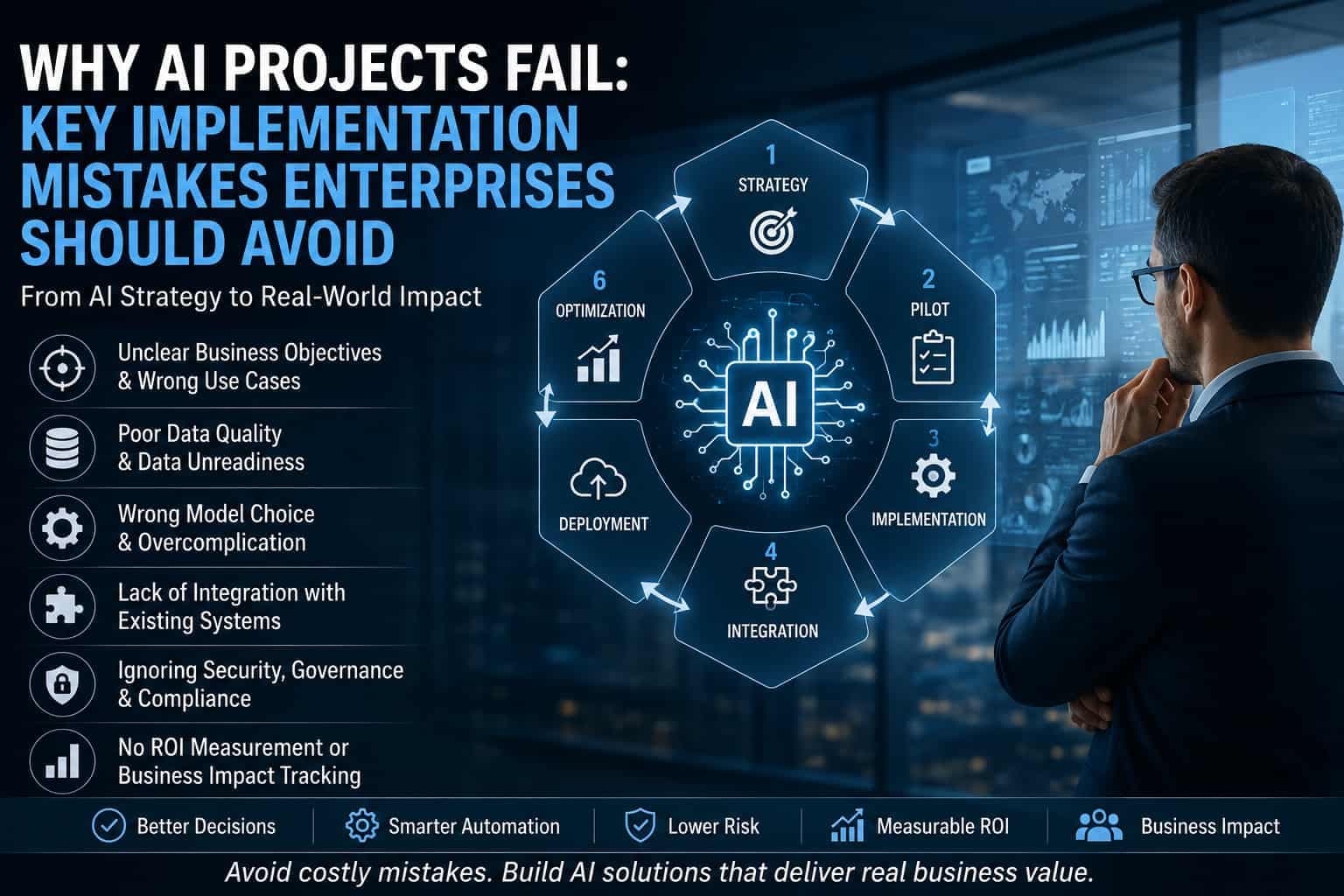
The transition requires a structured process:
Strategy → Pilot → Implementation → Integration → Deployment → Optimization
Skipping any of these stages can create problems later.
Mistake 1: Choosing AI Use Cases Without a Clear Business Objective
One of the most common mistakes is starting with technology instead of a business problem. An organization may decide to deploy generative AI, machine learning, or automation because competitors are doing so. However, without a defined objective, it becomes difficult to determine whether the project is successful. A stronger approach starts with questions such as:
- What business problem are we solving?
- Which process is creating measurable inefficiency?
- What outcome should AI improve?
- How will success be measured?
- Is AI actually the right solution?
High-value AI use cases often involve repetitive processes, large volumes of data, complex information analysis, or decisions that can be supported by intelligent automation. A focused AI strategy helps prioritize opportunities according to business impact, feasibility, risk, and scalability.
Mistake 2: Underestimating Data Readiness
AI performance depends heavily on data quality. Enterprises often have data distributed across CRM platforms, ERP systems, databases, spreadsheets, cloud applications, document repositories, and legacy systems. Data may also be incomplete, inconsistent, duplicated, outdated, or difficult to access. Building an advanced model on unreliable data will not solve the underlying problem. Before enterprise AI implementation, organizations should evaluate:
- Data quality
- Data availability
- Data ownership
- Data accessibility
- Data security
- Data governance
- Data integration requirements
Data preparation should therefore be treated as a core implementation activity rather than a preliminary technical task.
Mistake 3: Selecting the Wrong AI Model or Technology
Not every business problem requires the most advanced AI model. Enterprises sometimes select technologies based on popularity rather than suitability. The right solution depends on factors such as accuracy, cost, latency, scalability, data requirements, security, explainability, and the complexity of the use case. For some applications, traditional machine learning may be sufficient. Others may require generative AI, large language models, computer vision, predictive analytics, or AI agents. Effective AI consulting evaluates the business requirement first and then determines the appropriate technology architecture. The goal is not to use the most sophisticated model. It is to use the technology that delivers the required business outcome efficiently.
Mistake 4: Treating Integration as an Afterthought
An AI solution that operates separately from the business environment has limited value. For example, a customer service AI system may generate excellent responses, but its value decreases if employees must manually copy information between the AI platform and CRM. Successful AI integration services connect AI capabilities with the systems employees already use. Depending on the use case, this could involve integration with:
- CRM platforms
- ERP systems
- Databases
- APIs
- Enterprise applications
- Data warehouses
- Workflow platforms
- Document management systems
Integration should be considered during architecture and implementation, not after the AI model has already been selected.
Mistake 5: Ignoring Security, Governance, and Responsible AI
Enterprise AI can interact with sensitive business information, making security and governance essential. Organizations should establish clear controls around data access, authentication, authorization, model usage, monitoring, and human oversight. Responsible AI practices should also address issues such as inaccurate outputs, bias, explainability, privacy, and accountability. For generative AI applications, businesses may additionally need controls for confidential information, prompt security, model evaluation, and hallucination management. Effective AI implementation services incorporate security and governance into the architecture from the beginning rather than treating them as final compliance checks.
Mistake 6: Failing to Test AI Under Real-World Conditions
An AI solution can perform well during a controlled pilot but behave differently when exposed to real operational data. Testing should therefore cover more than technical functionality. Enterprises should evaluate:
- Accuracy
- Reliability
- Response time
- Security
- Scalability
- User experience
- Edge cases
- Failure scenarios
- Human escalation requirements
Testing should continue throughout the AI lifecycle. Before full AI deployment, businesses should establish clear acceptance criteria and determine how the system will respond when confidence is low or an unexpected situation occurs.
Mistake 7: Assuming Deployment Is the Finish Line
AI implementation does not end when the solution goes live. Models, data, business processes, and user requirements change over time. An AI system that performs well today may require adjustment as new data becomes available or business conditions change. Continuous monitoring should track both technical and business performance. Organizations may need to monitor model accuracy, system usage, response quality, operational costs, security events, and user feedback. Continuous optimization ensures that AI remains aligned with business objectives.
Mistake 8: Measuring Technology Instead of Business Impact
Another common problem is focusing on technical metrics without measuring business outcomes. For example, an organization may track the number of AI interactions but fail to determine whether the technology reduced costs or improved productivity. AI ROI should be connected to measurable business indicators such as:
- Time saved
- Cost reduction
- Revenue improvement
- Productivity gains
- Error reduction
- Faster processing
- Customer satisfaction
- Employee adoption
- Workflow automation rates
The right KPIs should be established before implementation so the organization has a baseline against which results can be compared.
When Should Businesses Work With an AI Implementation Services Provider?
Organizations do not necessarily need external support for every AI experiment. However, professional AI implementation services can become particularly valuable when a project needs to move from experimentation into enterprise production. An implementation partner can help with:
- AI readiness assessments
- Use-case prioritization
- Solution architecture
- Model and technology selection
- Data preparation
- AI integration
- Security and governance
- Production deployment
- Monitoring
- Performance optimization
- ROI measurement
External expertise can also help organizations avoid expensive architectural decisions that become difficult to change after deployment.
A Practical Framework for Successful AI Implementation
Enterprises can reduce implementation risks by following a structured lifecycle.
Strategy
Define business objectives, identify AI opportunities, establish KPIs, and create an enterprise AI strategy.
Pilot
Build a focused proof of concept to validate technical feasibility and business assumptions.
Implementation
Develop the production-ready AI solution with appropriate data, architecture, security, and operational processes.
Integration
Connect the AI solution with existing enterprise systems, applications, databases, APIs, and workflows.
Deployment
Release the solution into production with appropriate testing, monitoring, governance, and human oversight.
Optimization
Continuously evaluate performance, user adoption, costs, and business outcomes and improve the solution accordingly. This approach transforms AI from an isolated technology experiment into an operational capability.
Building AI That Delivers Long-Term Business Value
The biggest challenge in enterprise AI is rarely proving that the technology works. The real challenge is making it work reliably, securely, and economically within the business. Enterprises that prioritize business objectives, data readiness, appropriate technology selection, integration, governance, testing, and measurable outcomes are better positioned to scale AI successfully. Whether the goal is AI automation, predictive analytics, intelligent document processing, generative AI, or machine learning implementation, the same principle applies: successful AI requires disciplined execution from strategy through optimization. The right AI implementation services approach helps organizations turn promising AI ideas into scalable solutions that support real business operations.
Frequently Asked Questions
1. Why do AI projects fail after the proof-of-concept stage?
AI projects often struggle because pilots do not fully address data quality, enterprise integration, security, governance, scalability, user adoption, and ongoing operational requirements.
2. How can businesses choose the right AI use case?
Businesses should evaluate potential use cases based on business value, technical feasibility, data availability, risk, scalability, and the ability to measure results.
3. Why is data readiness important for AI implementation?
AI systems depend on reliable and relevant data. Poor-quality or inaccessible data can reduce performance and make an otherwise promising AI solution difficult to deploy successfully.
4. What do AI implementation services include?
AI implementation services can include use-case assessment, solution architecture, model selection, data preparation, integration, security, deployment, monitoring, and continuous optimization.
5. How can enterprises measure AI ROI?
Enterprises can measure AI ROI using business metrics such as productivity improvements, cost savings, revenue impact, processing time, error reduction, customer experience, and adoption.
Turn Your AI Strategy Into Production
AI creates the greatest value when it becomes part of real business operations—not when it remains an isolated pilot.
If your organization is ready to move from AI experimentation to scalable production, DashMindsAnalytics can help you evaluate AI opportunities, implement the right technology, integrate it with your enterprise environment, and build a roadmap focused on measurable business outcomes. Talk to DashMindsAnalytics about your AI implementation requirements and take the next step toward scalable enterprise AI.