How AI Implementation Services Turned an Enterprise AI Pilot Into a Production-Ready Solution
Client Situation
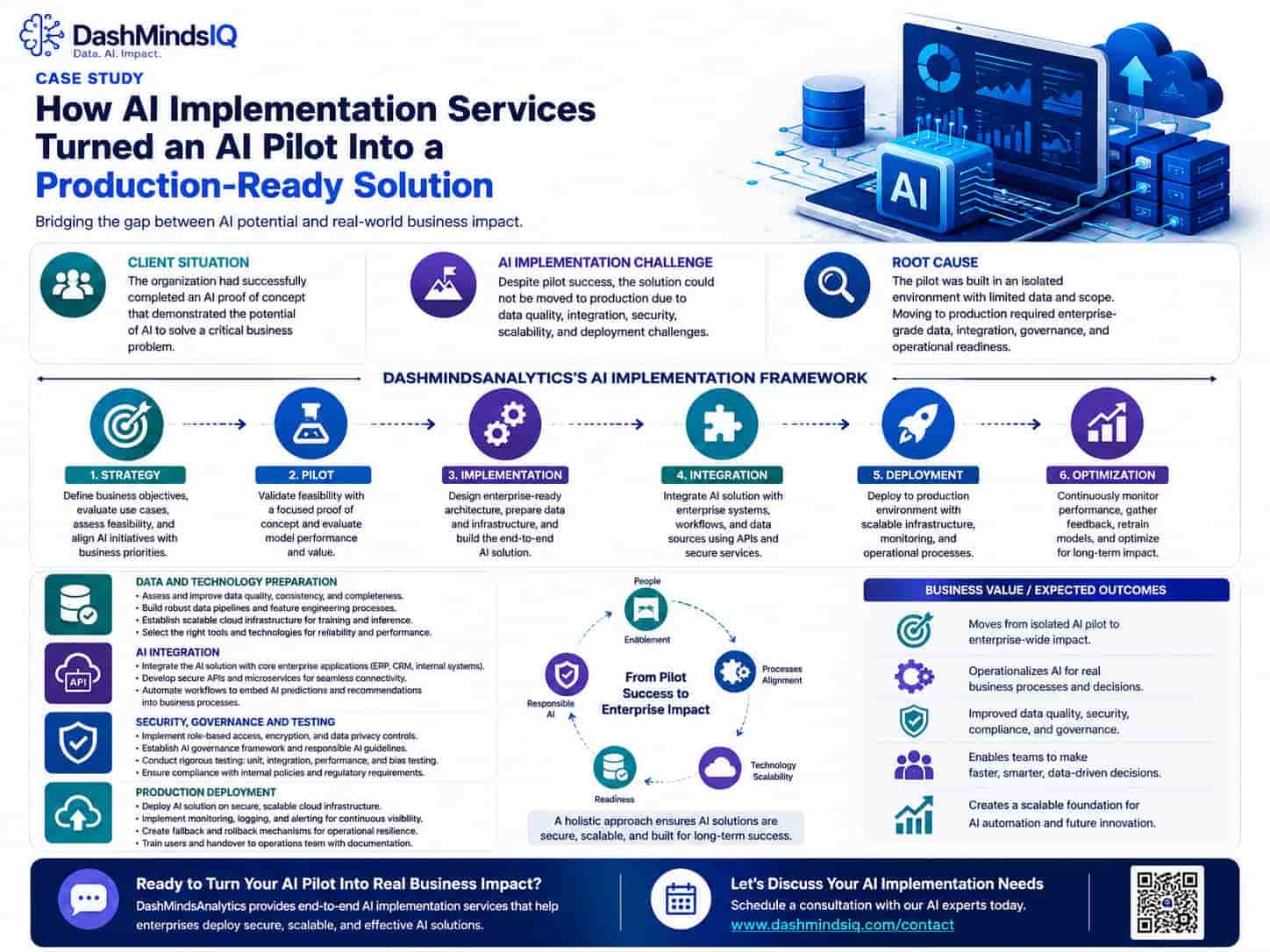
A representative enterprise had successfully completed an AI proof of concept. The pilot demonstrated that the proposed AI solution could analyze business data, support decision-making, and automate part of an operational process. However, success in a controlled environment did not translate directly into production readiness. When the organization attempted to expand the solution, teams encountered inconsistent data, integration limitations, security concerns, and uncertainty about how the system would perform at enterprise scale. The challenge was no longer proving that AI worked. It was making it work reliably within real business operations.
AI Implementation Challenge

The organization needed to move from an isolated pilot to a dependable enterprise AI capability. This required connecting the solution with existing applications, preparing production data, defining operational ownership, and establishing a scalable AI deployment model.
The organization needed to move from an isolated pilot to a dependable enterprise AI capability. This required connecting the solution with existing applications, preparing production data, defining operational ownership, and establishing a scalable AI deployment model.
Leadership engaged DashMindsAnalytics to evaluate the production gap and provide structured AI implementation services.
Root Cause
The original proof of concept had been designed primarily to validate the model or AI capability. Production requirements had received less attention. Key gaps included data readiness, API connectivity, cloud infrastructure, access controls, monitoring, exception handling, and responsible AI governance. The organization also lacked a clear implementation roadmap defining how the pilot would integrate with existing workflows. DashMindsAnalytics identified these dependencies before recommending a broader rollout.
DashMindsAnalytics's Implementation Approach
The engagement followed a practical framework:
Strategy → Pilot → Implementation → Integration → Deployment → Optimization
First, the team aligned the AI initiative with business processes and production requirements. The existing pilot was then reassessed to determine what could be retained, redesigned, or strengthened. This approach treated enterprise AI implementation as a business and technology transformation—not simply a model deployment exercise.
Data and Technology Preparation
DashMindsAnalytics evaluated data sources, quality, accessibility, and ownership. Required datasets were prepared for consistent production use, while data pipelines and validation processes were designed to improve reliability. The technology architecture also considered cloud infrastructure, scalability, APIs, model hosting, monitoring, and future integration requirements. This preparation created a stronger foundation for machine learning implementation and other enterprise AI solutions.
AI Integration
The AI capability was designed to operate within existing business workflows rather than as a separate tool. Through AI integration services, the solution could connect with approved enterprise applications and data sources using APIs and controlled interfaces. Integration planning considered how AI outputs would trigger downstream actions, support employees, update systems, or enable AI automation while maintaining clear operational controls.
Security, Governance and Testing
Before deployment, the implementation incorporated security and governance requirements. These included access controls, data protection, logging, monitoring, testing, and defined escalation processes. Responsible AI considerations were also incorporated into the solution design, particularly where AI outputs could influence business decisions or operational actions. Testing extended beyond model performance to include integration reliability, workflow behavior, security, and production readiness.
Production Deployment
The deployment plan introduced the solution through controlled stages rather than a single large-scale release. Operational teams were given clear ownership, while monitoring processes supported issue detection and ongoing improvement. This created a repeatable path from pilot to AI deployment, with the flexibility to optimize performance as usage expanded.
Business Value / Expected Outcomes
A successful implementation could provide [improved process efficiency], [greater workflow consistency], [better access to AI-driven insights], and [a scalable foundation for future AI initiatives], depending on the use case and deployment environment. The key value of an experienced AI implementation services provider is bridging the practical gap between experimentation and real-world adoption.

Have a technical challenge worth discussing?
Our practice leads are happy to talk through your specific situation with no sales pitch required.
Talk to an Expert →