Businesses today generate data from applications, websites, customer interactions, cloud platforms, connected devices, transactions, and internal systems. Having access to this data is no longer enough. Organizations need reliable ways to collect, integrate, transform, govern, and deliver data so teams can use it for analytics, reporting, artificial intelligence, and everyday decision-making.
This is where the difference between data engineering services and traditional data management becomes important.
Traditional data management often focuses on storing, organizing, maintaining, and controlling business data. Modern data engineering takes a broader engineering approach by building the pipelines, platforms, architectures, and processes required to move data reliably from its sources to the systems where it creates business value.
Understanding this distinction can help organizations determine whether their existing data environment is prepared for growing data volumes and modern analytics and AI requirements.
What Is Traditional Data Management?

Traditional data management typically focuses on activities such as database administration, data storage, data organization, backup, access control, and maintaining data quality. These capabilities remain important. Organizations still need structured databases, appropriate access permissions, consistent data definitions, and governance processes.
However, traditional approaches can become difficult to scale when businesses begin working with larger volumes of data and an increasing number of data sources. Data may be distributed across CRM platforms, ERP systems, SaaS applications, operational databases, cloud services, spreadsheets, and third-party systems. Simply storing this information does not create a usable data foundation.
Organizations need reliable mechanisms to bring these sources together and make the resulting data available to analytics and AI systems.
What Are Data Engineering Services?
Data engineering services focus on designing and building the technical infrastructure that enables organizations to collect, process, transform, integrate, and deliver data at scale.
Modern data engineering can include:
- ingestion
- Data integration
- Data transformation
- Data pipeline development
- Data quality management
- Cloud data platforms
- Data warehouses
- Data lakes
- Data lakehouses
- Workflow orchestration
- Data governance
- Pipeline monitoring and optimization
The objective is not simply to store data. It is to create a reliable and scalable data foundation that allows organizations to use information efficiently.
Data Ingestion: Bringing Data Together
Data ingestion is one of the first stages of a modern data architecture. Businesses may need to collect information from databases, APIs, applications, files, cloud platforms, IoT devices, and external data providers.
A modern data engineering approach considers how this information should be collected, how frequently it should be updated, and how the ingestion process should handle failures or changes in the source systems. Depending on business requirements, organizations may use batch ingestion, streaming ingestion, or a combination of both. Reliable ingestion reduces the risk of incomplete or outdated information entering downstream systems.
Data Integration and Transformation
Collecting data is only part of the challenge. Information from different systems may use different formats, naming conventions, structures, and definitions. Data integration brings these sources together, while transformation prepares the information for downstream use.
Transformation processes may include cleaning inconsistent values, standardizing fields, removing duplicates, joining datasets, applying business rules, and creating analytical models. This is particularly important for organizations that want to create a consistent view of customers, products, transactions, or operational performance across multiple systems.
Data Quality Becomes an Engineering Concern
Poor data quality can undermine even the most sophisticated analytics or AI initiative. Incorrect, incomplete, duplicated, or outdated data can result in misleading dashboards and unreliable models. Modern data engineering therefore incorporates data quality into the pipeline rather than treating it as a separate activity performed only after data reaches its destination.
Validation rules, automated checks, anomaly detection, monitoring, and quality metrics can help organizations identify problems earlier. The goal is to create pipelines that consistently deliver trustworthy data.
Cloud Data Platforms, Warehouses, Lakes, and Lakehouses
The architecture used to store and process data also matters. A data warehouse is commonly designed for structured analytical workloads and business reporting. A data lake can store large volumes of structured, semi-structured, and unstructured information. A data lakehouse combines characteristics of both approaches to support broader analytical and data workloads.
Cloud data platforms can provide organizations with scalable infrastructure without requiring them to manage every aspect of physical infrastructure themselves. However, moving to the cloud does not automatically create a modern data architecture. Businesses still need appropriate ingestion, transformation, storage, security, governance, and optimization strategies.
Orchestration Makes Data Pipelines More Reliable
As data environments become more complex, organizations may have hundreds or thousands of interconnected data workflows. Orchestration helps coordinate these processes by determining when pipelines run, which tasks depend on others, and what happens when a process fails.
Effective orchestration can improve visibility and operational reliability by providing mechanisms for scheduling, dependency management, retries, alerts, and workflow monitoring. Without appropriate orchestration, data teams may end up managing complex pipelines manually, increasing operational effort and the risk of failures.
Governance Must Be Built Into the Architecture
Data governance is another critical consideration. Organizations need to know where data comes from, who can access it, how it is being used, and whether it meets internal policies and applicable requirements. Modern data engineering architectures can incorporate governance through access controls, metadata management, data lineage, auditing, data classification, and policy enforcement. This becomes particularly important when data platforms support AI applications, where sensitive enterprise information may be processed across multiple systems.
Data Engineering vs Traditional Data Management
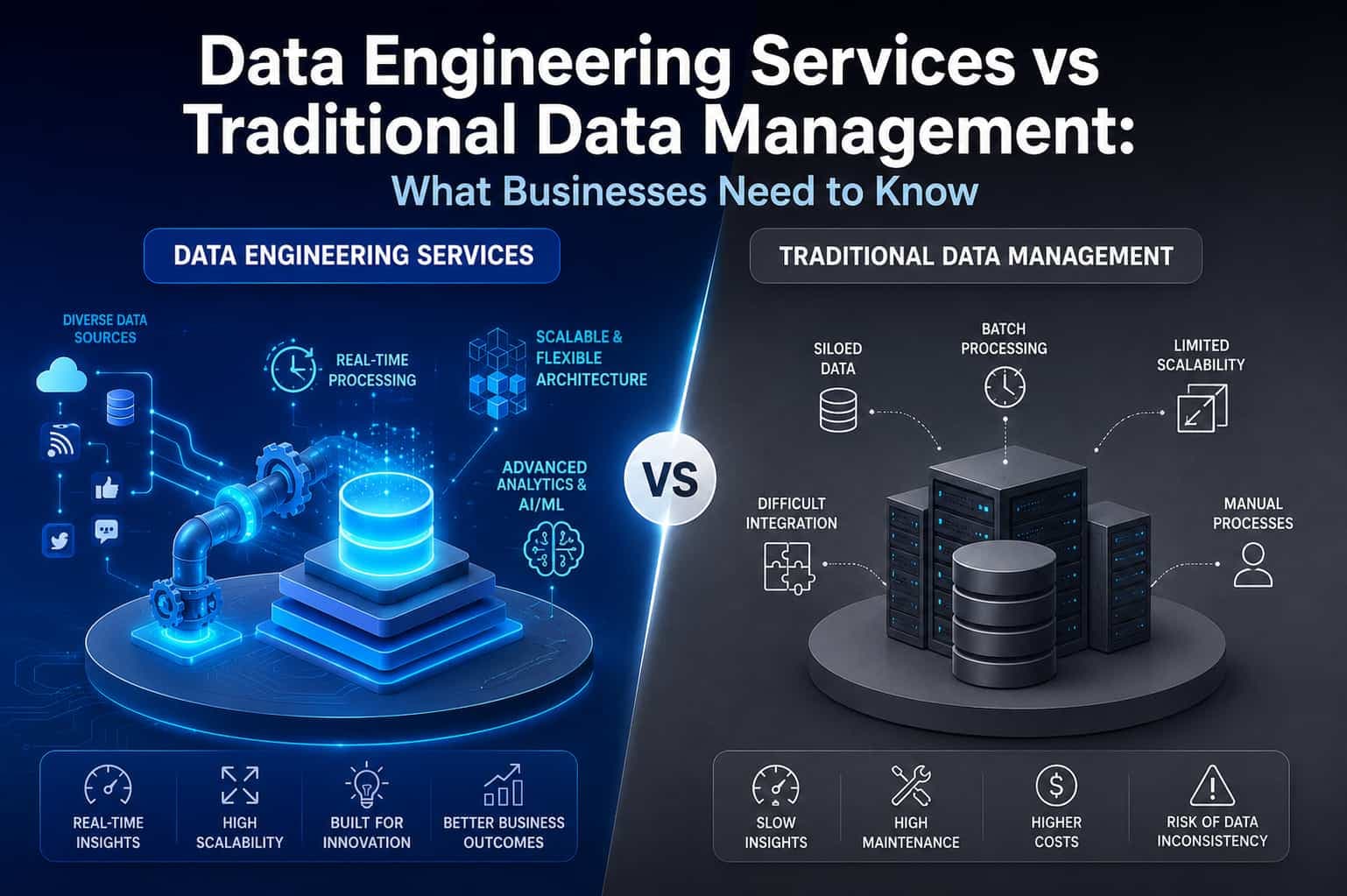
The distinction can be summarized simply. Traditional data management is often centered on managing and maintaining data assets, while modern data engineering focuses on engineering the systems and pipelines that make data continuously usable at scale.
For example, a traditional approach may focus on maintaining a business database and ensuring that users can access it appropriately. A data engineering approach may additionally design automated pipelines that extract information from multiple operational systems, transform it, validate it, load it into a cloud data platform, monitor pipeline health, and make curated datasets available to analytics and AI applications. Neither approach makes the other obsolete. Strong data engineering builds on fundamental data management practices while extending them to address modern data volumes, architectures, and use cases.
Why This Matters for Analytics and AI
Analytics and AI initiatives depend heavily on the quality and availability of underlying data. An organization may invest in advanced dashboards, machine learning models, or generative AI applications, but these technologies can struggle when the underlying data is fragmented, inaccessible, inconsistent, or unreliable. A scalable data engineering foundation can help businesses create standardized and governed data flows that support business intelligence, advanced analytics, machine learning, and enterprise AI. This allows organizations to treat data infrastructure as a strategic capability rather than simply a storage layer.
Why Choose a Data Engineering Approach?
Businesses considering modernization should evaluate whether their existing environment can handle increasing data sources, growing workloads, cloud adoption, real-time requirements, and emerging AI initiatives.
DashMindsAnalytics takes a data-driven and engineering-disciplined approach to data engineering services, focusing on the complete data lifecycle rather than isolated data tasks.
The approach can encompass data ingestion, integration, transformation, pipeline architecture, cloud data platforms, data quality, orchestration, and governance based on the organization's specific requirements.
This creates an important distinction from generalist IT service providers. A generalist provider may treat data work as one component of a broader technology engagement, while a specialized data engineering approach focuses deeply on pipeline reliability, scalable architecture, data quality, governance, and the technical foundation required for analytics and AI.
Build a Stronger Foundation for Your Data Strategy
Traditional data management remains essential, but modern businesses increasingly need more than databases and storage systems. They need engineered data pipelines and platforms capable of continuously delivering reliable, governed, and usable information. From data ingestion and integration to transformation, orchestration, cloud platforms, and governance, data engineering services can help organizations build the foundation required for modern analytics and AI.
If your business is dealing with fragmented data sources, unreliable pipelines, growing data volumes, legacy infrastructure, or plans to expand analytics and AI capabilities, now may be the right time to evaluate your data architecture.
Talk to a DashMindsAnalytics specialist about your data engineering requirements and explore an engineering-driven approach to building scalable, reliable, and business-ready data infrastructure.