How a Company Could Modernize Its Data Architecture for Analytics and AI
Business Challenge
A growing enterprise could be managing data across customer applications, operational systems, spreadsheets, third-party platforms, and legacy databases. While these sources contain valuable business information, the organization may struggle to turn that data into a reliable foundation for analytics and artificial intelligence initiatives. Data integration could depend heavily on manual processes, with teams moving and transforming information between systems using disconnected workflows. As data volumes and business requirements increase, inconsistent formats, duplicate records, missing values, and unreliable pipelines can make it difficult to trust downstream reports and analytical models.
The organization also wanted to expand its use of AI, but its existing architecture was not designed to consistently deliver clean, accessible, and governed data to modern analytics and AI workloads.
The company therefore explored data engineering services to modernize its data architecture and establish a scalable foundation for analytics, business intelligence, and AI.
Approach

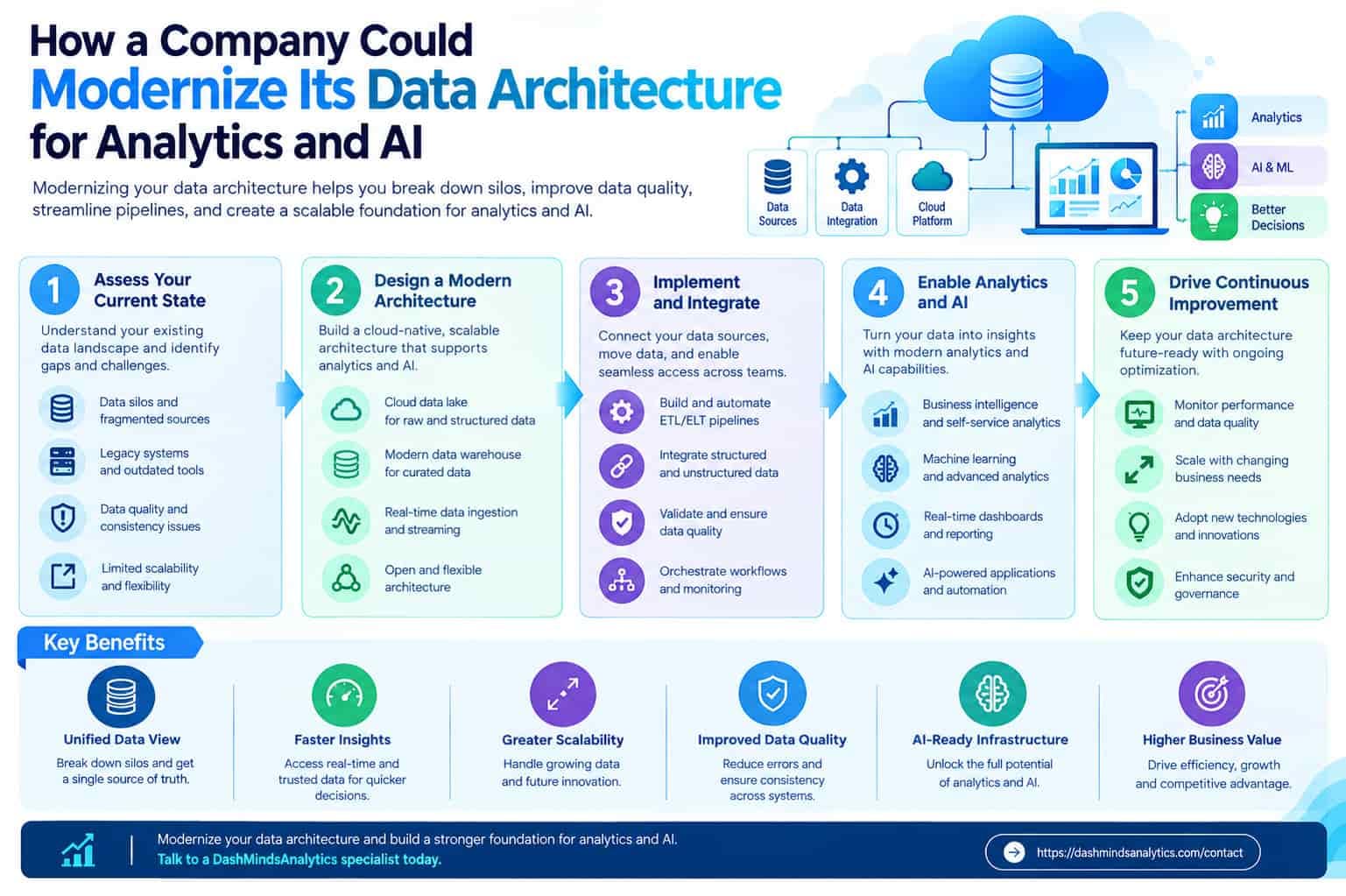
DashMindsAnalytics approached the modernization initiative by first assessing the organization’s existing data environment, integration workflows, quality issues, and future analytics and AI requirements. Rather than replacing every component immediately, the focus was on creating a practical architecture that could evolve with the organization.
Data Ingestion and Integration
The first stage focused on establishing reliable methods for bringing data from different sources into the modern data environment. Data ingestion processes were designed around the characteristics of individual sources, including operational databases, applications, files, and external systems. Integration patterns were then evaluated to reduce manual data movement and create more repeatable workflows.
Transformation and Cloud Data Platforms
The target architecture incorporated modern cloud data capabilities based on the organization’s requirements. Depending on specific workloads, the architecture could include a data warehouse, data lake, or lakehouse environment. Transformation processes were designed to convert raw information into structured and analytics-ready datasets. This approach created clearer separation between raw, processed, and business-ready data while providing a foundation that could support future analytical and AI workloads.
Orchestration and Pipeline Reliability
Data workflows were organized through orchestration mechanisms to coordinate ingestion, transformation, dependencies, and scheduled processing. Monitoring was incorporated to provide greater visibility into pipeline execution, failures, delays, and data movement. This helped shift the organization away from manually checking disconnected processes toward more observable and manageable data workflows.
Data Quality and Governance
Data quality was treated as an ongoing engineering requirement rather than a one-time cleanup exercise. Validation rules, consistency checks, metadata, lineage considerations, and governance processes were incorporated into the architecture. Appropriate controls could then be applied to help teams understand where data originated, how it was transformed, and how it should be used.
Solution
DashMindsAnalytics developed a structured modernization roadmap connecting the organization’s source systems with a scalable data platform.
The solution brought together data ingestion, integration, transformation, cloud data infrastructure, orchestration, quality controls, monitoring, and governance.
The architecture was designed to support both current analytics requirements and future AI initiatives. Instead of creating isolated pipelines for individual projects, the organization could establish reusable data engineering patterns that support multiple business use cases.
DashMindsAnalytics vs. Generalist IT Service Providers
A generalist IT service provider may focus primarily on connecting systems or migrating existing databases without addressing the broader data lifecycle. DashMindsAnalytics applies a data-driven and engineering-disciplined approach to data engineering services, considering ingestion, architecture, transformation, quality, orchestration, observability, governance, and future scalability as interconnected components. This approach can be particularly valuable for organizations that need their data architecture to support not only reporting and analytics but also increasingly sophisticated AI applications.
Expected Business Value
A modernized data architecture could provide the organization with a stronger foundation for using enterprise data across analytics, business intelligence, and AI initiatives.
Potential business value could include:
- 1. More reliable data integration across business systems
- 2. Reduced dependence on manual data movement
- 3. Better visibility into pipeline performance and failures
- 4. Improved data quality and consistency
- 5. A scalable foundation for analytics and AI workloads
- 6. Greater understanding of data lineage and governance
- 7. More structured access to enterprise data
- 8. An architecture that can evolve with changing business requirements
The actual outcomes would depend on the organization’s existing infrastructure, data maturity, technology choices, governance requirements, and implementation approach.
Conclusion
Modern analytics and AI initiatives depend on more than collecting large volumes of data. Organizations need reliable pipelines, appropriate cloud data platforms, consistent transformation processes, strong quality controls, monitoring, and governance.
DashMindsAnalytic’s engineering-disciplined data engineering services approach helps businesses address these requirements as part of a connected data architecture strategy rather than treating individual data problems in isolation.

Have a technical challenge worth discussing?
Our practice leads are happy to talk through your specific situation with no sales pitch required.
Talk to an Expert →