Generative AI and machine learning are becoming essential technologies for organizations looking to automate processes, improve decision-making, and create more personalized customer experiences. However, successful AI implementation depends heavily on the quality, accessibility, and scalability of enterprise data.
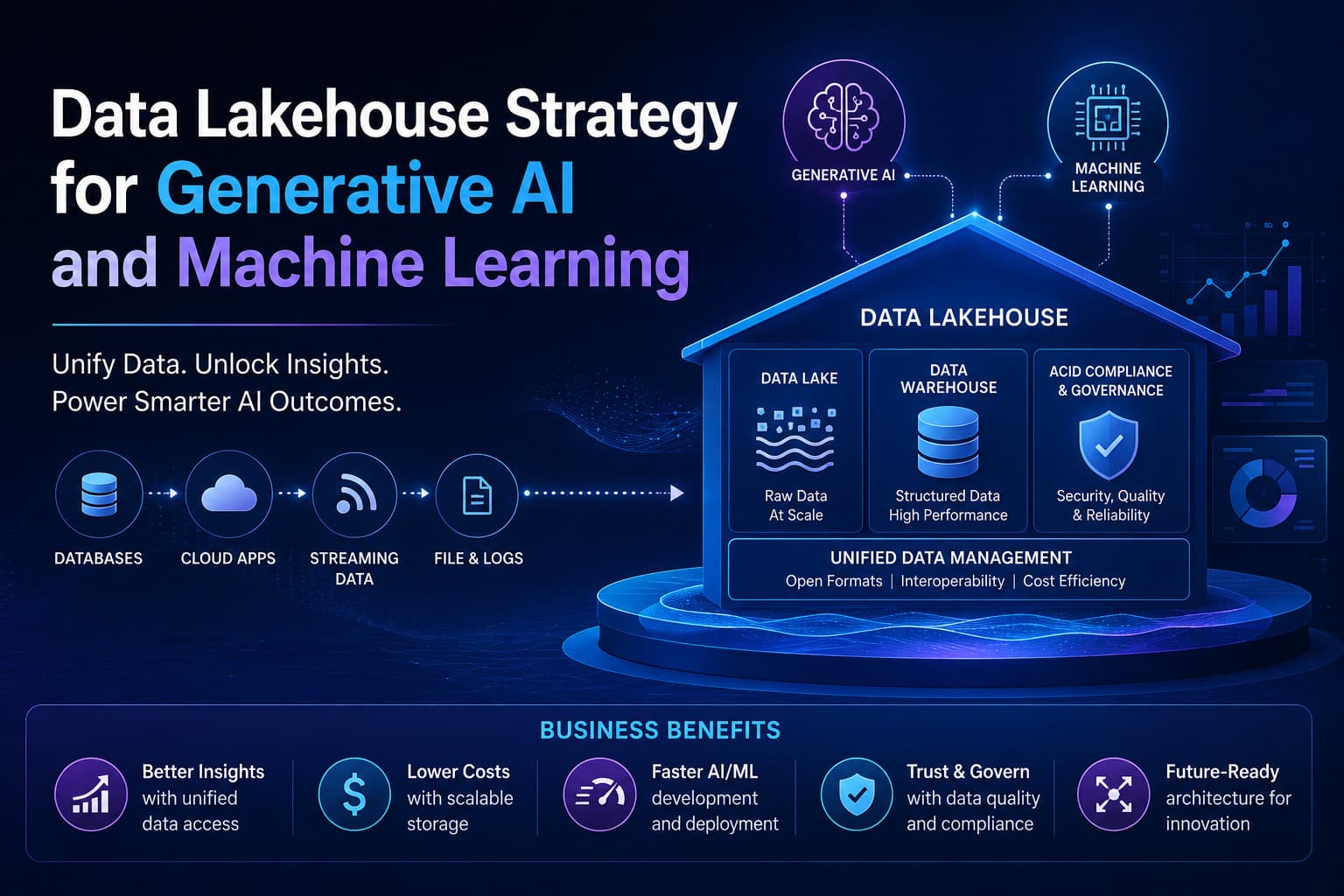
A well-designed Data Lakehouse Strategy provides a unified foundation for managing the large and diverse datasets required by modern AI applications. By combining the flexibility of a data lake with the structured capabilities of a data warehouse, a lakehouse architecture can help businesses prepare data for generative AI, machine learning, analytics, and business intelligence.
What Is a Data Lakehouse Strategy?

A data lakehouse strategy is an approach to organizing and managing enterprise data within a unified architecture that supports both data engineering and analytics workloads. Traditional data lakes are designed to store large amounts of structured, semi-structured, and unstructured data. Data warehouses, meanwhile, are optimized for structured data and analytical queries. A lakehouse combines capabilities from both models, allowing organizations to store different types of data while supporting analytics, machine learning, and AI workloads from a common data platform.
A strong Data Lakehouse Strategy typically focuses on:
- Data ingestion and integration
- Data storage and processing
- Data quality
- Data governance
- Security and access control
- Machine learning workflows
- Generative AI applications
- Business intelligence and analytics
Why Data Lakehouses Matter for Generative AI and Machine Learning
AI systems require access to reliable and relevant data. Generative AI applications may work with documents, customer records, product information, images, conversations, and other unstructured data. Machine learning models also require historical and real-time datasets for training, testing, and prediction. Managing these datasets across disconnected systems can create data silos and make AI development more difficult. A lakehouse architecture can provide a centralized data foundation where organizations can collect, process, govern, and analyze information before making it available to AI systems. DashMinds Analytics helps organizations build modern data foundations through data engineering, data platform modernization, and cloud lakehouse solutions, helping connect fragmented data sources and create governed environments for analytics, machine learning, and AI workloads.
Key Components of a Data Lakehouse Strategy
1. Unified Data Storage
A lakehouse can bring structured, semi-structured, and unstructured data together. Organizations may store:
- Customer records
- Transaction data
- Application logs
- Documents
- Images
- Product information
- Sensor data
- Website activity
This unified approach can simplify access to information for analytics and AI applications.
2. Data Integration
Enterprise data often exists across CRM systems, ERP platforms, ecommerce applications, databases, APIs, and cloud services. A successful lakehouse strategy should establish reliable data pipelines that bring these sources together. Data integration can help AI teams access consistent information without repeatedly building separate pipelines for individual applications.
3. Data Quality
AI output is strongly influenced by input data quality. Inaccurate, incomplete, duplicated, or outdated information can negatively affect model performance. Organizations should implement processes for:
- Data validation
- Deduplication
- Data cleansing
- Data profiling
- Metadata management
- Data quality monitoring
Improving data quality before AI implementation can reduce downstream problems.
Building a Data Lakehouse for Generative AI
Generative AI introduces additional data requirements because large language models and AI applications often work with unstructured enterprise information.
Supporting Retrieval-Augmented Generation
A lakehouse can provide the underlying data foundation for Retrieval-Augmented Generation (RAG). RAG systems retrieve relevant information from enterprise data sources and provide that information to a generative AI model when generating a response. For example, an organization could use a RAG application to answer employee questions using approved company policies, product documentation, and internal knowledge. A lakehouse can help centralize and govern the source information used by these applications.
Managing Unstructured Data
Generative AI can work with documents, text, images, audio, and other data types. A modern lakehouse architecture can provide a scalable environment for storing and processing these datasets. This is particularly useful for organizations building enterprise knowledge assistants, document analysis systems, recommendation applications, and AI-powered customer service tools.
Building a Data Lakehouse for Machine Learning
Machine learning requires reliable datasets for model development and ongoing monitoring. A lakehouse can support the machine learning lifecycle by providing access to historical and current data.
Model Training
Data scientists can use curated datasets stored in the lakehouse to train machine learning models.
Feature Engineering
Relevant data can be transformed into features that machine learning algorithms can use for predictions and classification.
Model Monitoring
After deployment, organizations can continue collecting data to monitor model performance, identify changes in data patterns, and improve models. This creates a more connected data-to-AI workflow.
Data Governance and Security
Data governance should be a core part of any Data Lakehouse Strategy. As organizations make more enterprise data available to AI applications, they need to control who can access information and how it can be used. Important governance practices include:
- Role-based access control
- Data classification
- Encryption
- Data lineage
- Metadata management
- Audit logging
- Privacy controls
- Retention policies
For generative AI applications, organizations should also consider how sensitive information is accessed, processed, and presented to users.
Benefits of a Data Lakehouse Strategy
Better Data Accessibility
A unified architecture can make relevant information easier for data scientists, analysts, and AI applications to access.
Improved AI Development
AI teams can spend less time searching for and preparing datasets and more time developing useful applications.
Greater Scalability
Lakehouse platforms can support growing data volumes and increasingly complex analytics and AI workloads.
Reduced Data Silos
Bringing multiple data sources into a unified architecture can reduce fragmentation between departments and applications.
Support for Multiple Workloads
The same data foundation can support business intelligence, analytics, machine learning, and generative AI.
Practical Tips for Developing a Data Lakehouse Strategy
Start With Business Objectives
Do not begin with technology alone. Identify the business problems the lakehouse needs to solve. Potential objectives include:
- Improving customer analytics
- Supporting AI applications
- Modernizing analytics
- Reducing data silos
- Improving data accessibility
Identify Critical Data Sources
Create an inventory of the systems and datasets that are important for your AI and analytics initiatives. Prioritize high-value data rather than attempting to migrate everything immediately.
Establish Governance Early
Implement data ownership, access controls, security policies, and quality standards from the beginning. Adding governance after large-scale implementation can be significantly more difficult.
Build Incrementally
A phased approach can reduce implementation risk. Start with a high-value use case, validate the architecture, measure results, and expand gradually.
Prepare Data for AI
AI-ready data should be accessible, well-documented, properly governed, and suitable for the intended workload. For generative AI, organizations should also consider document processing, metadata, embeddings, vector search, and retrieval pipelines where appropriate.
Common Data Lakehouse Challenges
Implementing a lakehouse is not without challenges. Organizations may face issues involving data migration, integration complexity, governance, security, skills, infrastructure costs, and changing AI requirements. Another common problem is creating a lakehouse without clearly defined business objectives. A technically advanced platform may deliver limited value if teams do not know which business problems they are trying to solve. Organizations should therefore align architecture decisions with measurable business outcomes.
Frequently Asked Questions
What is a Data Lakehouse Strategy?
A Data Lakehouse Strategy defines how an organization uses a lakehouse architecture to store, manage, govern, process, and analyze enterprise data for analytics, machine learning, and AI applications.
Why is a data lakehouse useful for generative AI?
A lakehouse can provide centralized access to structured and unstructured enterprise data, supporting applications such as RAG, enterprise search, document analysis, and AI assistants.
Is a data lakehouse better than a data warehouse for AI?
A lakehouse can provide greater flexibility for AI workloads because it can handle different data types and support analytics, machine learning, and AI from a unified environment. The right architecture depends on an organization's specific requirements.
How does a lakehouse support machine learning?
It can provide data for model training, feature engineering, testing, deployment, and monitoring while creating a consistent data foundation for machine learning workflows.
What are the most important lakehouse governance practices?
Important practices include data quality management, access control, security, data lineage, metadata management, privacy controls, and auditability.
Conclusion
A strong Data Lakehouse Strategy can provide the data foundation organizations need to scale generative AI and machine learning initiatives. By bringing diverse data sources into a unified architecture, businesses can improve data accessibility, reduce silos, strengthen governance, and support multiple AI and analytics workloads. The most effective approach is not simply to build a large data platform. Organizations should begin with clear business objectives, prioritize valuable use cases, establish governance, improve data quality, and expand the architecture as requirements grow. As generative AI and machine learning continue to evolve, a scalable and well-governed data lakehouse can help enterprises turn growing volumes of data into reliable insights, intelligent applications, and measurable business value.