Modernizing Legacy Data Infrastructure With a Data Lakehouse Strategy
Legacy data infrastructure can become a major obstacle when businesses need faster analytics, scalable AI, and reliable access to enterprise information. Systems built over time may contain valuable data but often struggle to support modern workloads. This case study explores how an enterprise turned legacy data infrastructure challenges into an opportunity to modernize its data environment using a Data Lakehouse Strategy. Because verified client-specific metrics are unavailable, no unsupported statistics or results are included.
Problem: Fragmented Legacy Data Infrastructure

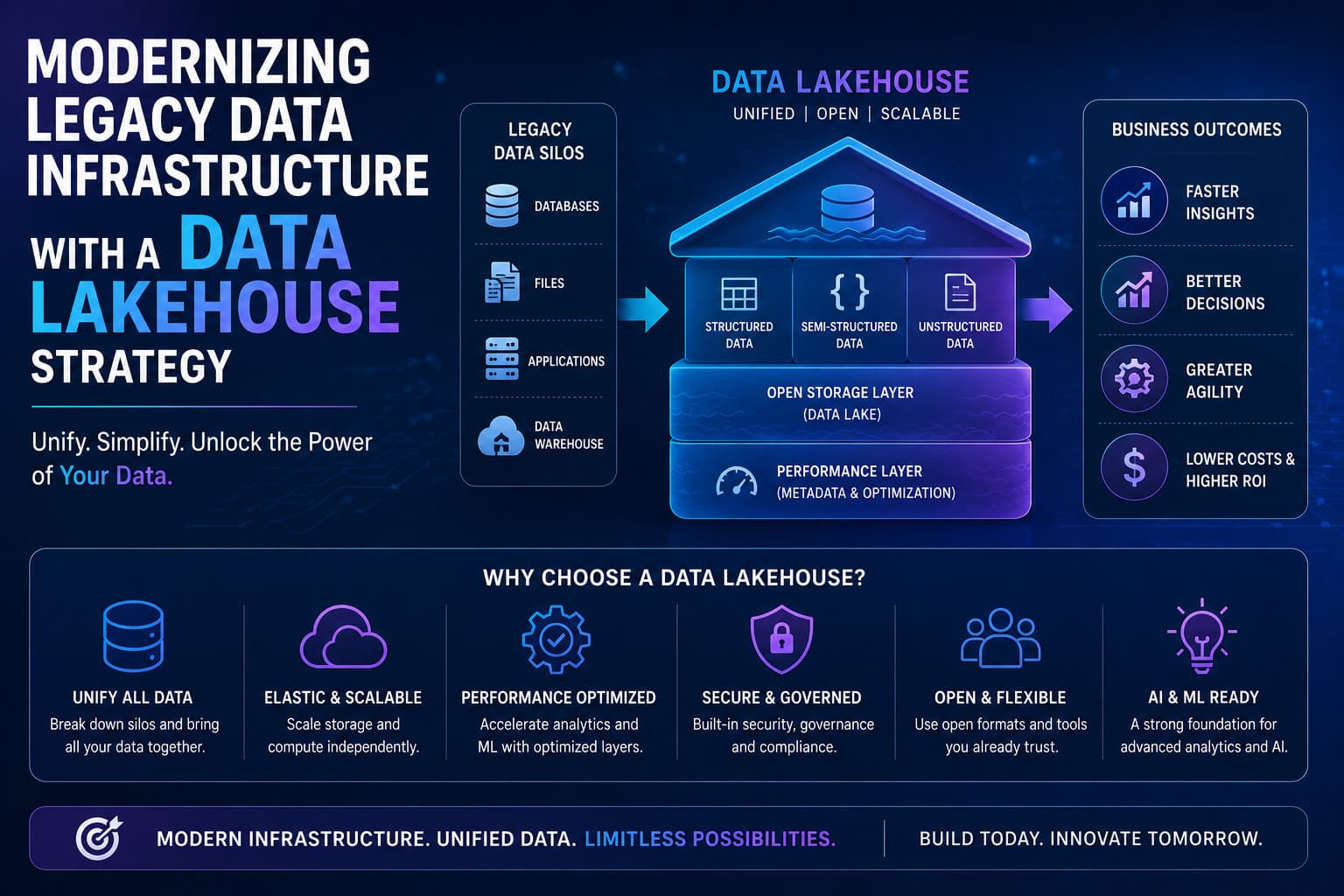
The organization relied on a combination of legacy databases, departmental applications, traditional data warehouses, and disconnected data sources. While these systems supported existing reporting requirements, they created challenges as business data volumes and analytics requirements increased.
Teams faced issues such as:
- Data stored across disconnected platforms
- Slow and complex data integration
- Repetitive data preparation
- Limited access to real-time information
- Difficulty scaling analytics workloads
- Data quality inconsistencies
- Increasing infrastructure complexity
The existing environment also made it harder to prepare enterprise data for machine learning, advanced analytics, and emerging AI applications.
Opportunity: Creating a Modern Data Foundation
Instead of treating the legacy environment only as a technical problem, the organization recognized an opportunity to create a scalable data platform.
The goal was to establish a unified architecture that could support:
- Business intelligence
- Advanced analytics
- Machine learning
- Generative AI
- Structured and unstructured data
- Future data-driven applications
A Data Lakehouse Strategy offered a way to combine the flexibility of a data lake with the structured management capabilities associated with a data warehouse.
Strategy: Designing a Data Lakehouse Architecture
The modernization strategy focused on creating a centralized and governed data environment. The organization first assessed its existing data sources, workloads, dependencies, and business requirements. High-value datasets were prioritized for modernization rather than attempting to migrate everything simultaneously.
The strategy included:
Data Integration
Relevant data sources were connected through modern data pipelines to create a more consistent flow of information.
Unified Data Storage
The lakehouse architecture was designed to support structured, semi-structured, and unstructured data.
Data Governance
Data ownership, access controls, metadata, security, and quality processes were incorporated into the new environment.
Analytics and AI Readiness
The architecture was prepared to support business analytics, machine learning workflows, predictive models, and generative AI applications.
Execution: Phased Modernization
Implementation followed a phased approach to reduce disruption to existing operations. The team began by identifying critical datasets and evaluating their quality. Data pipelines were then developed to move and transform information into the modern environment. Existing workloads were gradually assessed for migration, optimization, or retirement. Data governance controls were introduced alongside the technical implementation. This helped ensure that modernization did not create new security or data management problems. The organization also tested DashMinds Analytics workloads against the new environment before expanding the architecture to additional data sources.
Business Impact
The modernization created a stronger foundation for data-driven operations. The new environment can support:
- More centralized access to enterprise data
- Scalable analytics workloads
- Improved data management
- Better support for AI and machine learning
- Reduced dependence on fragmented legacy systems
- More flexible data processing
- Stronger data governance
Specific outcomes such as [cost savings], [processing-time reduction], or [analytics performance improvement] should be added only when verified business data is available.
Key Takeaways
This case demonstrates several important lessons for organizations considering a Data Lakehouse Strategy.
Modernization should be business-driven. Technology changes should support clear analytics, AI, or operational objectives.
Migration does not need to happen all at once. A phased approach can reduce risk and allow teams to validate each stage.
Governance must be built into the architecture. Security, data quality, access management, and lineage should be considered from the beginning.
AI readiness starts with a strong data foundation. Modern AI applications require reliable, accessible, and well-governed data.
Conclusion
Modernizing legacy data infrastructure is more than replacing outdated technology. It is an opportunity to create a scalable foundation for analytics, machine learning, and AI. A well-planned Data Lakehouse Strategy can help organizations reduce data silos, improve accessibility, strengthen governance, and prepare for future data-driven initiatives.
Ready to Modernize Your Data Infrastructure?
DashMindsIQ can help your organization assess legacy data challenges, design a scalable data lakehouse architecture, and build an AI-ready data foundation. Contact DashMindsAnalytics to explore how AI can transform your business processes. to discuss your data modernization goals.

Have a technical challenge worth discussing?
Our practice leads are happy to talk through your specific situation with no sales pitch required.
Talk to an Expert →