Businesses are generating more data than ever from applications, customer interactions, transactions, connected devices, cloud platforms, and operational systems. The challenge is no longer simply collecting this information. Businesses need to move and process data quickly enough for analytics, artificial intelligence, and operational decision-making.
For many organizations, however, the underlying data environment was not designed for this level of demand. Data remains distributed across disconnected systems, pipelines depend on manual processes, reporting takes too long, and data quality problems reduce confidence in business insights.
This is where data pipeline consulting can help organizations rethink how data moves through their technology environment.
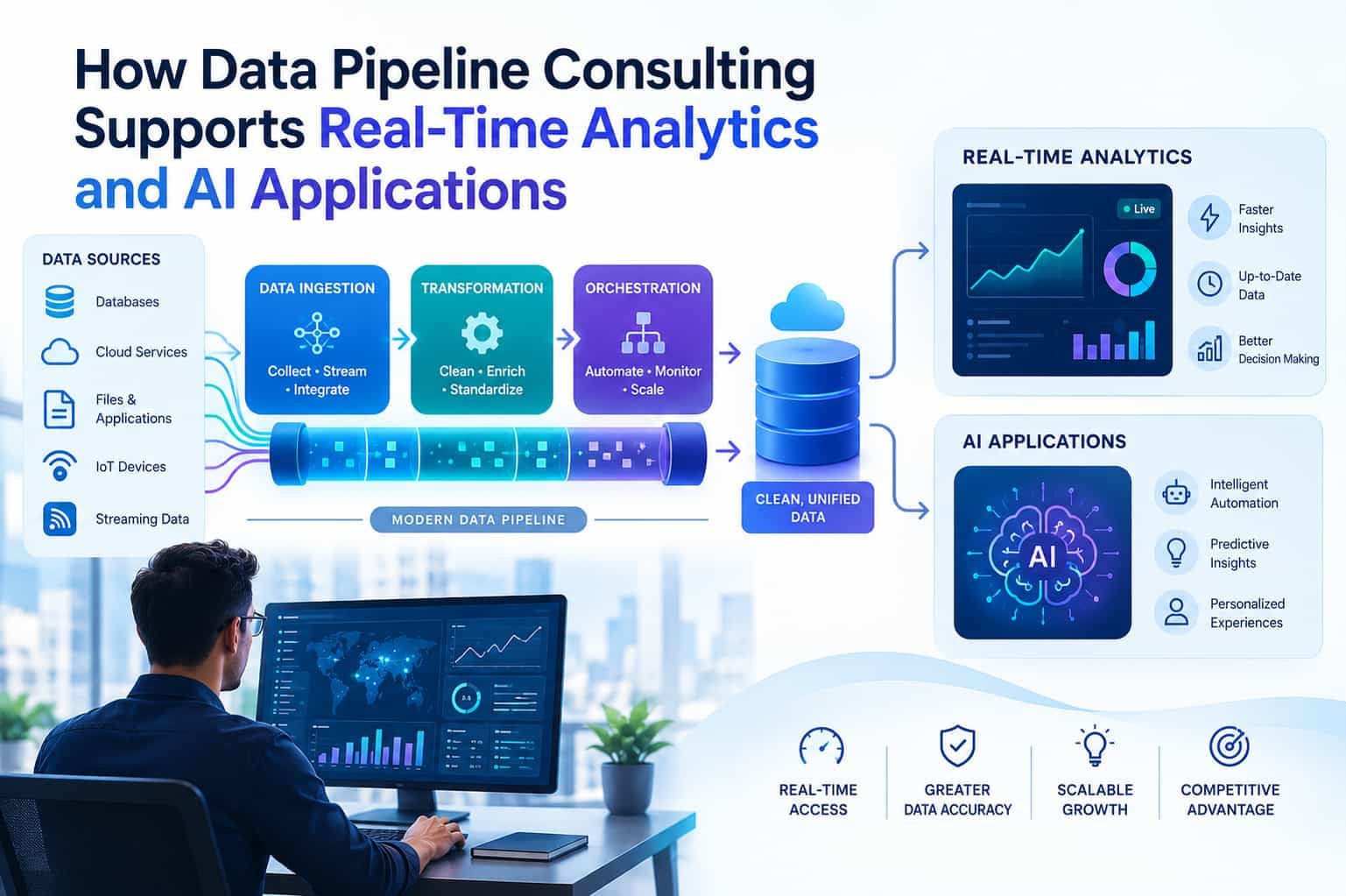
A well-designed data pipeline can continuously collect, transform, validate, and deliver information to the systems that need it. When properly engineered, these pipelines can provide a stronger foundation for real-time analytics, AI applications, business intelligence, and data-driven operations.
The Data Pipeline Challenges Businesses Face

Before improving a data pipeline, organizations need to understand what is preventing their existing architecture from delivering reliable data.
Fragmented Data Sources
Business data rarely exists in one location. A typical enterprise may have information spread across CRM platforms, ERP systems, databases, SaaS applications, cloud services, APIs, files, and third-party platforms. These systems may use different formats and data structures, making it difficult to create a consistent flow of information. Without effective integration, teams may spend significant time bringing data together manually before they can analyze it.
Manual Data Movement
Manual processes can become a major bottleneck as data volumes increase. Employees may rely on spreadsheets, scripts, or manually triggered workflows to transfer and prepare information. While these approaches may work for small datasets, they become increasingly difficult to maintain as organizations scale. Automated pipelines can reduce repetitive work while creating more consistent and predictable data flows.
Unreliable Data Pipelines
A pipeline that occasionally fails can have a significant business impact. If a data workflow stops running, downstream dashboards, reports, applications, and AI systems may receive incomplete or outdated information. Businesses therefore need pipelines designed with reliability in mind, including appropriate error handling, retries, validation, alerting, and monitoring.
Poor Data Quality
Even when data reaches its destination, it may not be ready for business use. Duplicate records, missing values, inconsistent formats, incorrect data types, and outdated information can affect analytics and AI outputs. Data quality checks need to be incorporated into the pipeline so problems can be identified before they affect downstream systems.
Slow Reporting and Growing Data Volumes
Traditional batch-oriented pipelines may not be suitable for organizations that increasingly need current information. For use cases such as operational monitoring, fraud detection, customer personalization, inventory visibility, and AI-powered applications, waiting hours for a data refresh may limit business value. As data volumes and processing requirements increase, organizations need architectures that can scale without creating excessive operational complexity.
How Data Pipeline Consulting Helps
Data pipeline consulting provides organizations with a structured way to evaluate their existing data movement and design an architecture that aligns with business and technical requirements. Rather than immediately replacing existing systems, a consulting-led approach begins by understanding how data currently flows through the organization.
1. Assessing the Existing Data Architecture
The first step is understanding the current environment.
A data pipeline assessment may examine:
- Data sources and destinations
- Existing ETL and ELT processes
- Batch and streaming workflows
- Data storage platforms
- Integration methods
- Pipeline dependencies
- Data quality controls
- Monitoring capabilities
- Security and governance
- Infrastructure and scalability
This assessment helps identify where the current architecture is creating unnecessary complexity or limiting performance.
2. Identifying Pipeline Bottlenecks
Not every pipeline problem has the same root cause. A workflow may be slow because of inefficient transformations. Another may struggle because of database limitations, poor orchestration, excessive dependencies, inefficient queries, or infrastructure constraints. Consultants can map the end-to-end flow of data to identify bottlenecks and determine which improvements are likely to have the greatest business impact. This helps organizations prioritize modernization rather than attempting to change everything at once.
3. Designing Scalable Data Pipelines
Once the current architecture has been assessed, businesses can design pipelines around their actual requirements. Depending on the use case, this may involve batch processing, streaming architectures, event-driven pipelines, or hybrid approaches. A scalable architecture should account for current workloads while allowing data volumes, sources, users, and applications to grow. The objective is to create a pipeline that can support future requirements rather than repeatedly redesigning infrastructure as demand increases.
4. Improving Data Reliability and Quality
Reliable data pipelines need more than successful data transfers. Organizations can incorporate validation, schema checks, data quality rules, error handling, retry mechanisms, logging, and automated alerts into their pipeline architecture. These controls help teams detect problems earlier and reduce the risk of unreliable information reaching analytics or AI applications.
5. Establishing Better Monitoring and Governance
Visibility becomes increasingly important as data environments grow. Pipeline monitoring can help teams understand whether workflows are running successfully, how long they take, where failures occur, and whether data is arriving as expected. Governance adds another layer by helping organizations manage access, data lineage, metadata, security, and compliance requirements. Together, monitoring and governance create a more controlled data environment.
Supporting Real-Time Analytics
Real-time analytics depends on the ability to move and process data quickly. For example, a business may want to monitor transactions, detect unusual activity, track customer behavior, or analyze operational events as they occur. A modern pipeline architecture can support streaming data ingestion and processing so information becomes available to analytical systems with minimal delay. However, real-time processing is not automatically the right solution for every workload. Data pipeline consulting can help organizations determine where real-time processing provides meaningful value and where traditional batch processing remains appropriate.
Building a Stronger Foundation for AI Applications
AI applications are also highly dependent on reliable data. Machine learning systems require consistent training and operational data, while generative AI applications may need timely access to enterprise information. If data is fragmented or unreliable, AI systems can produce incomplete, outdated, or inconsistent results. Well-engineered pipelines can create the foundation for delivering governed and appropriately processed data to AI platforms, analytical systems, and applications. This makes data pipeline architecture an important part of an organization's broader AI strategy.
DashMindsAnalytic's Approach to Data Pipeline Consulting
DashMindsAnalytics takes a structured, data-driven, and engineering-focused approach to data pipeline consulting. Rather than treating a pipeline as an isolated integration task, the approach considers the broader data architecture, business requirements, data quality, scalability, monitoring, and governance.
The process can begin with an assessment of existing pipelines and data flows, followed by bottleneck identification, architecture planning, pipeline modernization, quality improvements, monitoring, and governance based on the organization's requirements.
This creates a clear distinction from generalist consulting providers. A generalist provider may approach data integration as one component of a broader technology engagement, while a specialized data pipeline approach focuses specifically on data flow reliability, scalable architecture, processing requirements, quality, observability, and long-term maintainability.
Preparing Your Data Architecture for What's Next
Real-time analytics and AI applications require more than advanced analytical tools or AI models. They depend on a reliable data foundation capable of continuously delivering the right information to the right systems.
If your organization is dealing with fragmented data sources, manual data movement, unreliable pipelines, poor data quality, slow reporting, or infrastructure that struggles with increasing data volumes, it may be time to reassess your data architecture.
With the right data pipeline consulting strategy, businesses can identify existing limitations, design scalable workflows, improve reliability, and establish the monitoring and governance required for modern data operations.
Ready to build a more reliable data foundation for real-time analytics and AI? Talk to a DashMindsAnalytics specialist about your data pipeline requirements and explore an engineering-focused approach to modernizing your data architecture.