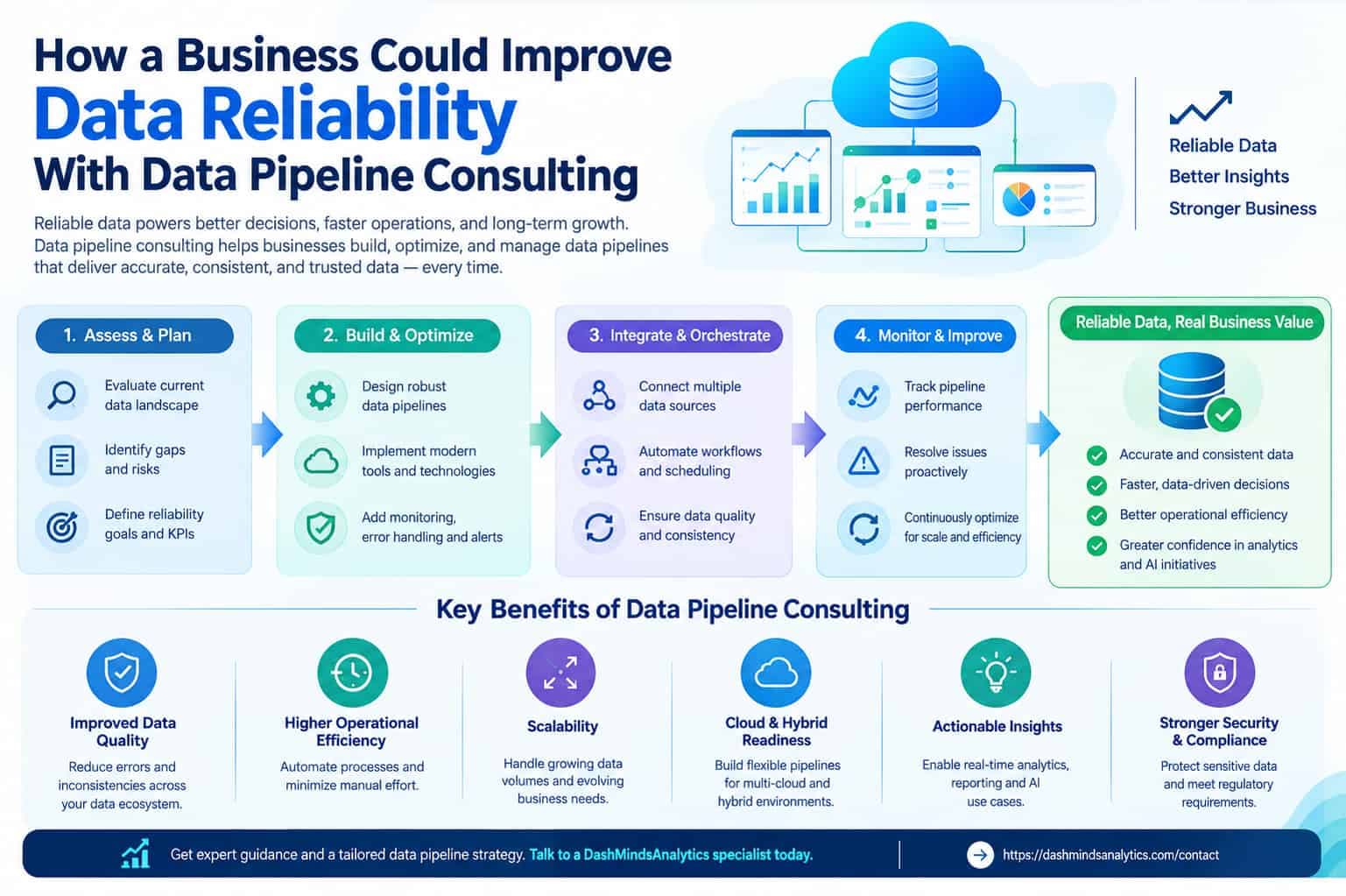
How a Business Could Improve Data Reliability With Data Pipeline Consulting
Approach
DashMindsAnalytics began by assessing the existing data architecture, pipeline dependencies, integration methods, and operational processes.
Rather than immediately replacing existing technologies, the objective was to understand how data moved through the organization and identify the areas creating the greatest reliability and scalability challenges.
Data Architecture and Flow Mapping
DashMindsAnalytics mapped major data sources, destinations, transformations, dependencies, and processing schedules. This provided a clearer view of how information traveled through the organization and helped identify duplicated workflows, unnecessary data movement, tightly coupled processes, and potential points of failure.
Identifying Pipeline Bottlenecks
The existing pipelines were evaluated to identify potential bottlenecks related to processing, dependencies, data volumes, scheduling, transformation logic, and integration patterns. The assessment also considered where pipeline failures could affect downstream reporting, analytics, and AI workloads.
Data Quality Assessment
Data quality was incorporated into the pipeline assessment rather than treated as a separate activity. Validation rules, completeness checks, consistency requirements, duplicate records, and transformation issues were reviewed to identify where poor-quality data could enter downstream systems.
Solution

Based on the assessment, DashMindsAnalytics could develop a modernized pipeline architecture designed around reliability, scalability, observability, and maintainability.
Existing workflows could be redesigned to reduce unnecessary manual intervention and establish more consistent data movement and transformation processes.
Better Orchestration
Pipeline orchestration could be introduced or improved to manage dependencies, scheduling, retries, and workflow execution.
Instead of relying on disconnected processes, the organization could establish coordinated workflows that provide greater control over how data moves between source systems and downstream platforms.
Monitoring and Observability
Monitoring capabilities could provide visibility into pipeline execution, failures, delays, processing status, and other operational conditions. This would help data teams identify issues earlier and investigate failures more systematically rather than discovering problems only after reports or downstream applications are affected.
Governance
Appropriate governance practices could also be incorporated across the pipeline environment. Metadata, lineage, ownership, access controls, and data management policies could help establish clearer accountability for enterprise data.
DashMindsAnalytics vs. Generalist Consulting Providers
A generalist consulting provider may focus on fixing individual pipeline failures or implementing isolated integrations. DashMindsAnalytics takes a more structured, data-driven, and engineering-focused approach to data pipeline consulting, evaluating architecture, data flows, bottlenecks, quality, orchestration, monitoring, and governance as connected parts of the data lifecycle. This broader approach can help organizations address underlying pipeline reliability challenges instead of repeatedly treating individual symptoms.
Expected Business Value
A better-engineered data pipeline environment could provide the organization with a stronger foundation for analytics, reporting, and AI initiatives.
Potential business value could include:
- Greater visibility into pipeline performance
- Reduced dependence on manual data movement
- More consistent data processing workflows
- Earlier identification of pipeline failures
- Improved data quality and validation
- Better understanding of data dependencies and lineage
- More scalable data workflows
- Stronger foundations for analytics and AI applications
The actual outcomes would depend on the organization’s architecture, data volumes, technology environment, governance requirements, and implementation strategy.
Conclusion
Reliable analytics and AI depend on reliable data pipelines. When fragmented workflows, manual processes, poor visibility, and inconsistent data begin affecting business operations, organizations may need to address the underlying pipeline architecture rather than simply fixing individual failures.
DashMindsAnalytic’s data pipeline consulting approach combines architecture assessment, data-flow mapping, pipeline redesign, data quality, orchestration, monitoring, and governance to help businesses build more reliable and scalable data environments.

Have a technical challenge worth discussing?
Our practice leads are happy to talk through your specific situation with no sales pitch required.
Talk to an Expert →