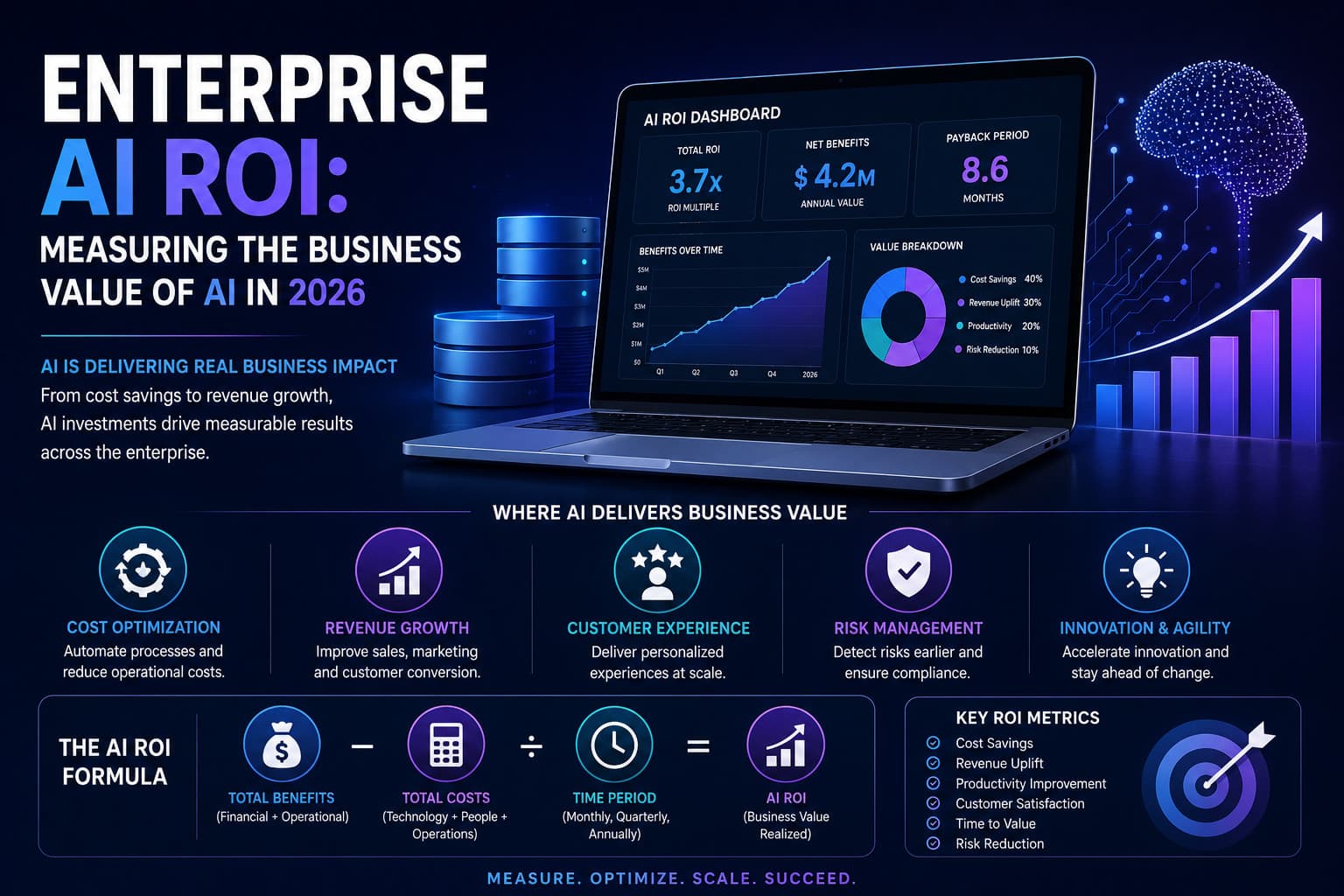
Artificial intelligence has moved beyond experimentation and become a strategic business priority. In 2026, enterprises are investing in generative AI, AI agents, predictive analytics, intelligent automation, and machine learning to improve efficiency and create new sources of revenue. However, investing in AI is only one part of the journey. Businesses also need to determine whether these investments are delivering measurable value. Understanding Enterprise AI Trends 2026 can help organizations identify where AI creates the greatest business impact and how to measure that impact effectively. From reducing operational costs to improving customer experiences, enterprise AI ROI should be evaluated through both financial and operational metrics.
Why Enterprise AI ROI Matters in 2026

AI projects can require significant investments in technology, infrastructure, data, talent, security, and implementation. Without clear performance measurements, organizations may struggle to determine whether an AI initiative is actually successful.
Enterprise AI ROI helps businesses answer important questions such as:
- Is AI reducing operational costs?
- Is automation improving employee productivity?
- Is AI increasing revenue or conversion rates?
- Are customers receiving better experiences?
- How quickly is the AI investment generating value?
- Can the AI solution scale across the organization?
As Enterprise AI Trends 2026 continue to evolve, organizations are shifting from simply adopting AI to measuring its actual business outcomes.
Key Areas Where Enterprise AI Creates Business Value
Enterprise AI can generate value in several areas. The right metrics depend on the organization's objectives and the specific AI application.
1. Cost Reduction
One of the most direct ways to measure AI ROI is through cost savings. AI-powered automation can reduce the amount of manual work required for repetitive processes. For example, intelligent process automation can handle document processing, customer inquiries, data analysis, and routine administrative tasks.
Businesses can measure:
- Reduction in operating costs
- Hours saved through automation
- Lower processing costs
- Reduced error-related expenses
- Employee productivity improvements
These metrics can provide a clear financial picture of an AI investment.
2. Revenue Growth
AI can also contribute directly to revenue generation. Generative AI, predictive analytics, recommendation engines, and AI-powered sales tools can help organizations identify opportunities and improve customer engagement.
Revenue-related metrics may include:
- Increased sales
- Higher conversion rates
- Improved customer retention
- Increased average order value
- New AI-enabled products or services
For example, an AI recommendation system may help an ecommerce business provide more relevant product suggestions, potentially increasing conversions and sales.
3. Employee Productivity
Employee productivity is becoming an important AI performance indicator. Enterprise AI tools can help employees summarize documents, generate content, analyze information, automate workflows, and retrieve business knowledge faster.
Organizations can measure:
- Time saved per task
- Tasks completed per employee
- Reduction in repetitive work
- Faster decision-making
- Employee adoption rates
Rather than measuring AI only by headcount reduction, enterprises should consider how AI enables employees to focus on higher-value activities.
Important Metrics for Measuring Enterprise AI ROI
A strong AI measurement framework should combine financial, operational, customer, and technical metrics.
Financial Metrics
Financial measurements can include:
- Return on investment
- Total cost savings
- Incremental revenue
- Cost per transaction
- Payback period
- Total cost of ownership
A simple ROI calculation can be expressed as: AI ROI = (Financial Benefits − AI Investment Cost) ÷ AI Investment Cost × 100 However, financial ROI should not be the only measurement.
Operational Metrics
Operational metrics help determine whether AI is improving business processes.
Examples include:
- Process completion time
- Automation rate
- Error reduction
- Workflow efficiency
- System availability
- Processing volume
These indicators can be particularly useful for AI automation projects.
Customer Experience Metrics
AI can significantly influence customer interactions. Enterprises should monitor:
- Customer satisfaction
- Customer retention
- Response time
- First-contact resolution
- Customer engagement
- Conversion rates
For AI-powered customer service, faster response times and higher resolution rates can demonstrate meaningful business value.
How to Calculate the Total Cost of Enterprise AI
Calculating AI ROI requires businesses to understand the complete cost of an AI initiative.
AI investment can include:
- AI software and platform costs
- Cloud infrastructure
- Data storage and processing
- Model development
- AI consulting and implementation
- Employee training
- Cybersecurity
- Compliance
- Maintenance and monitoring
Ignoring these costs can result in an inaccurate ROI calculation. Enterprises should therefore calculate the total cost of ownership (TCO) before comparing AI investment with expected benefits.
Measuring AI ROI Beyond Short-Term Gains
Some AI initiatives may not produce immediate financial returns. For example, an enterprise knowledge assistant may initially improve employee productivity rather than generate direct revenue. Similarly, AI governance investments may reduce future compliance and security risks. DashMinds Analytics helps organizations evaluate AI initiatives across both measurable business outcomes and longer-term strategic value, considering factors such as productivity, risk reduction, decision quality, operational efficiency, and scalability. This is why businesses should evaluate both short-term and long-term value when measuring the success of their AI investments.
Long-term AI benefits can include:
- Better decision-making
- Improved scalability
- Stronger customer relationships
- Faster innovation
- Reduced business risk
- Greater organizational agility
This broader perspective is particularly important when evaluating the Enterprise AI Trends 2026 landscape.
The Role of Data in Enterprise AI ROI
AI performance depends heavily on data quality. Poor-quality, incomplete, outdated, or fragmented data can reduce the effectiveness of AI systems. Enterprises should therefore measure data readiness alongside AI performance.
Important data-related factors include:
- Data quality
- Data accessibility
- Data governance
- Data security
- Data integration
- Data processing speed
Modern approaches such as data lakehouse architectures can help enterprises create a more unified foundation for analytics, machine learning, and generative AI applications.
Common Challenges in Measuring AI Business Value
Measuring AI ROI is not always straightforward.
Difficult-to-Measure Benefits
Some benefits, such as improved decision-making or employee satisfaction, can be difficult to convert into direct financial values.
Changing AI Costs
AI infrastructure and model costs can change as usage increases. Enterprises need to regularly review operational expenses.
Lack of Baseline Data
Without measuring performance before AI implementation, it can be difficult to determine the actual improvement generated by the technology.
Poorly Defined Objectives
AI projects without clear business goals are harder to evaluate. Businesses should establish measurable objectives before deployment.
Best Practices for Improving Enterprise AI ROI
Organizations can improve AI investment outcomes by following a structured approach.
Start with a specific business problem: Instead of adopting AI simply because it is a current technology trend, identify a measurable business challenge.
Establish a baseline: Record existing costs, processing times, error rates, revenue, or customer metrics before implementing AI.
Define KPIs: Select financial and operational KPIs that directly relate to the project's objectives.
Start with scalable use cases: Prioritize AI applications that can demonstrate measurable value and potentially expand across departments.
Monitor continuously: AI ROI should be reviewed regularly because models, costs, business requirements, and user behavior can change.
Consider responsible AI: Security, privacy, governance, and compliance should be included when evaluating the overall value and risk of an AI initiative.
Frequently Asked Questions
What is enterprise AI ROI?
Enterprise AI ROI measures the financial and business value generated by an AI investment compared with the total cost of implementing and operating the AI solution.
What are the most important AI ROI metrics?
Important metrics include cost savings, revenue growth, productivity, process efficiency, customer satisfaction, adoption rates, payback period, and total cost of ownership.
Why is measuring AI ROI difficult?
AI can create both direct and indirect benefits. While cost savings may be easy to calculate, improvements in decision-making, innovation, and employee productivity can be more difficult to quantify.
How can businesses improve AI ROI in 2026?
Businesses can improve AI ROI by selecting high-value use cases, establishing measurable KPIs, improving data quality, controlling AI infrastructure costs, and continuously monitoring performance.
Are Enterprise AI Trends 2026 focused only on generative AI?
No. Enterprise AI Trends 2026 include generative AI, agentic AI, predictive analytics, intelligent automation, AI-powered cybersecurity, machine learning, and AI-driven data analytics.
Conclusion
Measuring enterprise AI ROI in 2026 requires more than calculating financial returns. Businesses need to evaluate cost savings, revenue growth, productivity, customer experience, operational efficiency, risk reduction, and long-term strategic value. As Enterprise AI Trends 2026 continue to influence digital transformation, organizations that connect AI investments with measurable business objectives will be better positioned to achieve sustainable results. The key is to start with clear goals, establish meaningful baselines, track the right KPIs, and continuously optimize AI initiatives based on measurable outcomes.