
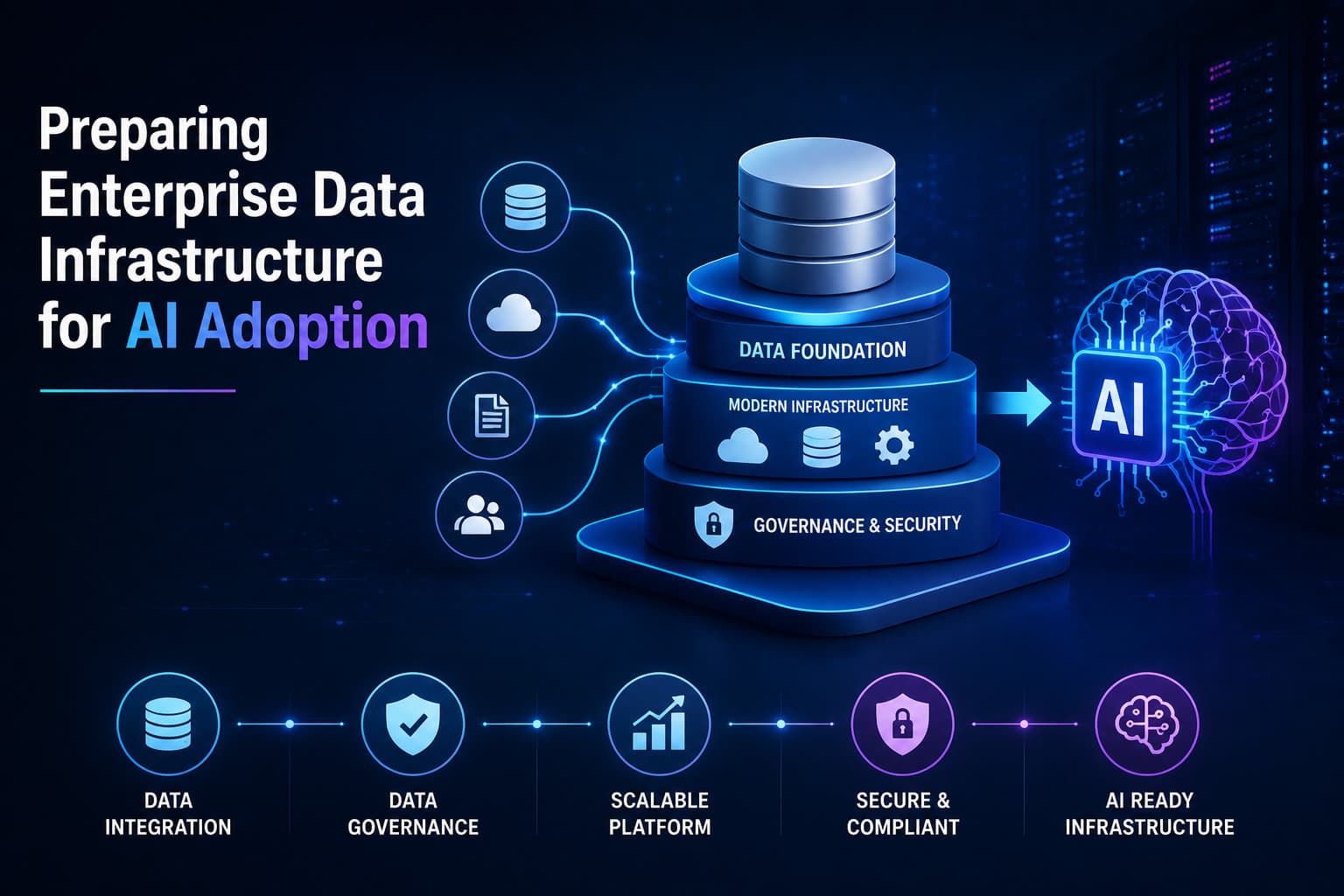
Preparing Enterprise Data Infrastructure for AI Adoption
As AI adoption accelerates, enterprises are discovering that successful AI implementation depends on more than selecting the right models or platforms. A reliable, scalable, and well-governed data foundation is essential for supporting generative AI, machine learning, predictive analytics, and intelligent automation. This case study explores how an enterprise addressed fragmented data infrastructure and prepared its systems for AI adoption. Client-specific information and measurable results are intentionally presented as placeholders where actual data is unavailable.
Business Situation

The enterprise had accumulated data across multiple business applications, databases, cloud platforms, and departmental systems. While the organization had significant amounts of valuable information, teams struggled to access and use it consistently. The business wanted to explore AI use cases such as predictive analytics, intelligent automation, and generative AI. However, its existing data environment was not designed to support these workloads efficiently. This challenge became particularly important as Enterprise AI Trends 2026 increasingly focused on scalable AI infrastructure, data readiness, AI governance, and enterprise-wide adoption.
Key Pain Points
The organization identified several barriers to AI adoption:
- Data was distributed across disconnected systems.
- Data quality varied between departments.
- Teams relied on manual data preparation.
- Access to business data was inconsistent.
- Existing infrastructure had limited scalability.
- Data governance requirements were not standardized.
- AI teams lacked a reliable source of enterprise data.
These issues increased the complexity of developing and deploying AI applications.
Strategic Approach
Instead of immediately implementing multiple AI tools, the enterprise first focused on strengthening its data foundation.
The strategy centered around five priorities:
1. Data Assessment
The organization began by mapping its major data sources and evaluating data quality, accessibility, ownership, and usage requirements.
2. Data Integration
Relevant data sources were connected through structured data pipelines. The goal was to create a more unified environment for analytics and AI workloads.
3. Data Governance
The enterprise established clearer policies for data ownership, access control, security, privacy, metadata, and data quality.
4. AI-Ready Architecture
The technology environment was designed to support machine learning, generative AI, predictive analytics, and business intelligence without requiring separate data foundations for every use case.
5. Scalable Implementation
Rather than attempting to transform the entire infrastructure at once, the organization prioritized high-value data sources and AI use cases before expanding the architecture.
Implementation
The implementation began with an assessment of the existing technology environment. Critical datasets were identified and prioritized based on business relevance and AI requirements. Data pipelines were then developed to collect and transform information from relevant systems. Data quality processes were introduced to identify inconsistencies, duplicates, and incomplete records. Governance controls were also incorporated into the architecture. Appropriate users were given access based on their roles, while sensitive information received additional protection. The organization then prepared curated datasets for DashMinds Analytics and AI experimentation. This created a stronger foundation for future machine learning models, generative AI applications, and predictive analytics initiatives.
Transformation
The biggest transformation was the shift from treating data as isolated departmental resources to viewing it as an enterprise-wide strategic asset.
The new approach created a foundation for:
- Faster access to trusted data
- Scalable AI development
- Better data governance
- More consistent analytics
- Easier experimentation with AI use cases
- Improved collaboration between business and technology teams
Actual measurable outcomes such as [percentage improvement], [cost savings], or [time reduction] should be added once verified business data is available.
Lessons Learned
This initiative demonstrated several important lessons for organizations following Enterprise AI Trends 2026. AI readiness starts with data. Even advanced AI models can deliver limited value when the underlying data is fragmented or unreliable. Governance should not be an afterthought. Security, privacy, access controls, and data ownership should be incorporated from the beginning. Start with business priorities. Enterprises should focus on data and AI initiatives that address measurable business problems rather than adopting technology without a clear objective. Build for scalability. AI requirements can change rapidly, so the data architecture should be flexible enough to support future workloads.
Conclusion
Preparing data infrastructure is one of the most important steps toward successful enterprise AI adoption. By addressing data silos, improving data quality, strengthening governance, and creating an AI-ready architecture, organizations can establish the foundation needed for scalable AI initiatives. As Enterprise AI Trends 2026 continue to evolve, businesses that invest in strong data foundations can be better positioned to move from AI experimentation toward practical, enterprise-wide applications.
Ready to Prepare Your Business for AI? If your organization is struggling with fragmented data, legacy infrastructure, or AI readiness, DashMindsIQ can help assess your current environment and develop a practical data and AI strategy aligned with your business goals.
Get in touch with DashMindsAnalytics to explore your AI readiness journey.

Have a technical challenge worth discussing?
Our practice leads are happy to talk through your specific situation with no sales pitch required.
Talk to an Expert →