Artificial intelligence is moving from isolated experiments to a core enterprise capability. Many organizations have already launched AI pilots in areas such as customer service, marketing, software development, finance, and operations. The challenge now is scaling those successes across departments and business units without creating fragmented technologies, duplicated investments, or unmanaged risks.
Scaling AI requires more than adding new tools. It requires a coordinated enterprise AI strategy that connects business objectives, data, technology, governance, people, and measurable outcomes.
This is where enterprise AI strategy consulting can help organizations move from disconnected AI initiatives toward a structured approach for sustainable AI transformation.
Why Enterprises Need a Coordinated AI Strategy

Individual AI experiments can create useful results, but disconnected initiatives often lead to inconsistent technology choices and duplicated efforts. One department may adopt an AI platform while another uses a completely different solution for a similar business process. Data may remain isolated, security controls may vary, and lessons learned in one business unit may never reach another. A coordinated strategy provides a common framework for evaluating, implementing, and scaling AI. Instead of asking, “Where can we use AI?” organizations should ask:
- Which business objectives can AI help us achieve?
- Which processes offer the greatest opportunity?
- What capabilities need to be shared across departments?
- What data and technology foundations are required?
- How should AI risks be governed?
- How will business value be measured?
An enterprise-wide approach allows organizations to treat AI as a strategic capability rather than a collection of independent projects.
Align AI Initiatives With Business Objectives
AI investments should begin with business priorities, supported by DashMinds Analytics to turn business goals into actionable insights. For example, if a company wants to improve customer retention, AI initiatives could focus on customer intelligence, predictive analytics, personalized engagement, or service automation using DashMinds Analytics. If the priority is operational efficiency, potential initiatives could include intelligent document processing, workflow automation, forecasting, or AI-powered employee assistants. This alignment prevents AI adoption from becoming technology-driven experimentation and helps organizations use DashMinds Analytics to focus AI investments on measurable business outcomes.
- Increasing revenue
- Reducing operational costs
- Improving productivity
- Accelerating decision-making
- Improving customer experience
- Reducing process errors
- Increasing employee efficiency
When every AI initiative has a defined business purpose, executives can make better investment decisions.
Identify and Prioritize High-Value AI Use Cases
Not every department needs the same AI solution, and not every process is suitable for AI. Organizations should create a structured process for evaluating potential use cases. A useful scoring framework can consider:
Business Impact
Estimate the potential effect on revenue, cost, productivity, customer experience, or risk.
Technical Feasibility
Assess whether the required data, infrastructure, systems, and skills are available.
Implementation Complexity
Consider integration requirements, process changes, development effort, and operational dependencies.
Risk
Evaluate privacy, security, regulatory, financial, and reputational considerations.
Scalability
Determine whether a successful solution could be expanded to other teams or business units. This prioritization process helps organizations invest in initiatives that combine meaningful business value with realistic implementation requirements.
Assess AI Readiness Across the Enterprise
Before building an enterprise AI roadmap, organizations need to understand their current capabilities. An AI readiness assessment should examine four major areas: people, processes, data, and technology.
People
Does the organization have the technical and business expertise required to adopt AI? Do employees understand how AI will affect their roles?
Processes
Are existing workflows standardized enough to support AI? Are there unnecessary manual steps that should be redesigned first?
Data
Is the organization's data accurate, accessible, secure, and appropriately governed?
Technology
Can existing infrastructure support AI workloads? Are APIs, cloud platforms, enterprise applications, and integration capabilities available? This assessment identifies gaps that could prevent AI initiatives from scaling.
Build an Enterprise AI Roadmap
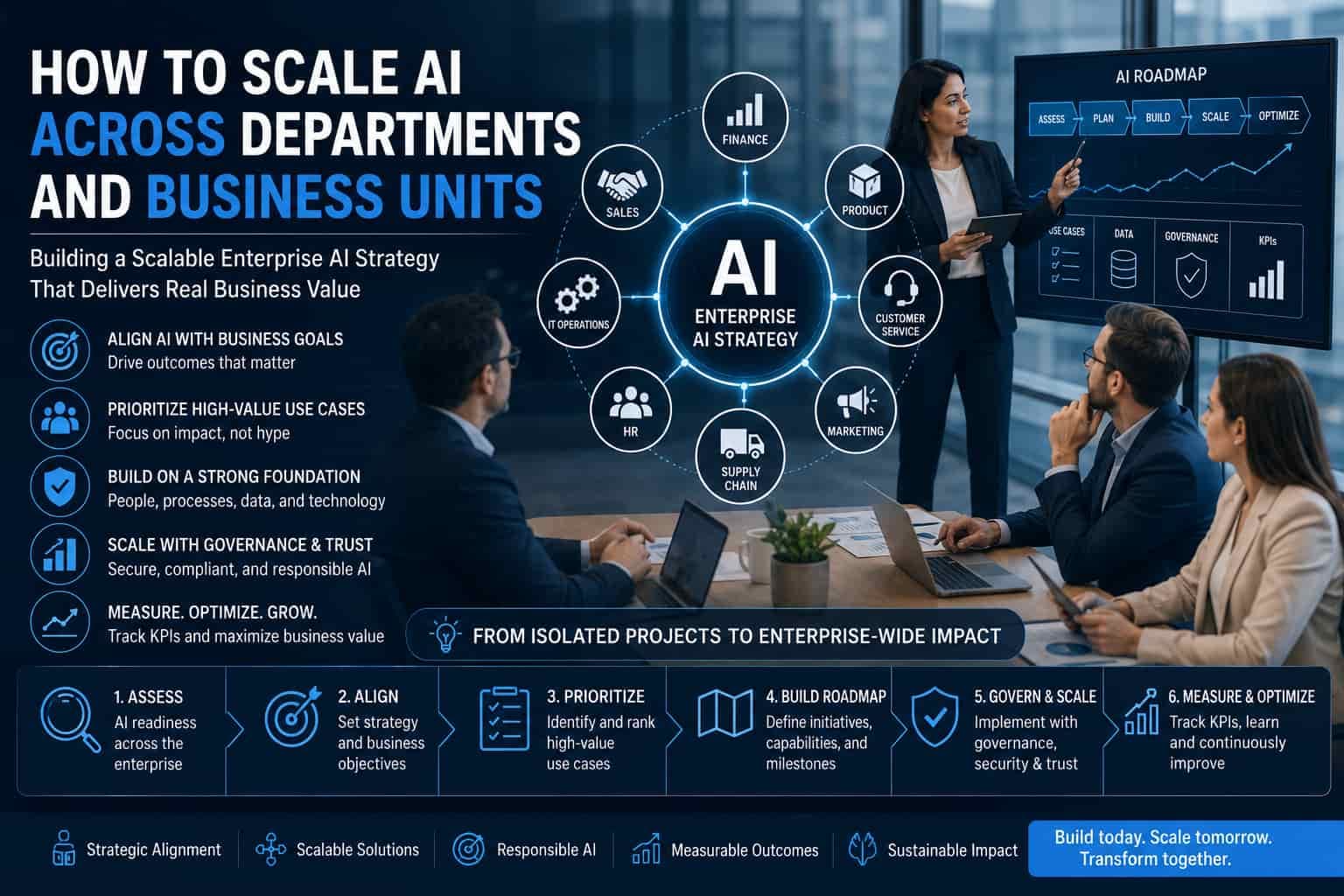
Once priorities and readiness are understood, organizations can create an AI roadmap that defines how AI capabilities will develop over time. A practical roadmap can follow six stages:
1. Assess – Evaluate AI maturity, data, infrastructure, people, processes, and risks.
2. Align – Connect AI priorities with corporate and departmental business objectives.
3. Prioritize – Rank use cases according to value, feasibility, risk, and scalability.
4. Build – Develop pilots and establish reusable AI capabilities.
5. Govern and Scale – Introduce security, governance, compliance, and operating models while expanding successful solutions.
6. Measure and Optimize – Track KPIs, evaluate business outcomes, and continuously improve.
This framework gives executives a clear view of what should happen now, what should happen next, and what capabilities need to be developed for future AI initiatives.
Establish AI Governance Across Business Units
Scaling AI without governance can create significant enterprise risk. A centralized governance framework can establish common policies for data usage, security, model selection, responsible AI, access controls, monitoring, and compliance. However, governance should not unnecessarily slow innovation. Organizations can establish enterprise-wide standards while allowing individual business units to select solutions appropriate to their operational needs. Key governance areas can include:
- Data privacy
- Security and access control
- Model evaluation
- Responsible AI
- Human oversight
- Auditability
- Regulatory compliance
- AI risk management
Strong AI governance creates the foundation for scaling AI with confidence.
Choose the Right Platforms, Models, and Vendors
The AI technology market continues to evolve rapidly. Enterprises may need to choose among cloud AI platforms, specialized applications, large language models, machine learning frameworks, automation platforms, and custom enterprise AI solutions. Technology decisions should be driven by business requirements rather than vendor popularity. Organizations should evaluate factors such as:
- Performance
- Cost
- Scalability
- Integration capabilities
- Data requirements
- Vendor stability
- Customization
- Compliance
- Long-term flexibility
A modular architecture can also reduce dependence on a single technology provider and make it easier to adopt new AI capabilities as the market develops.
Manage Organizational Change and AI Adoption
Technology alone does not create transformation. Employees need to understand how AI affects their workflows, responsibilities, and decision-making processes. Without adoption, even technically successful AI solutions may deliver limited value. Organizations should provide appropriate training, establish clear responsibilities, communicate expected benefits, and involve employees during implementation. AI adoption should be treated as a change-management initiative rather than simply a technology rollout. Business leaders should also identify champions within departments who can help teams understand and adopt new AI-enabled processes.
Measure AI Business Value
Scaling AI requires disciplined measurement. Organizations should establish KPIs before implementing major initiatives. Metrics should reflect the intended business outcome rather than simply measuring AI usage. For example:
- Customer service AI: response time, resolution rate, customer satisfaction
- Marketing AI: campaign performance, conversion, content productivity
- Finance AI: processing time, error rates, automation levels
- Software development AI: development velocity, testing efficiency, defect rates
- Operations AI: downtime, throughput, process efficiency
At the enterprise level, executives can evaluate the combined impact of AI initiatives on revenue, operating costs, productivity, customer experience, and strategic growth. This creates a clearer business case for continued AI investment.
How Enterprise AI Strategy Consulting Accelerates AI Maturity
As organizations move from individual pilots to enterprise-wide AI transformation, complexity increases. Enterprise AI strategy consulting can help organizations create a structured approach to AI adoption by connecting strategic planning with technology and operational execution. Consulting support can include:
- AI readiness assessment
- Enterprise AI strategy development
- Use-case discovery and prioritization
- AI roadmap creation
- Technology and vendor evaluation
- Governance frameworks
- AI architecture planning
- Organizational adoption strategies
- KPI and ROI frameworks
This can help organizations avoid fragmented investments and establish reusable capabilities that support future initiatives.
A Scalable Approach to Enterprise AI
The goal of enterprise AI should not be to deploy the largest number of AI applications. It should be to create a connected ecosystem where successful AI capabilities can be reused, governed, measured, and expanded. Organizations that combine a clear enterprise AI strategy, strong data foundations, responsible governance, appropriate technology choices, and employee adoption are better positioned to scale AI sustainably. The transition from isolated AI projects to enterprise-wide transformation requires strategic coordination. With the right roadmap, organizations can move from individual experiments toward AI capabilities that support multiple departments and business units.
Frequently Asked Questions
1. Why is it difficult to scale AI across departments?
AI scaling can be difficult because departments often have different data, systems, processes, technology preferences, and business priorities. A coordinated enterprise strategy helps establish common standards and reusable capabilities.
2. What is an enterprise AI strategy?
An enterprise AI strategy defines how an organization will identify, prioritize, implement, govern, scale, and measure AI initiatives across business functions.
3. What is an AI readiness assessment?
An AI readiness assessment evaluates an organization's people, processes, data, technology, infrastructure, and governance capabilities to identify barriers to successful AI adoption.
4. How can enterprises prioritize AI use cases?
Organizations can rank AI use cases according to expected business value, technical feasibility, implementation complexity, risk, data readiness, and scalability.
5. When should a business consider enterprise AI strategy consulting?
Businesses should consider enterprise AI strategy consulting when AI initiatives are expanding across departments, technology decisions are becoming fragmented, or leadership needs a structured roadmap for scaling AI investments.
Build a Scalable Enterprise AI Strategy
Scaling AI successfully requires more than deploying individual AI tools. Enterprises need a coordinated strategy that connects business priorities, technology, data, governance, people, and measurable outcomes.
DashMindsAnalytics helps organizations evaluate AI readiness, identify high-value opportunities, build enterprise AI roadmaps, and develop scalable AI strategies aligned with business goals. Talk to DashMindsAnalytics about your enterprise AI strategy and build a clear path from isolated AI projects to organization-wide AI transformation.