How Enterprise AI Strategy Consulting Supports Responsible AI Adoption
Client Situation
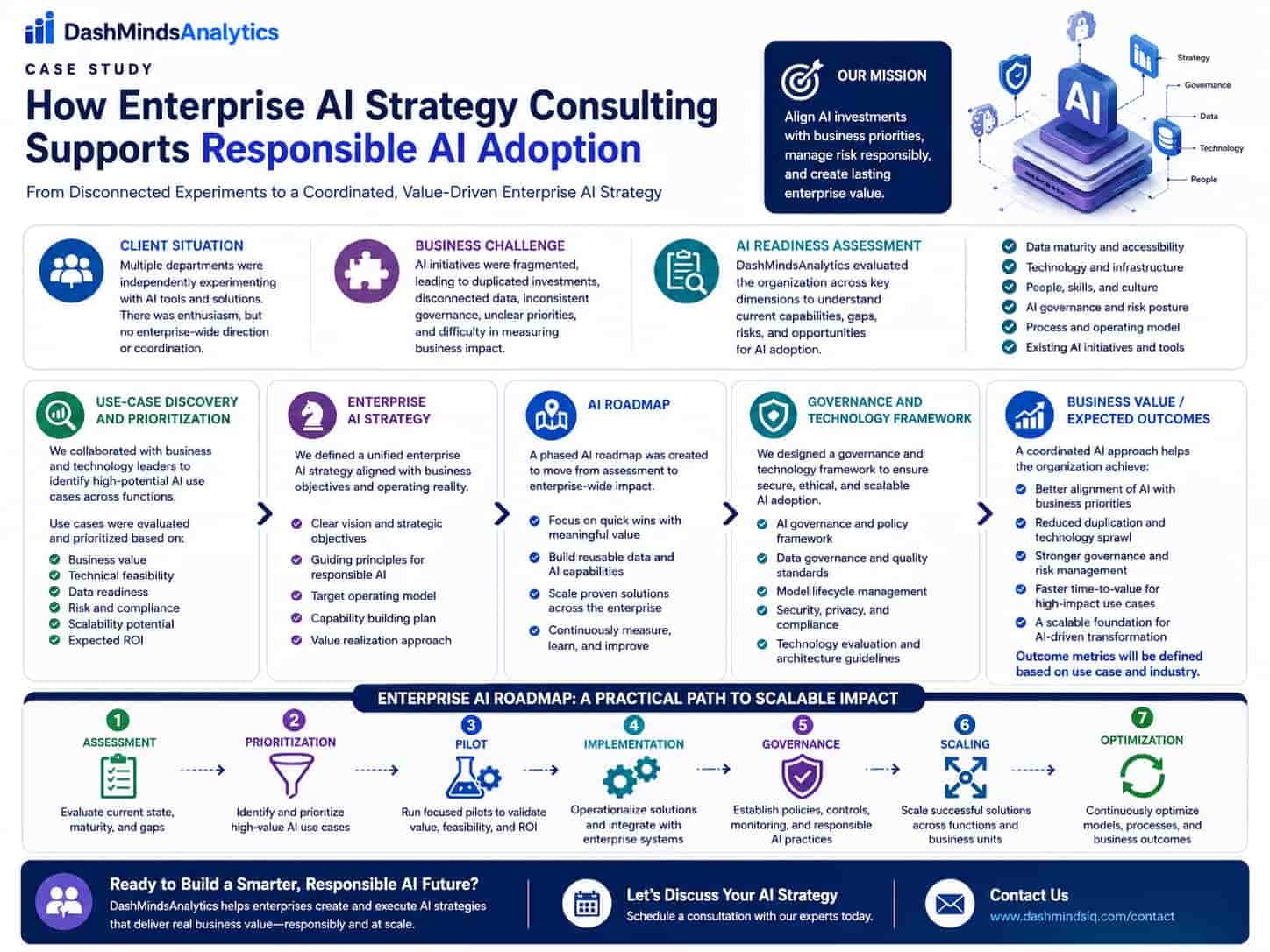
A representative enterprise had reached an important stage in its AI journey. Multiple departments were independently experimenting with AI tools, developing pilots, and exploring automation opportunities. While this activity created momentum, it also introduced duplication, disconnected data, inconsistent governance, and uncertainty about which initiatives deserved broader investment. Leadership recognized that the organization did not have an AI innovation problem. It had a coordination problem.
DashMindsAnalytics was engaged to explore how enterprise AI strategy consulting could help transform disconnected experiments into a coordinated approach to AI adoption.
Business Challenge

Different business units were evaluating similar technologies and pursuing overlapping AI use cases without a shared decision-making framework. Some initiatives had strong potential but lacked sufficient data readiness or integration planning. Others created governance and scalability concerns before their business value had been fully assessed. The organization needed an enterprise AI strategy that could connect business priorities, technology evaluation, data capabilities, risk management, and long-term AI transformation.
AI Readiness Assessment
The engagement began with an AI readiness assessment covering business objectives, existing AI initiatives, data accessibility, technology infrastructure, skills, governance, and operational readiness. This assessment provided a clearer picture of where the enterprise could adopt AI effectively and where foundational gaps needed attention first. It also helped identify duplicated investments and opportunities to reuse common enterprise capabilities.
Use-Case Discovery and Prioritization
DashMindsAnalytics worked with business and technology stakeholders to identify potential enterprise AI solutions across functions. Each opportunity was evaluated against practical criteria:
- Business value and strategic relevance
- Technical feasibility
- Data readiness and accessibility
- Risk and AI governance requirements
- Scalability and integration complexity
- Expected ROI and implementation effort
This approach to AI strategy consulting helped leadership distinguish between interesting experiments and AI initiatives with a stronger path toward enterprise value.
Enterprise AI Strategy
Based on the assessment and prioritization process, DashMindsAnalytics developed a coordinated strategy for responsible AI adoption. The strategy defined priority capability areas, decision-making responsibilities, technology principles, investment considerations, and requirements for scaling successful initiatives. Rather than requiring every department to follow identical use cases, it created a common framework for evaluating and implementing AI according to enterprise priorities.
AI Roadmap
The proposed AI roadmap followed a practical progression:
Assessment → Prioritization → Pilot → Implementation → Governance → Scaling → Optimization
Assessment established the organization's current capabilities and gaps. Prioritization focused resources on high-value opportunities. Selected pilots validated practical use cases before broader implementation. Governance was embedded throughout the process, supporting responsible AI decisions as solutions scaled. Optimization then focused on monitoring, improving, and adapting AI capabilities as business and technology requirements evolved.
Governance and Technology Framework
The strategy incorporated AI governance and responsible AI principles from the beginning rather than treating them as a final compliance exercise. DashMindsAnalytics could help define policies for technology evaluation, data access, security, human oversight, accountability, monitoring, and lifecycle management. The framework also considered how enterprise platforms, existing systems, and future AI capabilities could work together. This created a stronger foundation for consistent AI consulting, implementation decisions, and long-term scalability.
Business Value / Expected Outcomes
A coordinated enterprise AI strategy could help reduce duplicated experimentation, improve visibility into AI investments, and provide clearer direction for technology and business leaders. Expected outcomes may include [prioritized portfolio of AI initiatives], [improved alignment between AI investments and business objectives], [stronger AI governance], [greater reuse of enterprise technology and data capabilities], and [a clearer path for scaling successful AI solutions].
The key outcome is not simply more AI projects. It is a more disciplined way to identify, govern, implement, and optimize AI where it can support meaningful business priorities.

Have a technical challenge worth discussing?
Our practice leads are happy to talk through your specific situation with no sales pitch required.
Talk to an Expert →