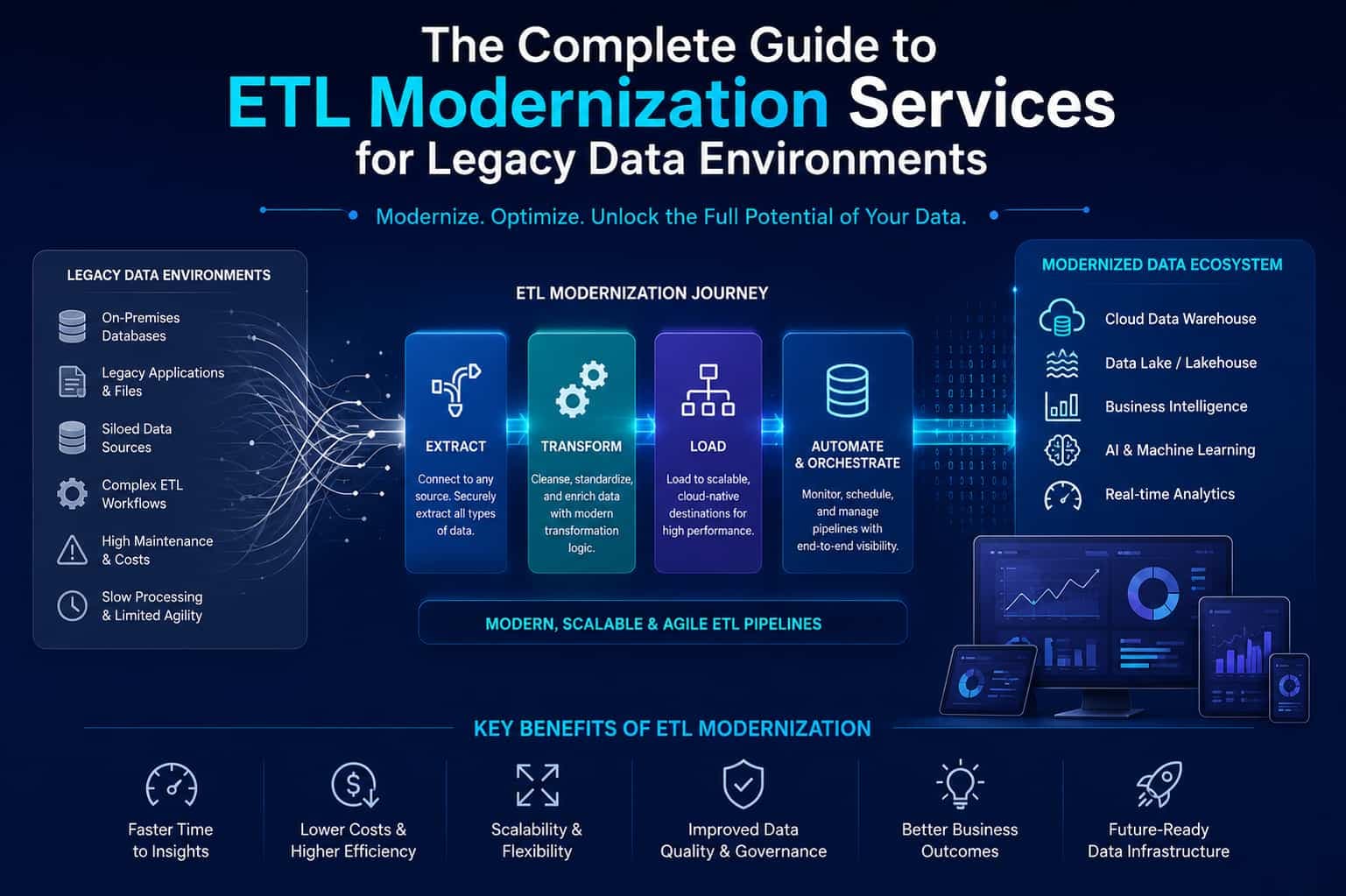
Many enterprises still depend on legacy ETL environments to move data between operational systems, databases, warehouses, and reporting platforms. These environments may have supported business operations for years, but growing data volumes, cloud adoption, real-time analytics, and artificial intelligence are changing what organizations expect from their data infrastructure.
Legacy ETL processes can become difficult to maintain when they rely on outdated tools, tightly coupled workflows, batch-heavy processing, and complex dependencies. As these challenges increase, businesses may find themselves spending more time maintaining data pipelines than improving their data capabilities.
This is where ETL modernization services can help.
ETL modernization is not simply about replacing an old ETL tool with a newer platform. It involves assessing existing data workflows, redesigning architecture, modernizing pipelines, improving orchestration and monitoring, and creating a scalable foundation for analytics and AI while minimizing disruption to ongoing operations.
What Is ETL Modernization?

ETL stands for Extract, Transform, and Load. Traditional ETL processes extract data from source systems, transform it according to business requirements, and load it into a target data warehouse or other destination. Over time, these pipelines can accumulate technical debt. Organizations may have hundreds of workflows created at different times, using different technologies and business rules.
ETL modernization focuses on improving these environments so they can support current and future data requirements. Depending on the organization's situation, modernization may involve migrating workloads to cloud platforms, redesigning pipelines, adopting modern orchestration, improving data quality, optimizing processing, or moving from traditional ETL patterns toward more flexible data engineering architectures.
Why Legacy ETL Environments Become a Problem
Legacy ETL systems do not necessarily become ineffective overnight. Their limitations usually become visible as business and technology requirements evolve.
Outdated ETL Tools
Older ETL tools may lack capabilities required for modern cloud environments, advanced orchestration, scalable processing, or integration with newer data platforms. In some cases, businesses also depend on specialized skills that are becoming increasingly difficult to maintain.
Batch-Heavy Processing
Many legacy environments were designed around scheduled batch processing. For traditional reporting, processing data once or several times a day may have been sufficient. Modern applications increasingly require fresher information for operational analytics, customer experiences, fraud detection, and AI. Moving toward more frequent or event-driven processing can therefore become an important modernization objective.
Complex Dependencies
Legacy ETL environments often contain tightly connected workflows. One pipeline may depend on another completing successfully, which may depend on several upstream jobs. As the number of dependencies grows, troubleshooting failures becomes increasingly difficult. A small change in one workflow can sometimes affect multiple downstream processes.
Poor Scalability
Data volumes continue to grow as organizations add applications, customers, transactions, and digital services. Legacy infrastructure may struggle to handle this growth efficiently. Increasing processing capacity can become expensive or require significant manual intervention. Modern architectures can provide more flexible ways to scale data processing based on workload requirements.
Data Quality Problems
Legacy pipelines may contain inconsistent transformation logic, outdated validation rules, duplicate records, or incomplete data quality checks. When these issues reach reporting and analytics systems, business users may lose confidence in the resulting information. Modernization provides an opportunity to introduce stronger validation and quality controls into the data pipeline lifecycle.
High Maintenance Effort
A significant amount of engineering time can be consumed by maintaining legacy workflows, troubleshooting failures, updating scripts, and responding to operational issues. This can prevent data teams from focusing on higher-value initiatives such as analytics modernization, AI enablement, and new data products.
Limited Cloud Readiness
Many organizations are moving data infrastructure toward cloud platforms, but legacy ETL environments may not have been designed for cloud-native architectures. This can make migration complicated and create opportunities to rethink how data is processed, stored, monitored, and governed.
How to Approach ETL Modernization
Successful modernization should be approached as a structured transformation rather than a simple technology replacement.
1. Assess the Existing ETL Environment
The first step is understanding what already exists. An assessment can examine:
- ETL tools and technologies
- Source and target systems
- Data pipelines and workflows
- Transformation logic
- Job dependencies
- Processing schedules
- Data volumes
- Failure patterns
- Data quality controls
- Infrastructure costs
- Monitoring capabilities
- Security and governance requirements
This creates a baseline for determining which workloads should be modernized, migrated, redesigned, consolidated, or retired.
2. Redesign the Data Architecture
Modernization provides an opportunity to evaluate whether the existing architecture still matches business requirements. Organizations may consider modern data warehouses, data lakes, lakehouses, cloud platforms, scalable processing frameworks, and improved integration patterns. The architecture should be designed around workload requirements rather than selecting technology simply because it is newer.
3. Create a Migration Plan
Migrating every ETL workflow simultaneously can create unnecessary operational risk. A phased migration strategy can prioritize workloads based on business importance, technical complexity, dependencies, and modernization value. Critical workloads may require additional testing and parallel execution before the legacy pipeline is retired. A carefully planned migration can help businesses modernize while keeping essential data operations running.
4. Modernize Data Pipelines
Once the target architecture and migration roadmap are defined, individual pipelines can be modernized. This may involve rewriting transformations, improving data integration, optimizing queries, introducing scalable processing, reducing unnecessary dependencies, and creating reusable pipeline components. Where appropriate, organizations can also move from rigid batch-oriented workflows toward more flexible processing patterns.
5. Strengthen Testing
Testing is critical when modernizing business-critical data workflows. A modernized pipeline should be tested against expected outputs, data quality requirements, transformation rules, performance expectations, and failure scenarios. Organizations can compare results between legacy and modernized pipelines before transitioning production workloads. This validation helps reduce the risk of introducing incorrect data into downstream systems.
6. Improve Orchestration and Monitoring
Modern ETL environments need clear visibility into pipeline performance. Orchestration can help manage workflow scheduling, dependencies, retries, and execution. Monitoring can provide visibility into processing times, failures, data quality issues, and unusual pipeline behavior. Together, these capabilities can reduce the operational burden of managing complex data environments.
7. Optimize After Migration
Modernization does not necessarily end when a pipeline has been migrated. Organizations should continue evaluating performance, infrastructure usage, processing costs, data quality, and pipeline reliability. Optimization can identify opportunities to simplify workflows, improve resource utilization, reduce unnecessary processing, and increase overall efficiency.
Minimizing Disruption During ETL Modernization
One of the biggest concerns businesses have is operational disruption. ETL systems often support financial reporting, customer operations, supply chain processes, analytics, and other critical functions. Replacing them without sufficient planning can create significant business risk. A phased approach can help reduce this risk. Organizations may run legacy and modernized pipelines in parallel, validate outputs, migrate workloads incrementally, and establish rollback procedures where appropriate. The objective is to modernize the underlying environment while maintaining continuity for business users and downstream applications.
ETL Modernization for Analytics and AI
Modern analytics and AI applications require reliable, accessible, and appropriately governed data. Legacy ETL environments can make it difficult to provide timely and consistent data to analytics platforms, machine learning workflows, and generative AI applications. Modernized pipelines can create more scalable data flows and support integration with cloud data platforms, analytical environments, and AI infrastructure. This makes ETL modernization services relevant not only for improving existing data operations but also for preparing the organization for future data and AI initiatives.
DashMindAnalytics Approach to ETL Modernization
DashMindsAnalytics takes an engineering-disciplined and data-driven approach to ETL modernization services.
Rather than treating modernization as a straightforward tool migration, the approach considers the existing architecture, business-critical workflows, data dependencies, quality requirements, scalability needs, and future technology direction.
The modernization process can include environment assessment, architecture redesign, migration planning, pipeline modernization, testing, orchestration, monitoring, and ongoing optimization.
This creates a meaningful distinction from traditional legacy modernization providers. A conventional provider may focus primarily on migrating existing workloads from one platform to another, while an engineering-focused approach looks beyond migration to pipeline reliability, architecture quality, data integrity, scalability, observability, and long-term maintainability.
Build a Modern Data Foundation
Legacy ETL environments can continue to support business operations, but maintaining them indefinitely may limit an organization's ability to scale data initiatives. If outdated tools, batch-heavy processing, complex dependencies, poor scalability, data quality problems, high maintenance requirements, or limited cloud readiness are slowing your data strategy, ETL modernization may be the next step
A structured modernization program can help organizations assess their current environment, prioritize workloads, redesign architecture, modernize pipelines, improve monitoring, and transition to a more scalable data foundation without unnecessary disruption.
Ready to modernize your legacy ETL environment? Talk to a DashMindsAnalytics specialist about your ETL modernization requirements and explore an engineering-driven approach to building more scalable, reliable, and future-ready data infrastructure.