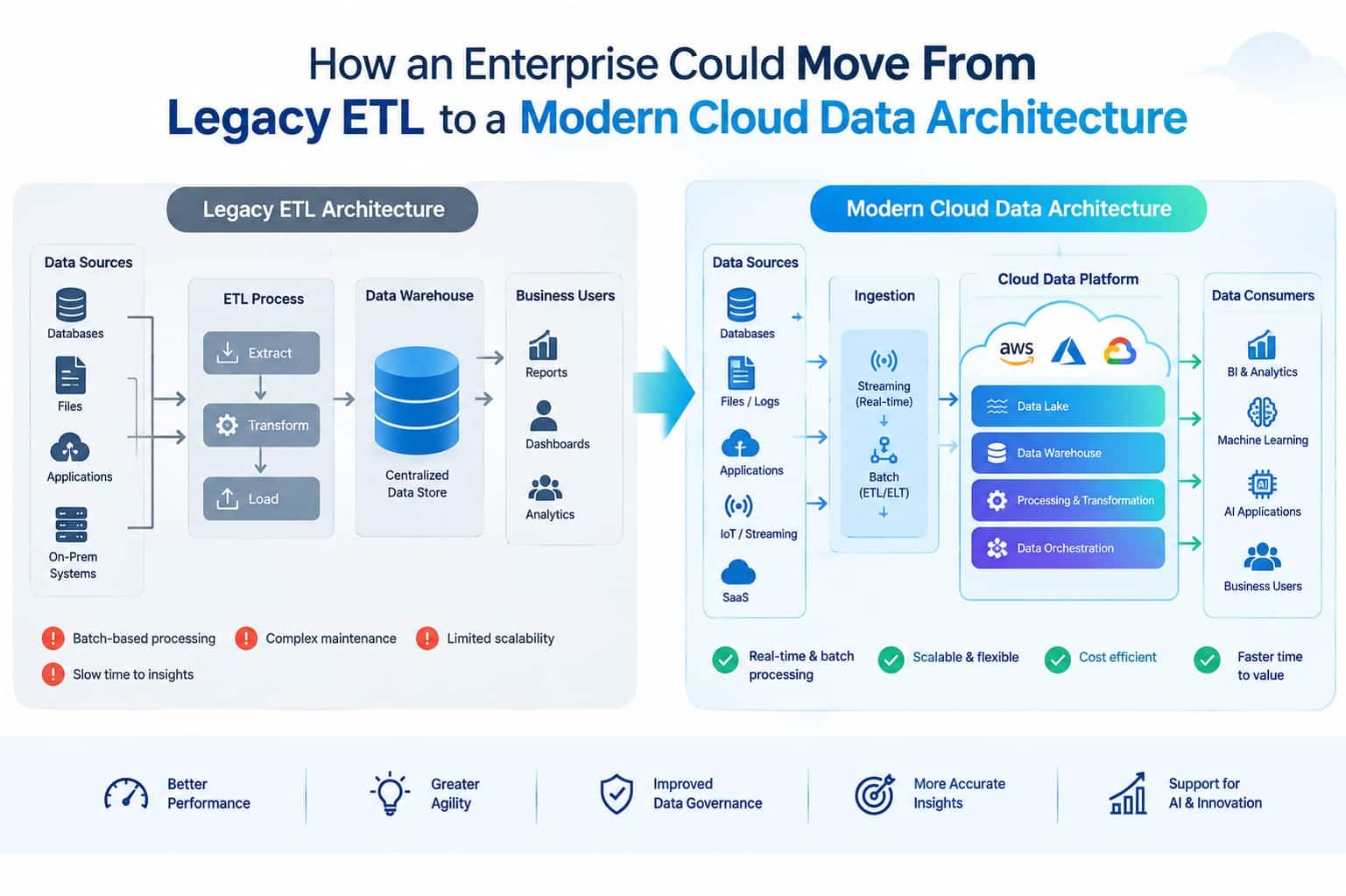
How an Enterprise Could Move From Legacy ETL to a Modern Cloud Data Architecture
Business Challenge
A large enterprise could be relying on legacy ETL tools and batch-oriented data workflows that were originally designed for a much smaller and less complex data environment. Over time, the organization may have accumulated hundreds of interconnected jobs, custom transformations, scheduling dependencies, and tightly coupled processes.
As data volumes and analytics requirements increased, maintaining these pipelines became increasingly difficult. Complex dependencies could make even small changes risky, while batch-heavy processing could limit how quickly data becomes available for reporting and analytics.
The enterprise was also experiencing data quality challenges, increasing maintenance effort, and limited scalability. Its legacy environment was not sufficiently prepared for a broader move toward cloud data platforms, modern analytics, and AI workloads.
The organization therefore explored ETL modernization services to transition toward a more scalable cloud data architecture while minimizing disruption to existing business operations.
Approach

DashMindsAnalytics approached the modernization initiative as a structured engineering program rather than a simple tool migration.
Legacy ETL Assessment
The first step involved assessing the existing ETL environment, including pipelines, transformations, schedules, data sources, destinations, operational dependencies, and maintenance requirements. This assessment helped establish which components were business-critical, which could be modernized, and which dependencies needed particular attention during migration.
Dependency Analysis
Pipeline dependencies were mapped to understand how upstream and downstream processes interacted. Identifying these relationships was important for migration planning because changing one pipeline could potentially affect multiple reporting processes or downstream applications.
Target Architecture
Based on the assessment, DashMindsAnalytics could define a target cloud data architecture aligned with the organization’s analytics, scalability, integration, and governance requirements. The objective was not simply to reproduce the legacy environment in the cloud, but to identify opportunities to simplify workflows, improve maintainability, and establish more modern data processing patterns.
Solution
DashMindsAnalytics could implement the modernization through a phased migration strategy designed to reduce operational disruption.
Pipeline Modernization
Legacy ETL workflows could be redesigned and migrated according to business priority, technical dependencies, and migration readiness. Where appropriate, transformation logic could be optimized rather than directly replicated, helping reduce unnecessary complexity in the modern environment.
Testing and Validation
Testing would be incorporated throughout the migration process. Data validation, transformation testing, reconciliation, workflow testing, and regression checks could help verify that modernized pipelines continue to meet required business and technical expectations. A phased approach could also allow legacy and modern workflows to be compared during transition before individual workloads are fully moved.
Orchestration and Monitoring
Modern orchestration capabilities could be introduced to manage pipeline dependencies, scheduling, retries, and workflow execution. Monitoring and observability could provide greater visibility into pipeline health, processing failures, delays, and data-quality conditions. This would help establish a more manageable operating model than relying heavily on manual monitoring of legacy ETL jobs.
Optimization
After migration, pipelines could be reviewed for performance, scalability, maintainability, and unnecessary processing. The modernization roadmap could remain iterative, allowing the organization to optimize workloads as cloud usage and business requirements evolve.
DashMindsAnalytics vs. Traditional Legacy Modernization Providers
Traditional legacy modernization providers may focus primarily on migrating existing ETL jobs to newer tools or infrastructure. DashMindsAnalytics takes an engineering-disciplined and data-driven approach to ETL modernization services, evaluating dependencies, architecture, transformation logic, testing, orchestration, monitoring, and optimization as part of the broader modernization lifecycle. The goal is to help organizations modernize the underlying data architecture rather than simply recreate legacy complexity on a new platform.
Expected Business Value
A modernized cloud data architecture could provide the enterprise with a stronger foundation for analytics, reporting, and future AI initiatives.
Potential business value could include:
- 1. Reduced dependence on outdated ETL technologies
- 2. Greater scalability for growing data workloads
- 3. More manageable pipeline dependencies
- 4. Improved visibility into data processing
- 5. Stronger data quality and validation practices
- 6. Better support for cloud-based analytics
- 7. Reduced operational complexity over time
- 8. A more flexible foundation for future data and AI requirements
The actual outcomes would depend on the enterprise’s existing ETL environment, cloud architecture, data complexity, migration strategy, and operational requirements.
Conclusion
Legacy ETL environments can become increasingly difficult to maintain as organizations expand their data volumes, analytics requirements, and cloud adoption. Modernization does not necessarily require a disruptive replacement of everything at once.
With a structured assessment, dependency analysis, phased migration plan, rigorous testing, modern orchestration, monitoring, and ongoing optimization, enterprises can create a practical path from legacy ETL to a modern cloud data architecture. DashMindsAnalytic’s ETL modernization services combine engineering discipline and data-driven decision-making to help organizations address legacy complexity while planning for scalable analytics and AI.

Have a technical challenge worth discussing?
Our practice leads are happy to talk through your specific situation with no sales pitch required.
Talk to an Expert →