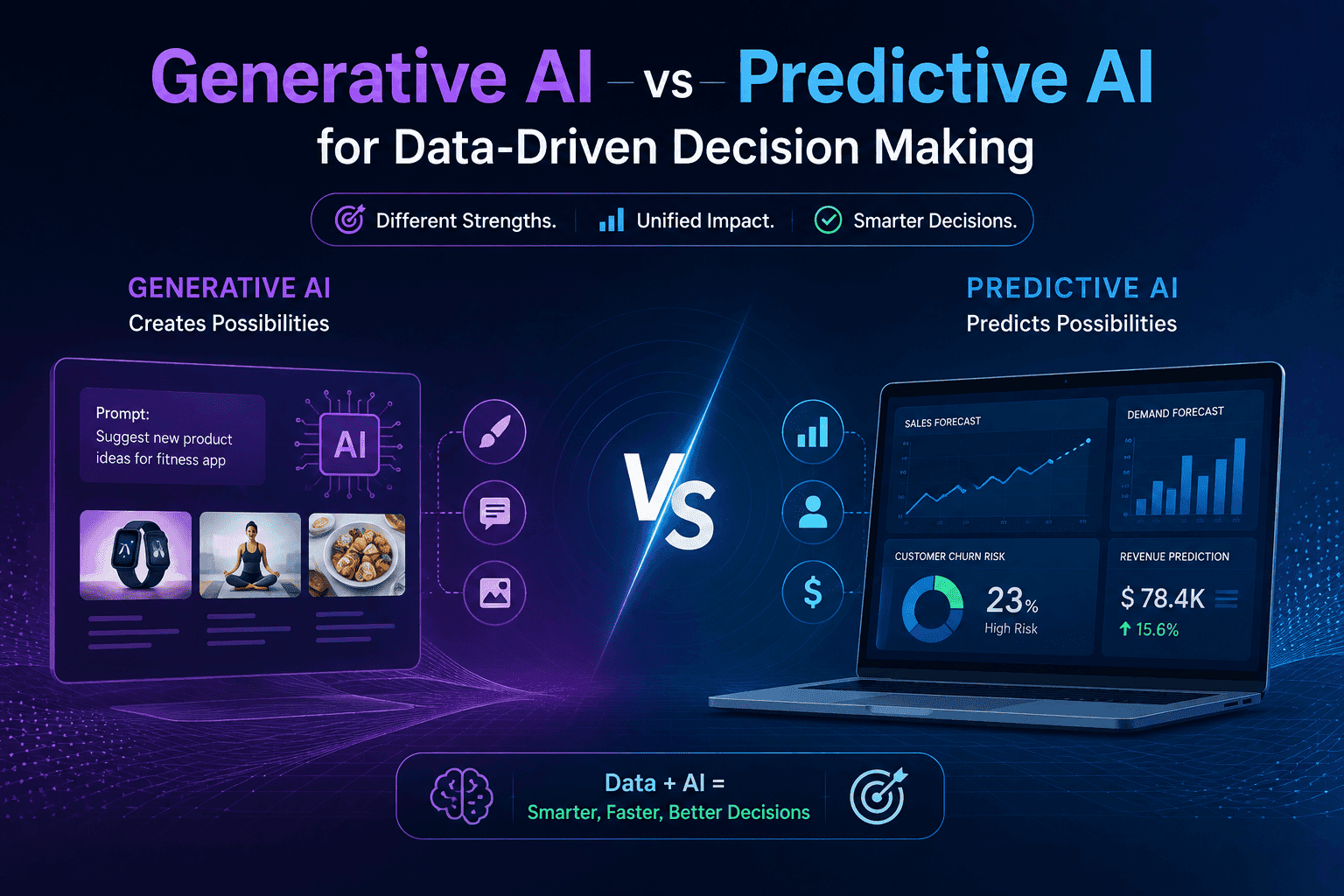
Artificial intelligence is changing how businesses analyze information and make strategic decisions. Two important approaches are generative AI and predictive AI. While both rely on advanced algorithms and data, they serve different purposes. Understanding Generative AI vs Predictive AI can help businesses choose the right technology for tasks such as forecasting, content creation, customer analytics, risk management, and business intelligence. Generative AI focuses on creating new content and information, while predictive AI analyzes historical and current data to estimate future outcomes. In many organizations, the two technologies can also work together to support more effective data-driven decision-making.
What Is Generative AI?
Generative AI is a type of artificial intelligence that can create new content based on patterns learned from existing data. Depending on the model and application, generative AI can produce:
- Text
- Images
- Code
- Audio
- Video
- Summaries
- Business reports
- Product descriptions
Large language models (LLMs) are a common example of generative AI. Businesses can use these systems to summarize large amounts of information, generate reports, answer questions, support employees, and assist with customer interactions. For example, a company could provide an AI system with sales reports and ask it to summarize the main trends, identify important changes, and create an executive-level explanation.

What Is Predictive AI?
Predictive AI uses historical and current data to identify patterns and estimate likely future outcomes. Machine learning and statistical models are commonly used for predictive analytics. Typical applications include:
- Demand forecasting
- Customer churn prediction
- Fraud detection
- Sales forecasting
- Risk assessment
- Predictive maintenance
- Credit scoring
- Customer lifetime value prediction
For example, an ecommerce business can use predictive AI to estimate which customers are most likely to purchase a product based on previous purchasing behavior and engagement.
How Generative AI Supports Data-Driven Decisions
Generative AI can make complex information easier to understand and act upon.
Turning Data Into Business Insights
Business users often have access to dashboards and reports but may struggle to interpret large amounts of information. Generative AI can summarize reports, explain trends, compare datasets, and produce natural-language insights.
Creating Business Reports
Instead of manually preparing recurring reports, organizations can use generative AI to create initial drafts based on approved business data. This can save time and allow employees to focus on analysis and strategic decisions. DashMinds Analytics helps organizations explore generative AI and intelligent automation solutions that can streamline reporting workflows, connect trusted enterprise data, and support faster access to business insights.
Supporting Knowledge Discovery
Generative AI can provide conversational interfaces for enterprise information. Employees can ask questions in natural language rather than manually searching through multiple documents and systems.
How Predictive AI Supports Data-Driven Decisions
Predictive AI is particularly valuable when businesses need to estimate future events.
Demand Forecasting
Retailers and manufacturers can analyze historical sales, seasonal trends, market conditions, and other variables to estimate future demand.
Customer Churn Prediction
Predictive models can identify customers who may be at risk of leaving based on behavioral patterns and historical data.
Risk Management
Financial institutions and other businesses can use predictive analytics to identify unusual patterns and estimate potential risks.
Predictive Maintenance
Manufacturers can analyze equipment data to identify potential failures before they happen, helping reduce downtime and maintenance costs.
Benefits of Generative AI
Generative AI can provide several business benefits.
Increased Productivity
AI assistants can automate repetitive writing, summarization, research, and communication tasks.
Faster Information Access
Employees can interact with enterprise knowledge using natural-language questions.
Improved Content Creation
Marketing and business teams can create drafts, product descriptions, reports, and other materials more efficiently.
Better Decision Communication
Generative AI can translate complex information into concise explanations that are easier for business stakeholders to understand.
Benefits of Predictive AI
Predictive AI offers a different set of advantages.
Better Forecasting
Organizations can use historical data to estimate future demand, revenue, risks, or customer behavior.
Proactive Decision-Making
Instead of reacting after an event occurs, businesses can identify potential outcomes and take action earlier.
Improved Resource Planning
Predictive models can help organizations allocate inventory, staff, budgets, and other resources more effectively.
Risk Reduction
Early identification of potential problems can help businesses reduce financial and operational risks.
Can Generative AI and Predictive AI Work Together?
Yes. In many cases, combining both technologies can create a stronger AI-driven decision-making process. For example, predictive AI can analyze customer data and determine that a customer has a high probability of leaving. Generative AI can then use that insight to create a personalized retention message for the customer service or marketing team. Another example involves sales forecasting. Predictive AI can estimate future sales, while generative AI can summarize the forecast, explain key factors, and create an executive report. This combination connects predictive analytics with natural-language communication and automation.
Generative AI vs Predictive AI: Which Should Businesses Choose?
Businesses should choose based on their specific objectives.
Choose Generative AI When:
- You need content generation.
- Employees spend significant time summarizing information.
- You want conversational access to enterprise knowledge.
- You need AI-powered assistants.
- Your goal is to automate content-heavy workflows.
Choose Predictive AI When:
- You need accurate forecasts.
- You want to predict customer behavior.
- You need risk scoring.
- You want to identify potential equipment failures.
- You need data-based estimates of future outcomes.
Consider Both When:
The business needs both prediction and automated action or communication. For example, predictive AI can identify what is likely to happen, while generative AI can explain the result and help determine the next step.
Key Factors to Consider Before Implementation
Define the Business Objective
Start with the problem rather than the technology. Determine whether the organization needs prediction, generation, automation, or a combination.
Evaluate Data Quality
Both AI approaches depend on reliable data. Inaccurate, incomplete, or outdated information can negatively affect results.
Consider Security and Privacy
Businesses should establish appropriate access controls, data protection measures, governance policies, and compliance requirements before deploying AI.
Measure Business Impact
Organizations should define KPIs such as productivity, cost savings, forecasting accuracy, conversion rates, customer retention, or response time.
Maintain Human Oversight
AI should support business decision-making rather than automatically replacing human judgment in situations involving significant financial, legal, operational, or customer consequences.
Frequently Asked Questions
What is the main difference between Generative AI and Predictive AI?
Generative AI creates new content or responses, while predictive AI analyzes data to estimate future outcomes.
Is Generative AI better than Predictive AI?
Neither is universally better. Generative AI is useful for content generation and knowledge-based tasks, while predictive AI is better suited to forecasting and estimating future events.
Can Generative AI be used for business analytics?
Yes. Generative AI can summarize reports, explain data patterns, generate insights, and provide conversational interfaces for business information.
What are common predictive AI use cases?
Common applications include demand forecasting, customer churn prediction, fraud detection, risk assessment, predictive maintenance, and sales forecasting.
Can businesses use both types of AI together?
Yes. Combining generative and predictive AI can help businesses predict outcomes, explain insights, generate recommendations, and automate follow-up actions.
Conclusion
Understanding Generative AI vs Predictive AI is important for organizations developing effective AI strategies. Although both technologies use data and machine learning techniques, they address different business needs. Generative AI excels at creating content, summarizing information, assisting employees, and providing natural-language interactions. Predictive AI focuses on forecasting outcomes, identifying risks, understanding customer behavior, and supporting proactive decisions. For many enterprises, the most effective strategy may not be choosing one over the other. Combining predictive analytics with generative AI can create a powerful approach to data-driven decision making, allowing businesses to understand what is likely to happen and communicate or act on those insights more efficiently. The key is to start with a clear business objective, use reliable data, establish appropriate governance, and measure measurable business outcomes.