Combining AI Prediction With AI Automation
Businesses are increasingly using artificial intelligence to improve forecasting, automate repetitive work, and make faster decisions. However, using predictive AI and automation separately can limit their overall value. This case study explores how a business can combine AI prediction with AI automation to create a more proactive and efficient workflow. The approach also demonstrates an important consideration in Generative AI vs Predictive AI: predictive AI can identify what is likely to happen, while generative AI and automation can help determine how to respond.
The Business Problem

The business was dealing with a decision-making process that relied heavily on historical data and manual intervention. Teams had access to reports and operational information, but employees still needed to review data, identify potential issues, and manually initiate follow-up actions.
This created several challenges:
- Delayed responses to changing business conditions
- Repetitive manual tasks
- Difficulty acting on predictive insights
- Data spread across multiple systems
- Limited automation of decision-driven workflows
The organization wanted to move from a reactive process toward a system that could identify potential outcomes and support appropriate actions.
How the Problem Was Analyzed
The first step was to map the existing workflow from data collection through decision-making and execution. The business identified which tasks required human judgment and which activities were repetitive and rule-based. Historical data was also reviewed to determine whether predictive models could identify useful patterns.
The analysis focused on three questions:
- What can the business predict?
- What action should follow the prediction?
- Which actions can safely be automated?
This helped prevent the organization from automating processes without first understanding the underlying business requirements.
The Solution Selected
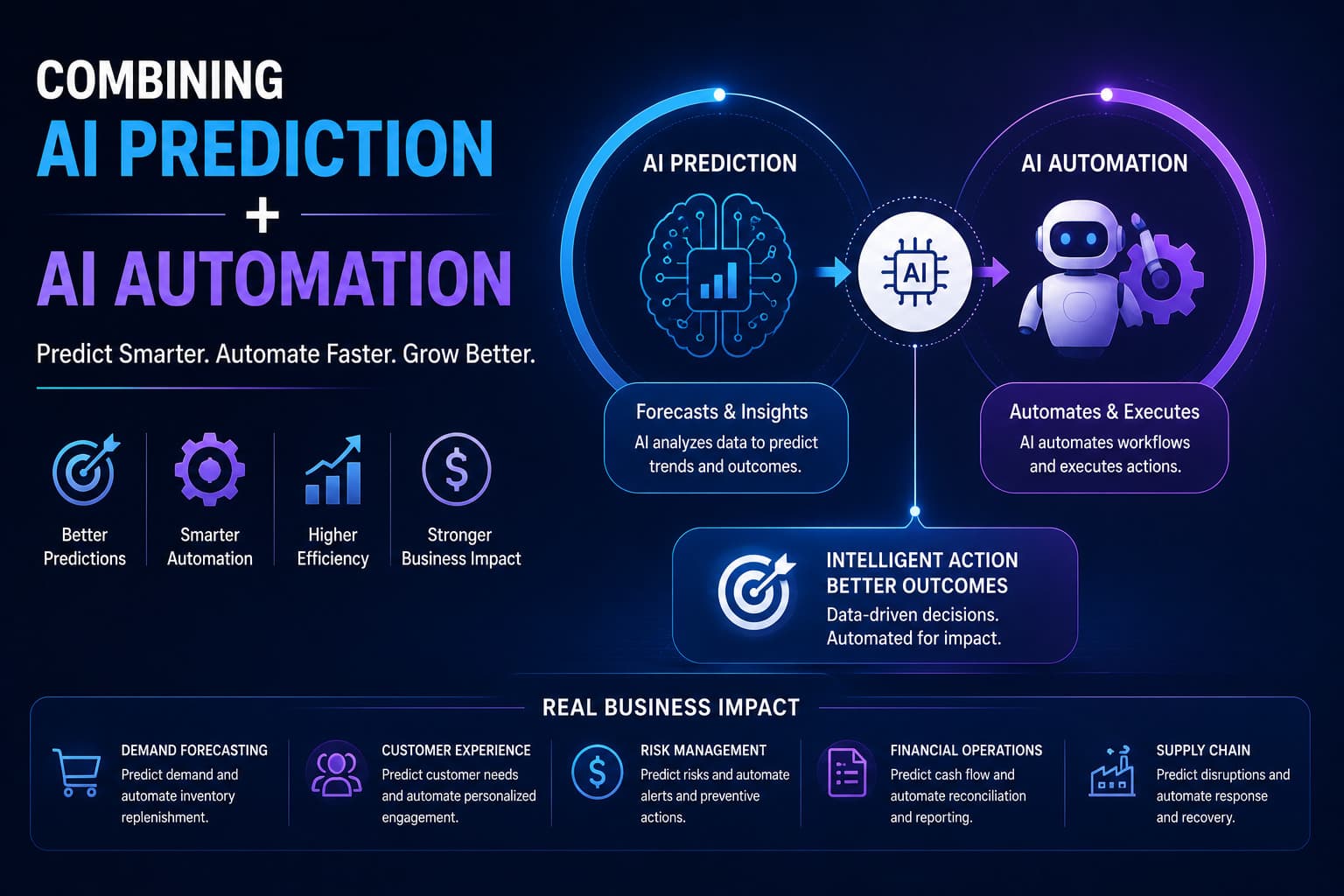
The proposed solution combined predictive AI with intelligent automation. Predictive AI would analyze historical and real-time information to generate forecasts, scores, or probability-based insights. Automation would then use those insights to initiate predefined workflows.
For example: Data → Predictive Model → Business Insight → Decision Rule → Automated Action → Human Review
Where appropriate, generative AI could also be introduced to summarize predictions, create communications, or assist employees in understanding AI-generated insights. This approach provided a practical way to connect prediction with execution.
Implementation Plan
1. Identify a High-Value Use Case
The business first selected a process where prediction could create measurable value, such as customer churn, demand forecasting, lead prioritization, or operational risk.
2. Prepare the Data
Relevant data sources were identified, cleaned, integrated, and prepared for model development.
3. Develop the Predictive Model
A machine learning model was designed to identify relevant patterns and generate predictions based on available data.
4. Connect Prediction to Automation
The prediction output was integrated with the business workflow. Specific thresholds or conditions determined when an automated action should occur.
5. Add Human Oversight
High-impact or uncertain decisions were routed to employees for review rather than being completely automated.
Challenges and How They Were Addressed
One challenge was data quality. Inconsistent or incomplete data could affect prediction accuracy. The business addressed this through data validation and preprocessing. Another challenge was automation risk. Not every prediction should automatically trigger an action. The solution therefore introduced approval steps and defined clear automation boundaries. Integration complexity was another consideration. Existing systems needed to exchange information reliably. APIs and controlled integration processes were used to connect relevant platforms. Finally, the organization needed employees to trust the system. Clear explanations, monitoring, and DashMinds Analytics helped teams understand how predictions influenced automated workflows.
Business Value
Combining AI prediction with automation can help organizations:
- Respond to potential issues earlier
- Reduce repetitive manual processes
- Turn predictive insights into actions
- Improve operational efficiency
- Support faster decision-making
- Create more scalable workflows
Actual results such as [percentage efficiency improvement], [cost savings], or [reduction in processing time] should be added only after verified business data is available.
Key Takeaways
The main lesson from this approach is that prediction and automation should not operate as isolated technologies. Predictive AI can answer “What is likely to happen?”, while automation can help answer “What should happen next?” Organizations considering Generative AI vs Predictive AI should therefore focus on their specific business objectives rather than selecting technology based on trends alone.
How DashMindsIQ Can Help
Businesses looking to connect AI predictions with intelligent automation need the right combination of data, AI models, integration, governance, and workflow design. DashMindsIQ can help organizations identify high-value AI opportunities, design predictive and automation workflows, integrate existing systems, and build practical AI solutions aligned with business goals. Contact DashMindsAnalytics to explore how AI can transform your business processes.

Have a technical challenge worth discussing?
Our practice leads are happy to talk through your specific situation with no sales pitch required.
Talk to an Expert →