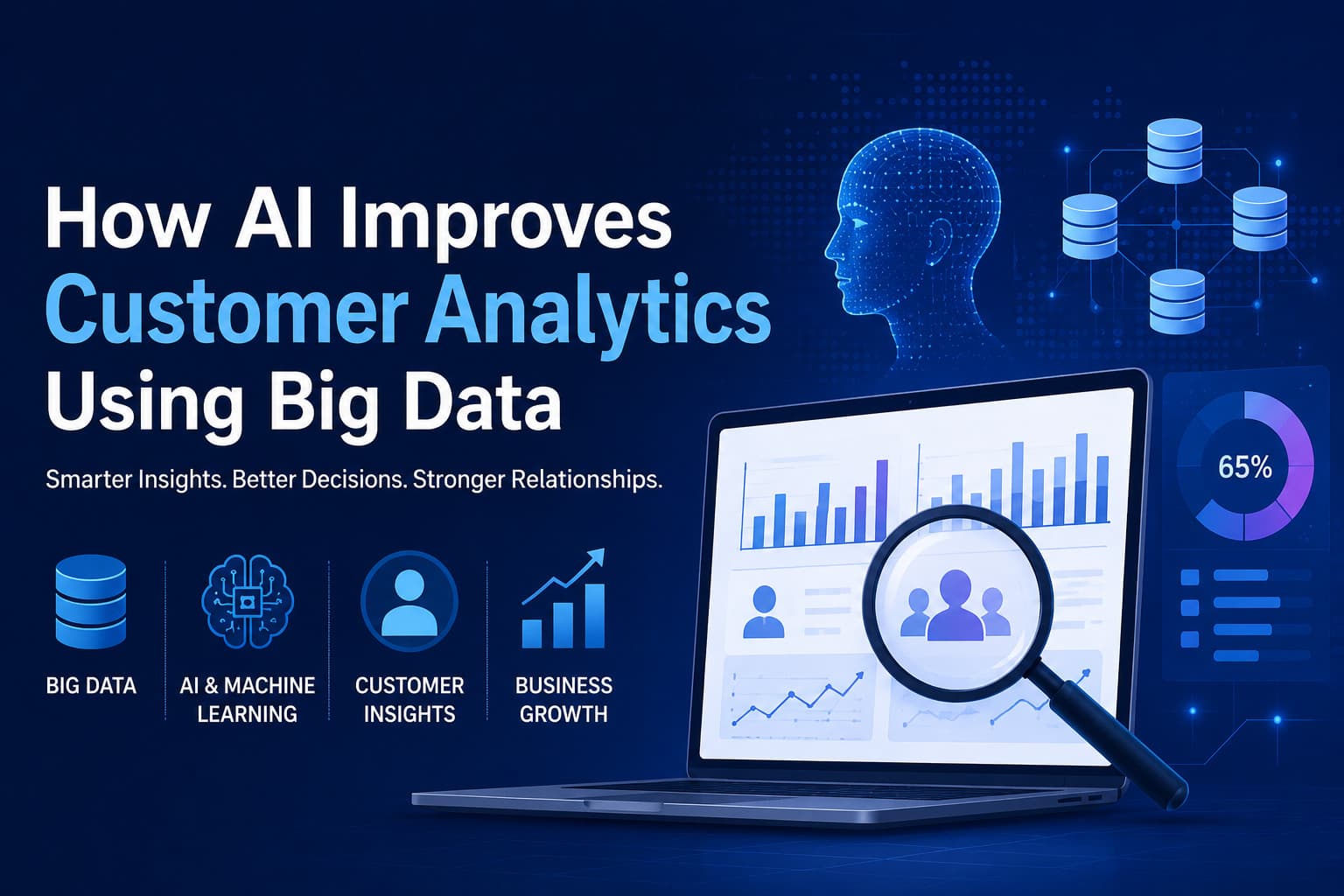
Businesses generate massive amounts of customer data through websites, mobile apps, ecommerce platforms, social media, CRM systems, transactions, and customer support channels. The challenge is no longer simply collecting this information. Businesses need to understand it quickly and turn it into actionable insights. Artificial intelligence (AI) combined with big data analytics helps organizations identify customer behavior patterns, predict future needs, personalize experiences, and make better business decisions. Among the growing AI big data analytics use cases, customer analytics is one of the most valuable because it connects data directly to customer experience, retention, marketing, and revenue.
What Is AI-Powered Customer Analytics?

AI-powered customer analytics uses artificial intelligence, machine learning, predictive analytics, and big data technologies to analyze large volumes of customer information. Traditional analytics often depends on predefined reports and manual analysis. AI can process structured and unstructured data at scale, identify hidden patterns, and generate predictions based on historical and real-time information.
Customer analytics may include:
- Purchase history
- Website behavior
- Mobile app activity
- Customer demographics
- Social media interactions
- Product reviews
- Customer support conversations
- Email engagement
- Search behavior
- Transaction history
When these sources are combined, businesses can develop a more complete view of customer behavior.
Why Big Data Matters for Customer Analytics
Customers interact with businesses across multiple channels. A customer may browse an ecommerce website, open an email, use a mobile application, contact support, and make a purchase through another device. Each interaction creates data. Big data analytics allows organizations to process these large and diverse datasets. AI then helps identify relationships and patterns that may be difficult for humans to discover manually. DashMinds Analytics helps businesses turn fragmented customer data into actionable insights through AI, advanced analytics, and data engineering solutions, supporting more connected and data-driven customer experiences. For example, traditional analytics may show that a customer purchased a particular product. AI-powered customer analytics can go further by analyzing browsing activity, previous purchases, engagement, and similar customer behavior to predict what the customer may need next. This can help businesses move from simply understanding past customer behavior toward more proactive and personalized decision-making.
How AI Improves Customer Analytics
1. Identifying Customer Behavior Patterns
One of the key AI big data analytics use cases is understanding customer behavior. Machine learning algorithms can analyze millions of interactions to identify patterns in browsing, purchasing, engagement, and product usage.
Businesses can discover:
- Which products customers prefer
- When customers are most active
- Which channels generate engagement
- What influences purchasing decisions
- Why customers abandon purchases
These insights help companies improve their marketing, sales, and customer experience strategies.
2. Predicting Customer Behavior
Predictive analytics enables businesses to anticipate potential customer actions.
AI models can analyze historical and real-time data to estimate:
- Future purchases
- Customer churn
- Conversion probability
- Product demand
- Customer lifetime value
- Engagement levels
For example, an ecommerce company can analyze previous purchases, browsing behavior, and engagement to identify customers who are likely to purchase a specific product. This allows businesses to act proactively rather than simply responding to customer actions after they occur.
3. Creating Smarter Customer Segmentation
Customer segmentation divides customers into groups based on shared characteristics or behaviors. Traditional segmentation may focus primarily on factors such as age, location, or gender. AI can create more dynamic segments by analyzing hundreds of behavioral signals.
Machine learning can identify groups based on:
- Purchase frequency
- Average order value
- Product preferences
- Website behavior
- Customer loyalty
- Engagement
- Promotional response
AI-driven segmentation helps businesses deliver more relevant campaigns to specific customer groups.
4. Delivering Personalized Experiences
Personalization is another important application of AI in customer analytics. AI systems can analyze customer data to recommend products, content, offers, and messages that are more relevant to individual users. For example, an ecommerce platform can combine purchase history, browsing behavior, product availability, and similar customer preferences to generate personalized product recommendations. This can improve engagement and help businesses create more relevant customer journeys.
5. Predicting and Reducing Customer Churn
Customer churn can have a significant impact on revenue. AI-powered churn prediction helps businesses identify customers who may be at risk of leaving.
Machine learning models can analyze signals such as:
- Reduced engagement
- Lower purchase frequency
- Customer complaints
- Negative reviews
- Declining product usage
- Changes in subscription behavior
Once high-risk customers are identified, businesses can provide targeted offers, personalized support, or retention campaigns.
6. Using Sentiment Analysis
Customer feedback contains valuable insights, but manually reviewing thousands of reviews, emails, surveys, and support conversations is time-consuming. Natural language processing (NLP) enables AI systems to analyze text and identify customer sentiment.
Businesses can use sentiment analysis to understand whether customers are:
- Satisfied
- Positive
- Negative
- Confused
- Concerned about a product or service
These insights help organizations identify customer issues faster and improve products and services.
7. Optimizing Marketing Campaigns
AI and big data analytics can help marketing teams understand which campaigns and channels generate the strongest results.
AI can analyze:
- Email engagement
- Advertising performance
- Website conversions
- Social media interactions
- Customer acquisition data
- Purchase behavior
Marketing teams can use these insights to improve audience targeting, campaign timing, content, and advertising budgets. Instead of treating all customers the same, businesses can create data-driven campaigns based on actual behavior.
8. Improving Customer Lifetime Value
Customer lifetime value (CLV) estimates how much revenue or value a customer may generate throughout their relationship with a business. AI can analyze historical purchases, engagement, retention, and customer behavior to identify customers with high long-term value. Businesses can then prioritize valuable customer segments with loyalty programs, personalized recommendations, premium services, and retention strategies.
Key Benefits of AI Big Data Analytics for Customer Insights
Better Decision-Making
AI transforms large and complex datasets into actionable customer insights that support faster decisions.
Improved Personalization
Businesses can better understand customer preferences and provide more relevant products, content, and offers.
Higher Customer Retention
Predictive models can identify potential churn risks early, allowing businesses to take proactive action.
More Efficient Marketing
AI helps businesses target the right customers and optimize marketing activities based on data.
Faster Analysis
AI can process large datasets much faster than manual analysis, allowing organizations to respond quickly to changing customer behavior.
Increased Revenue Opportunities
Better recommendations, personalization, customer retention, and marketing optimization can contribute to stronger revenue performance.
Practical Tips for Implementing AI Customer Analytics
Define a Clear Business Goal
Start with a specific objective rather than the technology itself. For example, your goal could be reducing churn, increasing conversions, or improving customer satisfaction.
Improve Data Quality
AI depends on reliable data. Organizations should address duplicate, incomplete, outdated, or inconsistent information before using it for analytics.
Integrate Customer Data
Connect relevant sources such as CRM, ecommerce, marketing, customer service, and product systems to create a more complete customer profile.
Protect Customer Information
Customer analytics should include strong data governance, privacy controls, access management, encryption, and security practices.
Start With High-Value Use Cases
Rather than implementing AI everywhere, begin with measurable applications such as recommendation engines, churn prediction, customer segmentation, or sentiment analysis.
Measure Business Outcomes
Track KPIs such as conversion rate, retention rate, customer lifetime value, engagement, customer satisfaction, and revenue impact.
Frequently Asked Questions
What are AI big data analytics use cases?
AI big data analytics use cases include customer segmentation, predictive analytics, churn prediction, personalization, sentiment analysis, recommendation systems, fraud detection, marketing optimization, and demand forecasting.
How does AI improve customer analytics?
AI can analyze large volumes of customer data, identify behavioral patterns, predict future actions, automate analysis, and generate actionable insights.
What types of customer data can AI analyze?
AI can analyze transaction data, browsing behavior, CRM records, customer feedback, social media interactions, support conversations, demographics, and product usage data.
Can AI predict customer churn?
Yes. Machine learning models can analyze historical and behavioral signals to identify customers who may be at risk of leaving.
Why is data quality important for AI analytics?
AI models rely on the data provided to them. Poor-quality, incomplete, or inconsistent data can lead to inaccurate analysis and unreliable predictions.
How can businesses start using AI for customer analytics?
Businesses should begin with a clear objective, identify reliable data sources, select a high-value use case, establish governance, and measure the resulting business impact.
Conclusion
AI is changing how businesses understand their customers. By combining artificial intelligence with big data analytics, organizations can move beyond traditional reporting and develop deeper, predictive, and actionable customer insights. From customer segmentation and personalization to churn prediction, sentiment analysis, and marketing optimization, AI big data analytics use cases can create value across the entire customer journey. The key to successful implementation is not simply collecting more data. Businesses need reliable data foundations, appropriate AI technologies, strong governance, and clearly defined business objectives. When these elements work together, AI-powered customer analytics can help organizations make smarter decisions, improve customer experiences, strengthen retention, and identify new opportunities for growth.