How AI and Big Data Helped Improve Customer Lifetime Value
Customer lifetime value (CLV) is an important metric for businesses that want to understand the long-term value of their customer relationships. However, calculating and improving CLV becomes difficult when customer information is spread across multiple platforms. This case study explores how a business used AI and big data analytics to create a more informed approach to customer lifetime value. Since verified client-specific information is unavailable, no customer names, statistics, or unsupported results are included.
Initial Situation

The business had access to substantial customer data from ecommerce transactions, CRM records, website activity, marketing campaigns, and customer interactions. However, these data sources were not being fully connected. Teams could see individual customer interactions but had limited visibility into the complete customer journey.
The organization wanted to better understand:
- Which customers generated long-term value
- What behaviors indicated customer loyalty
- Which customers were likely to make repeat purchases
- Which marketing activities influenced retention
- How customer experiences affected future purchases
This created an opportunity to use AI Big Data Analytics Use Cases to move from basic reporting toward predictive customer insights.
The Challenge
The main challenge was not a lack of data. It was the ability to turn large amounts of fragmented information into actionable insights. Several considerations emerged:
- Customer data existed across multiple systems.
- Data quality was inconsistent.
- Traditional segmentation provided limited behavioral insights.
- Teams had difficulty identifying high-value customer patterns.
- Marketing decisions were sometimes based on historical reports rather than predictive insights.
The business needed a scalable approach that could combine customer data and identify meaningful patterns.
The Approach
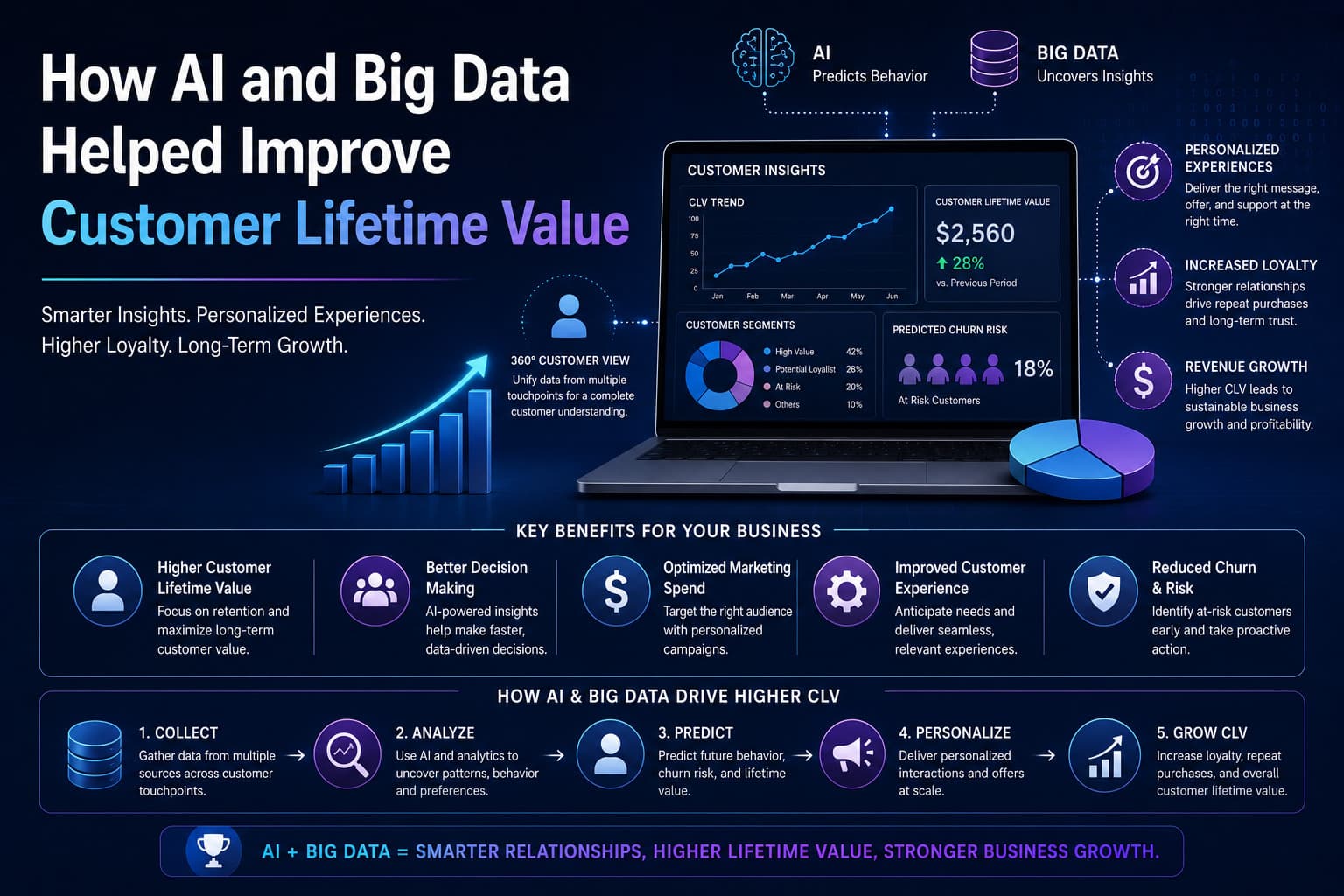
The organization adopted an AI-powered customer analytics approach. First, relevant customer data sources were identified and consolidated. The data included purchasing behavior, engagement, customer interactions, and campaign activity. Machine learning techniques were then considered for identifying customer segments and behavioral patterns. Instead of treating all customers equally, the approach focused on understanding different customer profiles and their potential long-term value using DashMinds Analytics. Predictive analytics could then be used to identify customers who demonstrated characteristics associated with repeat purchases, stronger engagement, or higher potential lifetime value.
Implementation
1. Data Integration
Customer information from relevant systems was brought together to create a more complete view of customer behavior.
2. Data Quality Management
The organization reviewed duplicate, incomplete, and inconsistent records before using the information for analytics.
3. Customer Segmentation
AI-based analysis helped identify behavioral groups based on factors such as purchase frequency, engagement, order value, and customer activity.
4. Predictive Analytics
Machine learning models could be used to identify patterns associated with customer retention, repeat purchases, and potential customer value.
5. Personalized Engagement
Insights from the analysis could support more relevant marketing campaigns, product recommendations, loyalty initiatives, and customer retention strategies.
Outcome
The project created a stronger analytical foundation for understanding customer lifetime value. Rather than relying only on historical sales reports, the business could use customer data to identify behavioral patterns and potential opportunities for improving retention and engagement. Potential business metrics such as [increase in repeat purchases], [improvement in retention], or [increase in customer lifetime value] should only be added after verified results are available.
Mistakes and Considerations
One important lesson is that more data does not automatically produce better insights. Poor-quality or disconnected data can reduce the reliability of AI analytics. Businesses should therefore prioritize data quality and integration before developing complex models. Another consideration is customer privacy. Organizations must establish appropriate data governance, access controls, security measures, and privacy practices when analyzing customer information. Businesses should also avoid treating AI predictions as guaranteed outcomes. Predictive models identify probabilities and patterns, not certainties.
Key Lessons for Businesses
Start With the Business Question
AI implementation should begin with a specific objective, such as improving retention or understanding customer value.
Build a Reliable Data Foundation
Integrated and high-quality customer data is essential for meaningful analytics.
Combine Historical and Behavioral Data
Looking beyond transactions can provide a more complete understanding of customer journeys.
Use AI to Support Decisions
AI should provide actionable insights while allowing business teams to apply context and judgment.
Measure What Matters
Organizations should establish clear KPIs before implementation and evaluate whether AI analytics is contributing to business objectives.
Conclusion
This case demonstrates how AI Big Data Analytics Use Cases can help businesses move beyond basic customer reporting toward deeper behavioral and predictive insights. By integrating customer data, improving data quality, applying machine learning, and using insights to support personalized engagement, organizations can build a stronger foundation for improving customer lifetime value. The biggest lesson is that successful AI analytics depends on more than technology. Data quality, governance, business objectives, and effective implementation are equally important.
Looking for a Similar Solution?
DashMindsIQ can help businesses turn fragmented customer data into actionable AI-powered insights through data analytics, machine learning, and intelligent solutions. Contact DashMindsAnalytics to explore a customer analytics strategy aligned with your business goals.

Have a technical challenge worth discussing?
Our practice leads are happy to talk through your specific situation with no sales pitch required.
Talk to an Expert →