Large language models have moved quickly from experimentation to enterprise technology. Organizations are using them for customer service, knowledge management, software development, document processing, research, marketing, and employee productivity. But selecting an LLM and building a demonstration is very different from deploying a reliable AI application across an enterprise.
The challenge for technology leaders is no longer simply finding a powerful model. It is determining which model, architecture, data strategy, security controls, integration approach, and operating model are appropriate for each business requirement.
A well-designed LLM strategy helps enterprises make these decisions systematically. LLM consulting services can further support organizations in evaluating technology choices, designing enterprise architectures, managing implementation risks, and building AI applications that can scale with changing business needs.
Why Enterprises Are Evaluating Multiple LLM Options

The LLM ecosystem is becoming increasingly diverse. Enterprises can choose from proprietary models, open-source models, specialized models, smaller language models, multimodal models, and models offered through different cloud platforms. There is no universally best LLM for every business application. DashMinds Analytics can help organizations evaluate AI requirements and align model choices with specific business objectives. A customer-facing application may prioritize response quality and reliability. An internal document-processing workflow may place greater emphasis on privacy and cost. A real-time application may require extremely low latency, while a complex reasoning application may benefit from a more capable model. This means model selection should start with the business use case, not the model's popularity.
Step 1: Define the Business Use Case
Before evaluating models, organizations should clearly define what the application needs to accomplish. Questions to consider include:
- What business problem is being solved?
- Who will use the application?
- What information does it need?
- What systems must it interact with?
- What level of accuracy is required?
- How much latency is acceptable?
- What security and compliance requirements apply?
- What business outcome should the application improve?
For example, an employee knowledge assistant may need reliable access to internal policies and documents, while a software development assistant may require strong code-generation and reasoning capabilities. This use-case-first approach prevents organizations from selecting technology before understanding the actual requirement.
Step 2: Choose Between Open-Source and Proprietary LLMs
One of the most important decisions in an enterprise LLM strategy is whether to use a proprietary model, an open-source model, or a combination of both.
Proprietary LLMs
Proprietary models can provide access to highly capable models through managed platforms and APIs. They may reduce some infrastructure responsibilities and allow teams to begin development quickly. However, enterprises should evaluate pricing, data handling, vendor dependencies, availability, contractual terms, and customization capabilities.
Open-Source LLMs
Open-source models can provide greater control over deployment, customization, and infrastructure. They may be attractive for organizations with specific privacy, performance, or customization requirements. However, running models independently can introduce additional infrastructure, optimization, security, and maintenance responsibilities. For many enterprises, the most practical strategy may involve using different models for different workloads rather than adopting a single model everywhere.
Step 3: Evaluate Performance, Cost, Latency, and Scalability
Model performance is only one part of the decision. Enterprise technology leaders should evaluate the total operating requirements of an LLM application. Important factors include:
Performance: How accurately does the model handle the required tasks?
Latency: How quickly does it respond under expected workloads?
Cost: What is the expected cost per request, user, or business transaction?
Scalability: Can the architecture handle increasing usage?
Reliability: Does the service provide the availability required by the application?
Context capability: Can the model process the amount of information required?
A smaller model may sometimes provide sufficient performance at a significantly lower cost. This makes model benchmarking essential before committing to an enterprise architecture.
Step 4: Use RAG for Enterprise Knowledge Integration
Enterprise applications often need to answer questions using proprietary company information. Simply placing internal documents into prompts is rarely a scalable approach. Retrieval-augmented generation (RAG) provides a structured way to connect an LLM with enterprise knowledge. A RAG architecture can retrieve relevant information from approved data sources and provide that context to the model before generating a response. This can support applications such as:
- Internal knowledge assistants
- Policy search
- Customer support
- Technical documentation
- Product information
- Research
- Enterprise search
RAG can help ground responses in relevant business information while allowing organizations to keep knowledge sources under appropriate access controls. However, successful RAG implementation requires attention to document quality, retrieval accuracy, permissions, indexing, data freshness, and evaluation.
Step 5: Determine When LLM Fine-Tuning Is Appropriate
Not every enterprise application requires LLM fine-tuning. Prompt engineering and RAG may be sufficient when the primary requirement is providing the model with relevant context. Fine-tuning can become useful when organizations need to adapt model behavior, terminology, formatting, or performance for a specific domain or task. The decision should be based on measurable requirements rather than assuming customization is always better. A structured evaluation can compare the performance of the base model, RAG-based approach, prompting techniques, and fine-tuned models before selecting the final architecture.
Step 6: Build Security and Privacy Into the Architecture
Enterprise LLM applications may process sensitive information, making security a fundamental design requirement. Organizations should establish controls around:
- Data access
- Authentication
- Authorization
- Encryption
- Sensitive information handling
- Model and API access
- Logging
- Monitoring
- Data retention
- Third-party services
Enterprises should also understand how vendors handle submitted data and what contractual or regulatory requirements apply. Security should be incorporated into LLM development from the beginning rather than addressed immediately before deployment.
Step 7: Evaluate and Monitor LLM Performance
Traditional software testing alone is not enough for LLM applications. Enterprise teams need to evaluate whether the system produces useful, accurate, relevant, and safe outputs. Evaluation can include:
- Accuracy
- Relevance
- Groundedness
- Response quality
- Hallucination rates
- Toxic or inappropriate outputs
- Latency
- Cost
- User satisfaction
Organizations should establish representative test datasets and continuously evaluate the application as models, prompts, data, and business requirements change. Monitoring is especially important after production deployment because real-world usage can reveal failure patterns that were not visible during development.
Step 8: Integrate LLMs With Existing Enterprise Applications
An LLM application becomes significantly more valuable when it can interact with existing enterprise systems. LLM integration may involve CRM platforms, ERP systems, databases, APIs, workflow applications, document repositories, and internal knowledge platforms. For example, a customer service assistant could retrieve account information from a CRM, access product information from an internal database, generate a response, and recommend an appropriate next action. This turns an LLM from a standalone chatbot into an integrated enterprise AI solution. API architecture, identity management, permissions, error handling, and auditability should be considered carefully when designing these integrations.
Managing LLM Costs and Measuring ROI
LLM costs can increase quickly as enterprise usage grows. Organizations should monitor token consumption, model selection, request volume, infrastructure costs, and application usage. Cost optimization strategies may include:
- Using smaller models for simpler tasks
- Routing workloads to different models
- Caching appropriate responses
- Optimizing prompts
- Limiting unnecessary context
- Monitoring usage by department
- Establishing usage policies
Cost should also be evaluated alongside business value. For example, an AI application that costs more to operate but saves employees thousands of hours may still generate strong ROI. Relevant business KPIs can include processing time, employee productivity, customer response time, automation rates, error reduction, operating costs, and revenue impact.
How LLM Consulting Services Support Enterprise Strategy
Building an enterprise LLM capability requires decisions across strategy, architecture, data, security, integration, and operations. This is where LLM consulting services can provide value. An experienced AI consulting partner can help enterprises:
- Identify high-value LLM use cases
- Compare model options
- Design LLM architectures
- Evaluate RAG and customization approaches
- Plan LLM integration
- Establish security and governance
- Develop evaluation frameworks
- Optimize infrastructure and costs
- Create implementation roadmaps
- Define business KPIs
Rather than committing prematurely to a specific model or platform, organizations can use a structured decision process to build an architecture that remains adaptable.
A Practical Enterprise LLM Strategy Framework
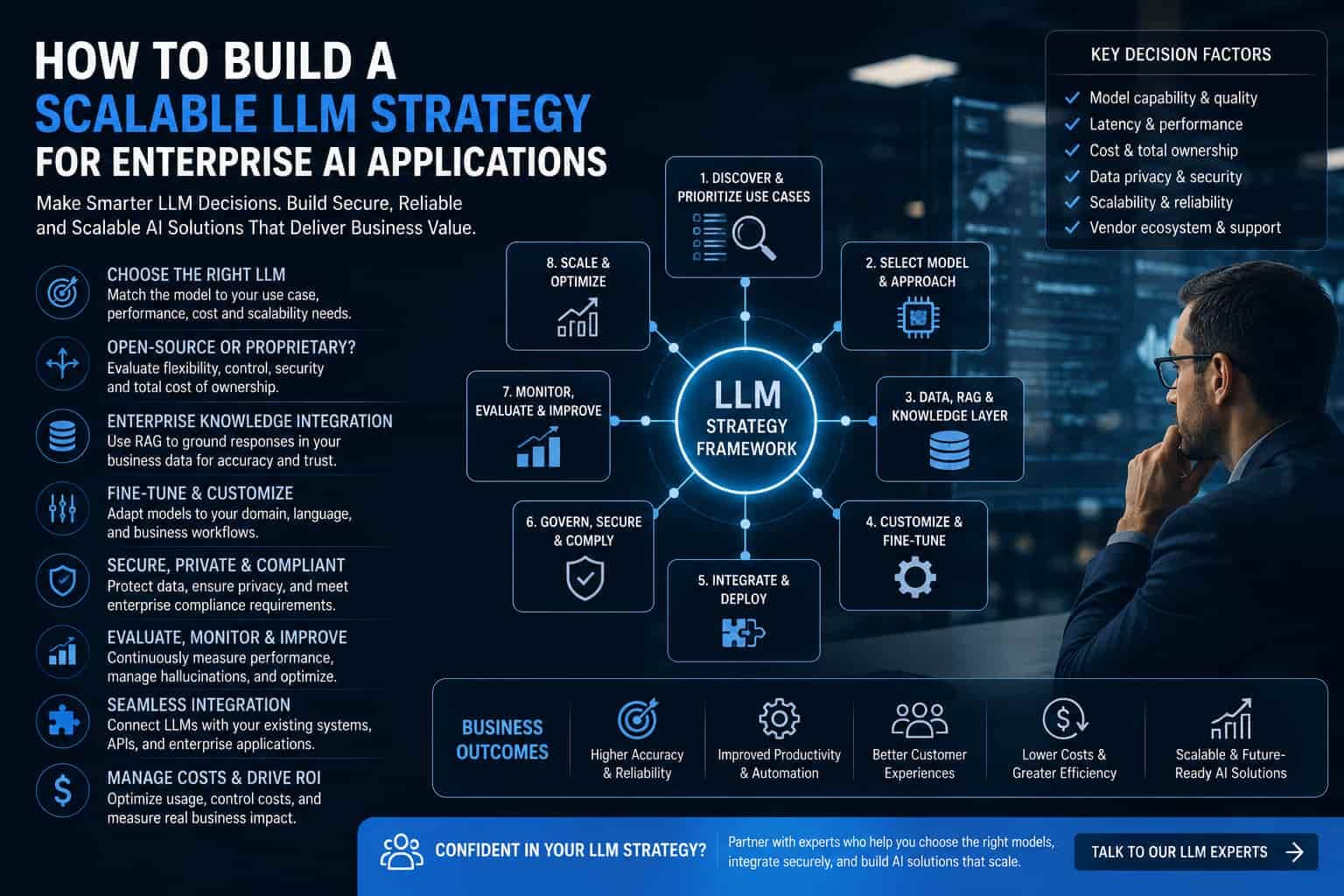
A scalable LLM strategy can follow eight stages:
1. Discover: Identify business opportunities and requirements.
2. Assess: Evaluate data, technology, security, and AI readiness.
3. Select: Benchmark models and architectures against the use case.
4. Design: Define RAG, fine-tuning, integration, and security requirements.
5. Build: Develop and test the LLM application.
6. Deploy: Release the application with appropriate governance and monitoring.
7. Measure: Track technical performance, adoption, cost, and business outcomes.
8. Scale: Expand successful applications and continuously optimize the architecture.
This framework helps enterprises move from isolated LLM experiments toward repeatable and scalable AI capabilities.
Frequently Asked Questions
1. What are LLM consulting services?
LLM consulting services help businesses evaluate, design, implement, integrate, secure, and optimize large language model solutions for specific enterprise use cases.
2. How should enterprises choose an LLM?
Enterprises should compare models based on the specific use case, including performance, accuracy, latency, cost, security, scalability, customization, and integration requirements.
3. When should a business use RAG instead of fine-tuning?
RAG is generally useful when an application needs access to changing or proprietary business information. Fine-tuning may be more appropriate when the organization needs to adapt model behavior for a specific task or domain.
4. How can enterprises control LLM costs?
Businesses can manage costs through model selection, workload routing, prompt optimization, caching, usage monitoring, and selecting appropriately sized models for individual tasks.
5. How can businesses reduce LLM hallucinations?
Organizations can combine RAG, high-quality data sources, structured prompts, model evaluation, output validation, monitoring, and human oversight to reduce and manage inaccurate outputs.
Build a Scalable LLM Strategy
Enterprise LLM adoption should not be driven by the latest model announcement alone. Sustainable value comes from choosing the right architecture for each business requirement and combining capable models with secure data, effective integration, strong evaluation, and continuous optimization. A structured LLM consulting approach can help organizations make these decisions with greater clarity while reducing unnecessary technology and implementation risks.
DashMindsAnalytics helps enterprises evaluate LLM opportunities, design scalable AI architectures, integrate LLMs with existing systems, and build secure AI applications aligned with measurable business goals. Talk to DashMindsAnalytics about your LLM strategy and discover how to turn enterprise AI opportunities into scalable, production-ready solutions.