How LLM Consulting Services Helped an Enterprise Build a Secure AI Knowledge Assistant
Client Situation
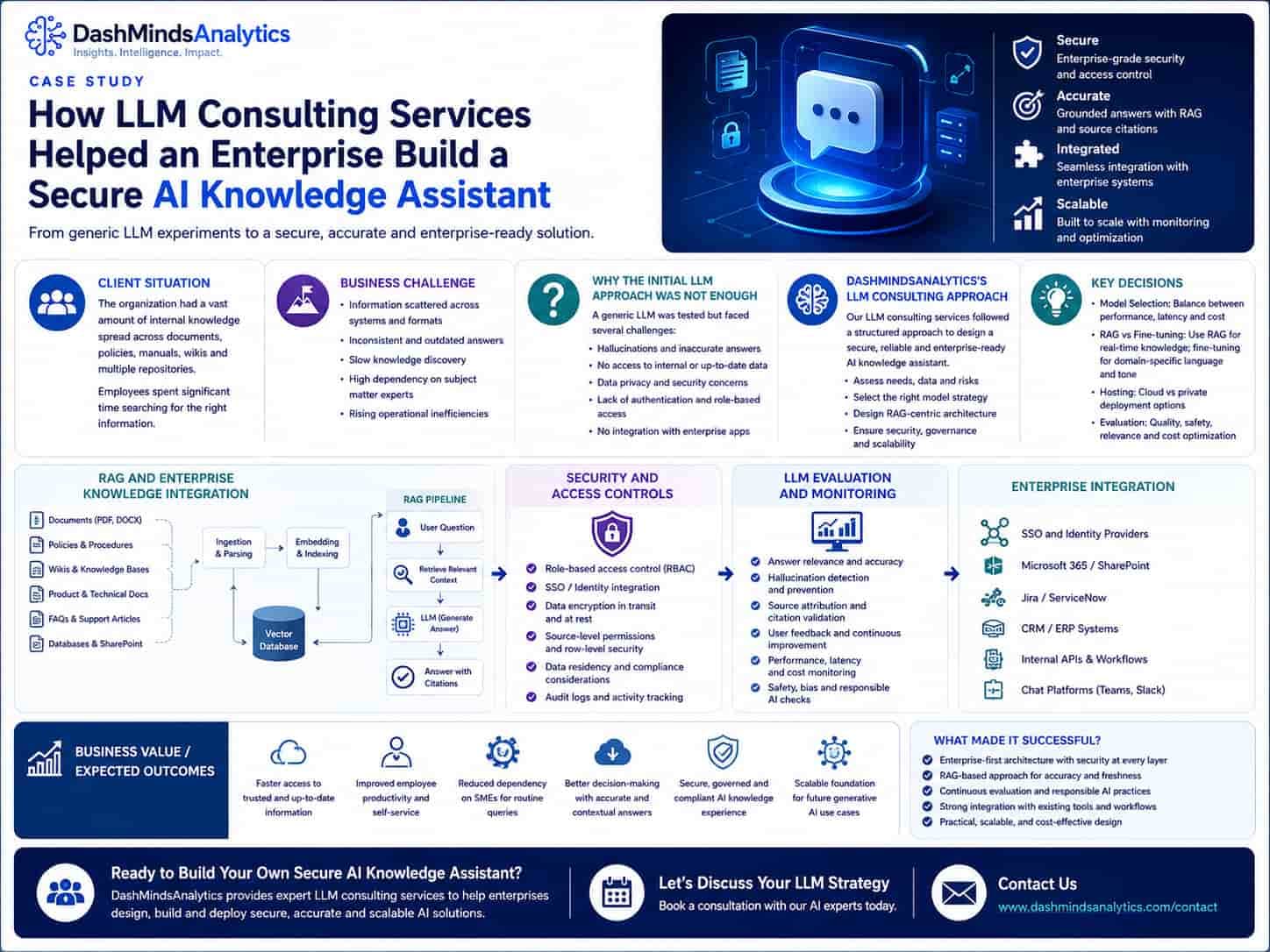
A representative enterprise had accumulated a large volume of internal knowledge across policy documents, product information, technical documentation, process guides, and digital repositories. Employees often spent significant time searching across systems to find accurate, current information. The organization began experimenting with large language models to create an internal knowledge assistant. Early results demonstrated potential, but leadership quickly recognized that a generic LLM could not simply be deployed as an enterprise-wide source of truth.
Business Challenge

Employees needed fast access to relevant information, but enterprise knowledge was distributed across multiple repositories and changed over time. The initial approach also raised concerns about inaccurate answers, outdated content, hallucinations, data privacy, and inconsistent access to sensitive information. The organization needed an enterprise LLM solution that could provide useful responses while respecting existing data boundaries, permissions, and governance requirements. This required more than selecting a model. It required a production-focused architecture and a clear strategy for LLM integration.
Why the Initial LLM Approach Was Not Enough
A standalone LLM had limited awareness of the organization's proprietary and frequently changing information. Fine-tuning alone was also not necessarily the right answer, particularly when knowledge needed to remain current or access had to vary by employee role.
DashMindsAnalytics used LLM consulting services to evaluate the practical gap between experimentation and enterprise deployment.
The assessment considered model selection, knowledge architecture, data quality, security, scalability, latency, and ongoing LLM costs. It also examined where RAG could provide grounded access to enterprise information and where LLM fine-tuning might be appropriate for specialized behavior or tasks.
DashMindsAnalytics's LLM Consulting Approach
The engagement began by identifying the highest-value employee knowledge needs and mapping the systems that contained relevant information. The LLM consulting approach evaluated:
- Business and employee use cases
- Model capabilities and deployment options
- Data quality and document readiness
- RAG versus fine-tuning requirements
- Security and access controls
- Evaluation and hallucination management
- Scalability, latency, and operational costs
This created a practical foundation for LLM development rather than treating the AI assistant as a simple chatbot project.
RAG and Enterprise Knowledge Integration
The proposed architecture used retrieval-augmented generation to connect the model with approved enterprise knowledge sources. When an employee submitted a question, the system could retrieve relevant, authorized information before generating a response. This approach helped ground answers in enterprise content and supported knowledge updates without retraining the model whenever documents changed.
DashMindsAnalytics also considered document processing, metadata, indexing, retrieval quality, and source references to improve the usefulness of the knowledge assistant.
Security and Access Controls
Security was designed into the solution architecture. Access controls could align with existing enterprise permissions so employees only retrieved information they were authorized to view. The solution also considered data privacy, secure model interactions, logging, retention requirements, and protections for sensitive information. These controls helped position the application as a more responsible enterprise AI solution.
LLM Evaluation and Monitoring
Production readiness required continuous evaluation. DashMindsAnalytics defined testing criteria for answer relevance, factual grounding, retrieval quality, latency, failure scenarios, and inappropriate or unsupported responses. Monitoring could help identify hallucination patterns, knowledge gaps, cost trends, and performance issues as usage expanded.
Enterprise Integration
The AI knowledge assistant was designed to fit existing employee workflows through approved LLM integration with enterprise applications, document platforms, portals, or collaboration tools. This reduced the need for employees to switch between disconnected systems and created a clearer path for future generative AI and AI automation initiatives.
Business Value / Expected Outcomes
A successful implementation could support [faster knowledge discovery], [improved access to approved enterprise information], [reduced manual searching], [greater consistency in knowledge access], and [a scalable foundation for future AI initiatives]. The broader value of LLM consulting services is helping organizations make the right architectural and operational decisions before scaling an AI application across the enterprise.

Have a technical challenge worth discussing?
Our practice leads are happy to talk through your specific situation with no sales pitch required.
Talk to an Expert →