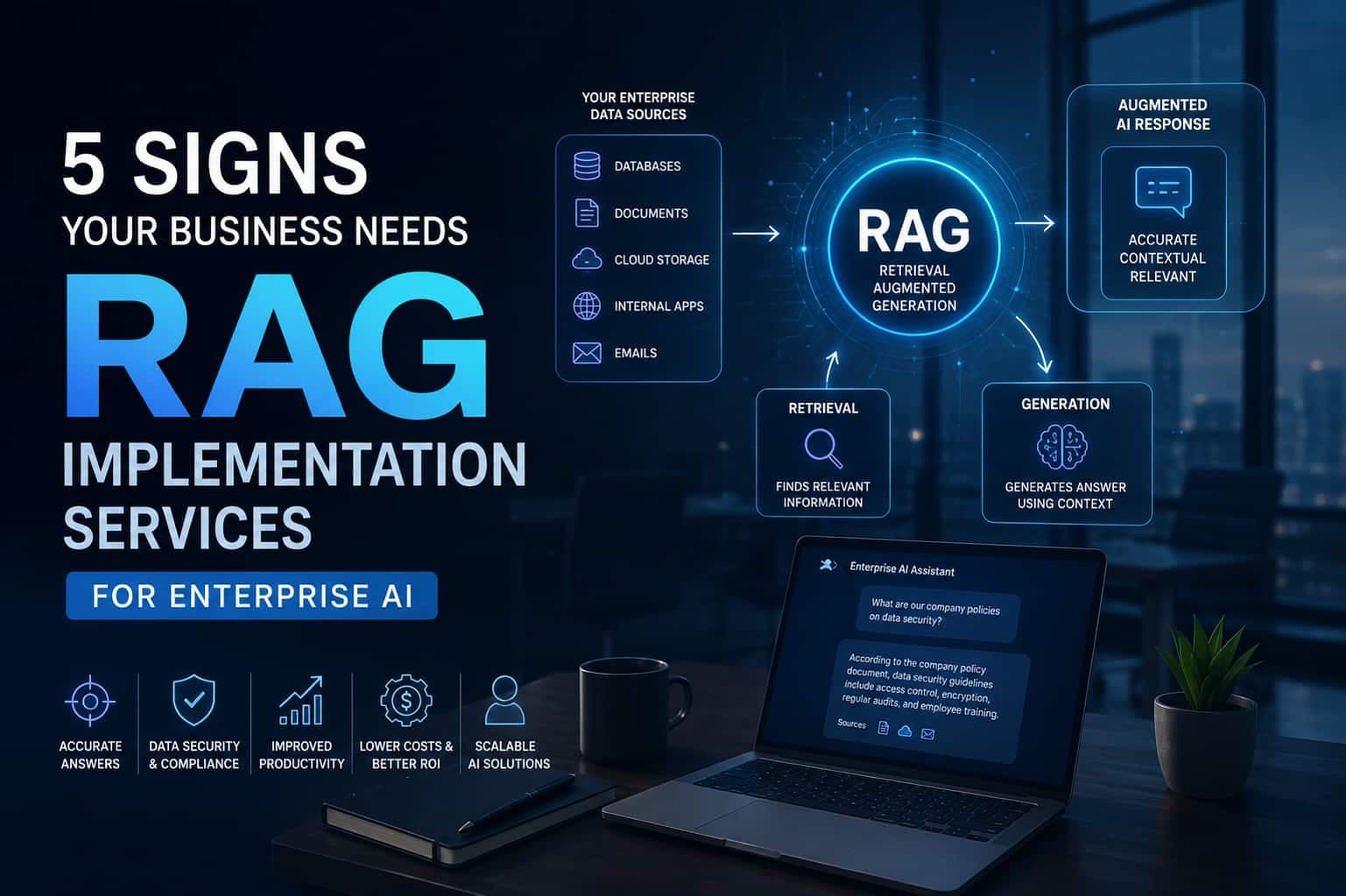
Enterprise AI is moving beyond experimentation. Businesses are increasingly using large language models (LLMs) to search knowledge, support employees, automate workflows, answer customer questions, and accelerate decision-making. Yet many organizations discover that a general-purpose LLM cannot reliably answer questions using their proprietary business information. This is where Retrieval-Augmented Generation (RAG) becomes valuable. RAG connects an LLM with trusted enterprise data by retrieving relevant information before generating a response. However, building an enterprise-ready RAG system involves much more than connecting documents to a vector database. Data preparation, document ingestion, chunking, embeddings, retrieval strategies, security, evaluation, and production deployment all influence the quality and reliability of the final system.
Here are five signs that your business may need RAG implementation services to move from AI experimentation to a reliable enterprise solution.
1. Your AI Application Cannot Reliably Use Proprietary Business Data

One of the clearest signs is that your AI application struggles to answer questions using internal information. Businesses often have valuable knowledge distributed across policies, product documentation, contracts, knowledge bases, technical manuals, reports, customer records, and other enterprise repositories. A general-purpose LLM does not automatically have access to this information, and simply uploading large amounts of content does not guarantee accurate responses. RAG addresses this challenge by creating a connection between enterprise information and the LLM.
A typical RAG workflow involves preparing business data, ingesting documents, dividing content into meaningful chunks, generating embeddings, storing those embeddings in a vector database, and retrieving relevant information when a user submits a query. The retrieved context is then provided to the LLM so it can generate a response based on relevant enterprise information. If your organization wants AI applications to work with frequently changing proprietary data without retraining the underlying model every time information changes, RAG implementation services can provide a structured path forward.
2. Your RAG Experiment Works in a Demo but Not in Production
A proof of concept can make RAG look deceptively simple. A few documents are uploaded, a question is entered, and the system produces an impressive answer. Problems often appear when the solution needs to support thousands of documents, multiple data sources, different user roles, higher query volumes, and continuously changing information. Production RAG requires careful attention to the entire data and AI pipeline.
Document ingestion needs to account for different file formats and source systems. Chunking strategies must preserve enough context while creating useful retrieval units. Embedding models need to represent enterprise content effectively. Vector search must return relevant results, while retrieval strategies may need filtering, reranking, metadata handling, or hybrid search. This is why moving from experimentation to production requires engineering discipline. A structured implementation approach helps businesses evaluate the complete RAG architecture rather than focusing only on the LLM component.
3. Your AI Responses Are Inconsistent or Difficult to Evaluate
An enterprise AI system cannot be considered reliable simply because it produces fluent responses. The important question is whether those responses are relevant, accurate, grounded in the available information, and appropriate for the user's query. Poor retrieval can cause an otherwise capable LLM to generate an incorrect response. If the wrong document or irrelevant chunk is retrieved, the model may produce an answer based on incomplete context. Businesses therefore need evaluation processes that examine both retrieval and generation.
Evaluation can include testing retrieval relevance, measuring answer quality, checking whether responses are grounded in source information, identifying hallucinations, and analyzing performance across representative enterprise queries. Organizations may also need to continuously monitor system behavior after deployment. If your team is spending significant time manually testing responses but does not have a systematic evaluation framework, it may be time to consider professional RAG implementation services.
4. Your Enterprise Data Requires Strong Security and Access Controls
Enterprise RAG introduces another important consideration: data security. A RAG system may connect an LLM to sensitive internal information. Not every employee, customer, or application should necessarily have access to the same documents. Security therefore needs to be considered throughout the architecture. Access controls, authentication, authorization, metadata filtering, data isolation, secure ingestion, encryption, logging, and monitoring may all be relevant depending on the application and regulatory environment.
For example, an employee asking about a company policy may need access to internal HR documentation, while another user should not be able to retrieve confidential financial or customer information. Security cannot be treated as an afterthought added after the RAG application has been built. It should be incorporated into data ingestion, retrieval, application logic, and deployment architecture.
5. You Need to Scale AI Across Multiple Enterprise Use Cases
Another major sign is that your organization wants to move beyond one AI chatbot or proof of concept. RAG can support a wide range of enterprise applications, including internal knowledge assistants, customer support systems, technical documentation assistants, employee helpdesks, research tools, and AI-powered search experiences. However, scaling these applications requires a repeatable architecture.
Businesses need to consider how new data sources will be added, how embeddings will be updated, how retrieval quality will be monitored, how models will be evaluated, and how infrastructure will scale as usage increases. A production-ready architecture can make it easier to expand RAG capabilities without rebuilding the entire system for every new use case.
Moving From RAG Experimentation to Reliable Enterprise AI
The difference between an impressive RAG demonstration and a dependable enterprise AI application often comes down to implementation quality. A practical RAG implementation should address the complete lifecycle—from data preparation and document ingestion to chunking, embeddings, vector search, retrieval, LLM integration, evaluation, security, monitoring, and production deployment. This is where DashMindsAnalytics takes a structured, engineering-driven approach.
Rather than treating RAG as simply an LLM integration project, DashMindsAnalytics can help organizations approach the solution as an end-to-end enterprise data and AI architecture. The focus is on understanding the business use case, preparing the underlying data, designing appropriate retrieval workflows, integrating the required models and infrastructure, evaluating performance, and creating a path toward production.
This approach also creates an important distinction from generic AI development providers. A generalist provider may focus primarily on connecting an LLM to an application, while an engineering-led RAG approach considers data architecture, retrieval quality, security, evaluation, scalability, and operational reliability together.
Build a More Reliable Enterprise RAG Solution
RAG can give enterprise AI applications access to relevant business knowledge, but successful implementation requires more than a simple chatbot and a vector database. If your business is struggling with proprietary data access, unreliable RAG experiments, inconsistent AI responses, enterprise security requirements, or the need to scale AI across multiple use cases, professional RAG implementation services can help create a more structured path from experimentation to production.
Ready to build a reliable RAG-powered enterprise AI application? Talk to a DashMindsAnalytics specialist about your RAG implementation requirements and explore an engineering-driven approach to building, evaluating, securing, and scaling your enterprise AI solution.