How a Healthcare Organization Could Build a Secure AI Knowledge Assistant With RAG
Business Challenge
A large healthcare organization could have extensive internal knowledge distributed across clinical guidelines, operating procedures, compliance documents, employee handbooks, policy repositories, training materials, and other enterprise knowledge sources. Although the information exists, employees may struggle to find accurate and current answers quickly. Traditional keyword search can make it difficult to locate relevant information across different repositories. At the same time, outdated documents and inconsistent content can create additional challenges when employees rely on internal knowledge for operational or administrative decisions.
The organization had already developed an initial Retrieval-Augmented Generation (RAG) proof of concept, but moving from a limited demonstration to a secure, scalable enterprise AI knowledge assistant presented several engineering challenges. The proof of concept needed stronger data preparation, retrieval quality, security controls, evaluation processes, and production architecture.
The organization therefore explored RAG implementation services to create a more reliable AI knowledge assistant while maintaining appropriate controls around sensitive enterprise information.
Approach

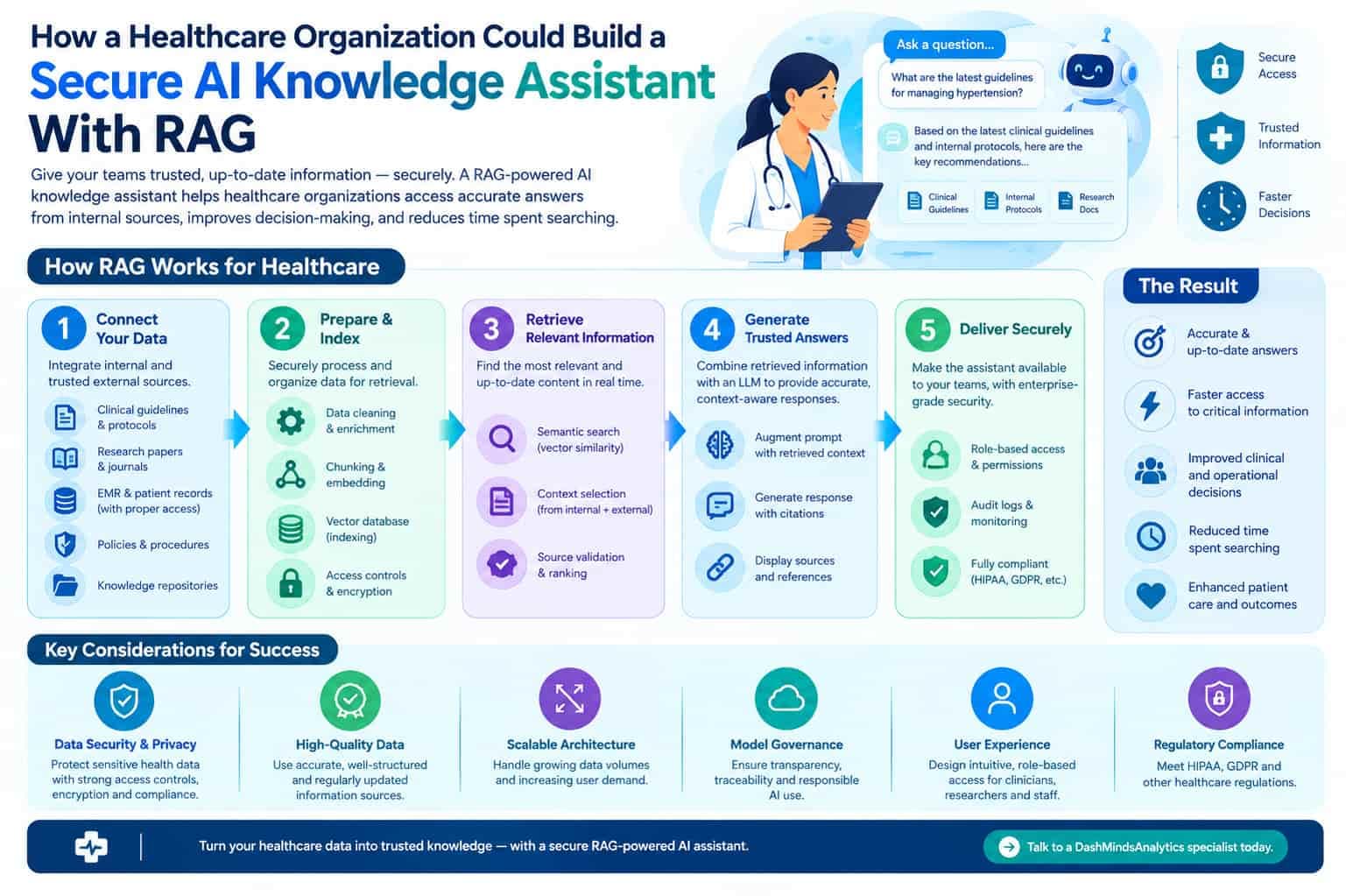
DashMindsAnalytics approached the initiative as an engineering and data architecture challenge rather than simply connecting an LLM to a vector database. The first step involved assessing the existing RAG proof of concept and identifying gaps across the complete retrieval and generation pipeline.
Data Preparation and Document Ingestion
The organization’s information sources were reviewed to determine which content should be included in the knowledge assistant. Documents were collected from relevant repositories and prepared for ingestion. The process included identifying outdated or duplicate content, extracting usable text, preserving important document metadata, and establishing rules for content updates. This created a cleaner foundation for downstream retrieval and helped the organization establish greater control over which information could be surfaced by the AI assistant.
Chunking and Embeddings
Documents were divided into meaningful content segments using chunking strategies designed around document structure and retrieval requirements. Embedding models were then used to convert relevant content into vector representations. Metadata could also be associated with individual chunks to support filtering based on factors such as document type, department, access permissions, or content status.
Vector Search and Retrieval
The RAG architecture incorporated vector search to identify content semantically related to an employee’s question. Rather than depending exclusively on similarity search, retrieval strategies could combine semantic retrieval, metadata filtering, ranking, and other contextual techniques where appropriate. This helped create a retrieval layer designed specifically for enterprise knowledge rather than relying on a basic RAG configuration.
LLM Integration and Evaluation
Retrieved information was passed to the selected large language model (LLM), allowing the assistant to generate responses grounded in enterprise-approved content.
DashMindsAnalytics also emphasized evaluation before production deployment. Representative questions could be used to assess retrieval relevance, answer quality, grounding, consistency, and failure scenarios.
This evaluation process helped the organization identify where retrieval or generation required further refinement.
Solution
DashMindsAnalytics designed a structured RAG architecture covering the complete flow from enterprise data sources to the AI knowledge assistant. The solution included controlled document ingestion, data preparation, intelligent chunking, embeddings, vector search, retrieval strategies, LLM integration, and evaluation workflows. Security was treated as a core architectural requirement. Access controls, data permissions, authentication, authorization, secure data handling, and appropriate separation of information were considered throughout the RAG pipeline. The architecture was also designed with production readiness in mind. Monitoring, logging, error handling, content refresh processes, evaluation workflows, scalability, and maintainability were considered so the organization could move beyond its initial proof of concept.
DashMindsAnalytics vs. Generic AI Development Providers
A generic AI development provider may focus primarily on connecting an LLM with a vector database and demonstrating a working chatbot. DashMindsAnalytics takes a more structured, engineering-driven approach to RAG implementation services, considering the entire system—from data quality and ingestion through retrieval, security, evaluation, monitoring, and production deployment. This distinction is important for healthcare and other organizations where an AI assistant must be designed around controlled enterprise information rather than simply producing conversational responses.
Expected Business Value
A properly engineered RAG knowledge assistant could help the organization create a more accessible interface for finding information across approved internal knowledge sources. Expected business value could include:
- Easier access to relevant enterprise information
- Better organization of distributed knowledge
- More consistent retrieval of current internal content
- A scalable foundation for enterprise AI use cases
- Greater visibility into retrieval and response quality
- Stronger security and access-control considerations
- A clearer path from RAG proof of concept to production
The actual business impact would depend on factors such as data quality, content governance, retrieval performance, user adoption, security requirements, and the organization’s implementation environment.
Conclusion
Building an enterprise AI knowledge assistant requires more than selecting an LLM and adding vector search. Healthcare organizations must consider data preparation, retrieval quality, security, evaluation, scalability, and production readiness as interconnected engineering requirements. DashMindsAnalytic’s structured approach to RAG implementation services helps organizations move from experimental RAG solutions toward thoughtfully engineered enterprise AI systems.

Have a technical challenge worth discussing?
Our practice leads are happy to talk through your specific situation with no sales pitch required.
Talk to an Expert →