
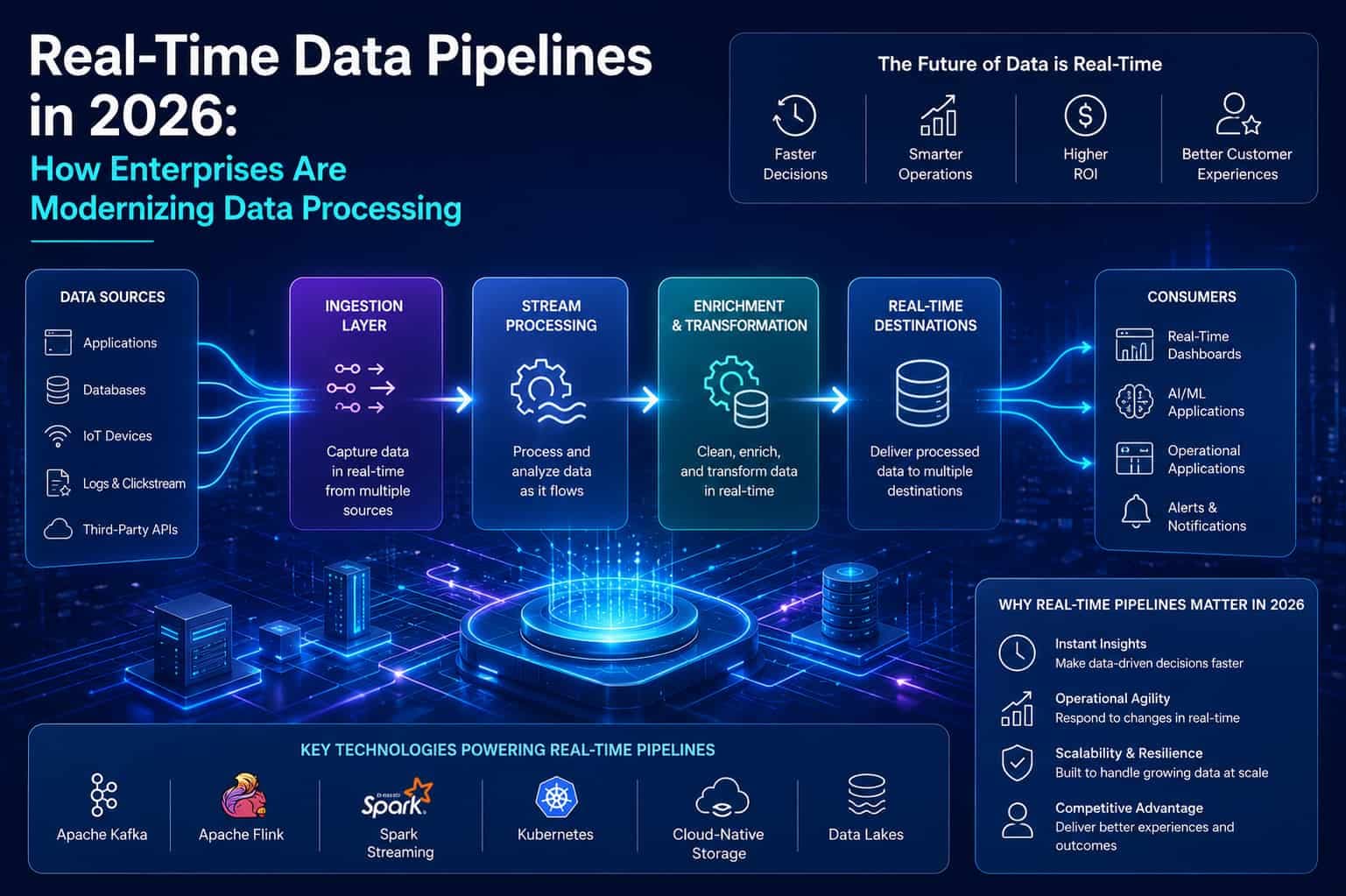
Enterprises are generating data continuously. Customer interactions, financial transactions, connected devices, applications, websites, business systems, and digital platforms can produce new information every second. For many organizations, processing this information once or several times a day is no longer sufficient.
Businesses increasingly need data while it is still relevant.
This is driving greater interest in real-time data pipelines. Instead of waiting for scheduled batch jobs to process information, real-time architectures can ingest, process, and deliver data with minimal delay. This can support faster analytics, responsive customer experiences, AI applications, fraud detection, operational monitoring, and data-driven decision-making.
However, implementing real-time data processing is not simply a matter of adding a streaming platform. Enterprises need to consider architecture, data ingestion, processing, integration, scalability, monitoring, security, data quality, and reliability.
What Are Real-Time Data Pipelines?

A real-time data pipeline continuously moves and processes data as events occur. For example, when a customer completes a transaction, an application generates an event. A real-time pipeline can capture that event, process the information, apply business rules, and make the resulting data available to downstream applications or analytics systems. Traditional batch pipelines typically collect data over a period and process it according to a schedule. Real-time pipelines are designed for situations where reducing the delay between data creation and data availability provides meaningful business value. The right architecture depends on the organization's requirements. Not every workload needs real-time processing.
When Do Enterprises Need Real-Time Data Processing?
One of the first questions businesses should ask is whether real-time data actually solves an important business problem. Real-time processing may be valuable when decisions depend on current information.
Common use cases include:
- 1. Fraud and suspicious transaction detection
- 2. Real-time customer personalization
- 3. Operational monitoring
- 4. Inventory visibility
- 5. Application and system monitoring
- 6. IoT and connected-device data
- 7. Real-time financial analytics
- 8. Customer support automation
- 9. AI-powered applications
- 10. Recommendation systems
- 11. Event-driven business workflows
For example, a retailer may not need real-time processing for a monthly financial report. However, it may need real-time inventory information to prevent overselling products. The objective should therefore be business-driven real-time processing, rather than adopting streaming technology simply because it is modern.
Streaming Data Ingestion
Real-time pipelines begin with reliable data ingestion. Data may originate from applications, databases, APIs, message brokers, IoT devices, cloud platforms, or enterprise systems. These sources can produce different types and volumes of events. Streaming ingestion allows data to be captured continuously rather than waiting for a scheduled extraction process. A well-designed ingestion layer needs to consider event formats, throughput, ordering, duplication, failure handling, schema changes, and data delivery requirements. Poor ingestion design can create downstream reliability problems even when the rest of the pipeline is well engineered.
Event-Driven Architecture
Many real-time data environments use event-driven architectures. Instead of applications constantly polling systems for changes, events can be produced when something happens. Other services or data pipelines can consume those events and perform the required processing. This approach can help decouple systems and enable organizations to respond to business events more quickly. For enterprises, however, event-driven architecture also introduces additional considerations around event schemas, message delivery, ordering, retries, failures, and system dependencies. These architectural decisions need to be planned rather than added incrementally without a broader design.
Real-Time Data Processing
Once data has been ingested, it needs to be processed. Processing may involve filtering events, enriching records, joining information from different sources, applying business rules, aggregating data, detecting anomalies, or preparing information for downstream systems. The processing layer should be designed according to the required latency, data volume, complexity, and reliability requirements. Some applications may need extremely low latency, while others may simply need information to become available within seconds or minutes. Defining these requirements early helps prevent unnecessary architectural complexity.
Integrating With Enterprise Systems
Real-time data rarely exists in isolation. Enterprises may need to connect streaming data with CRM systems, ERP platforms, databases, data warehouses, data lakes, lakehouses, analytical applications, and AI platforms. Integration therefore becomes an important part of real-time pipeline architecture. Organizations need to determine where processed events should go, how data should be transformed for each destination, and how failures or unavailable downstream systems should be handled. A reliable integration strategy helps prevent real-time pipelines from becoming another collection of disconnected systems.
Designing for Scalability
Data volumes can change rapidly. A successful real-time pipeline needs to handle increasing event rates without creating unacceptable delays or failures. Scalability considerations can include processing capacity, storage, partitioning, workload distribution, infrastructure resources, and system bottlenecks. Enterprises should also consider future growth rather than designing only for current traffic. A pipeline that performs well today may struggle when transaction volumes or application usage increases significantly.
Monitoring and Observability
Real-time systems require strong visibility because problems can affect downstream applications almost immediately. Monitoring should provide insight into pipeline health, processing latency, throughput, failures, resource usage, and unusual behavior. Organizations can also establish alerts for conditions such as increasing processing delays, failed events, missing data, or unexpected changes in volume. Observability makes it easier for engineering teams to identify issues before they create larger business problems.
Maintaining Data Quality
Speed does not make poor-quality data useful. Real-time pipelines still need mechanisms for validating incoming information and identifying anomalies. Data quality controls may include schema validation, duplicate detection, required-field checks, format validation, business-rule validation, and monitoring for unexpected data patterns. Organizations should determine how invalid or incomplete events are handled without unnecessarily stopping the entire pipeline. This balance between data quality and continuous processing is an important part of real-time architecture.
Security and Governance
Real-time data environments may process sensitive customer, financial, operational, or business information. Security therefore needs to be incorporated throughout the pipeline. Organizations should consider authentication, authorization, encryption, access controls, data masking, auditing, and appropriate data retention policies. Governance is also important for understanding where data comes from, how it moves through the environment, who can access it, and how it is being used. Building these capabilities into the architecture from the beginning is generally more effective than attempting to add them after deployment.
Reliability and Failure Management
Real-time pipelines need to continue operating when individual components fail. Failures can occur at the data source, ingestion layer, processing layer, network, infrastructure, or destination. A reliable architecture can incorporate retries, buffering, recovery mechanisms, fault isolation, error handling, and appropriate backup strategies. Organizations should also determine how events are handled when downstream systems become temporarily unavailable. Reliability planning helps prevent a single component from bringing an entire real-time data workflow to a halt.
Real-Time Pipelines for Analytics and AI
One of the biggest drivers of real-time data adoption is the growing demand for faster analytics and AI. Analytics applications can use current information to support operational decisions. AI systems can use timely data to provide more relevant recommendations, detect changes, and support automated workflows. For example, an enterprise AI application may need access to current operational information rather than yesterday's data. A real-time pipeline can help deliver relevant events to the systems responsible for analytics or AI processing. The quality of these applications ultimately depends on the quality and reliability of the underlying data architecture.
How Enterprises Can Modernize Data Processing
Modernizing data processing should begin with an assessment of existing requirements and architecture. Businesses can identify which workloads genuinely require real-time processing, evaluate current data sources and pipelines, identify latency and reliability bottlenecks, and define an architecture that balances performance with cost and complexity. A phased modernization strategy can also reduce operational risk. Organizations may begin with high-value use cases, establish reusable streaming capabilities, and gradually expand real-time processing to additional applications.
DashMindsAnalytics Approach to Real-Time Data Pipeline Services
DashMindsAnalytics takes a data-driven and engineering-disciplined approach to real-time data pipeline services.
Rather than treating streaming as a standalone technology implementation, the approach considers the complete data lifecycle, including ingestion, processing, enterprise integration, scalability, monitoring, data quality, security, governance, and reliability.
This creates an important distinction from generalist data engineering providers. A generalist provider may implement a streaming component as part of a broader technology project, while a specialized approach focuses specifically on real-time architecture, data flow reliability, processing requirements, observability, scalability, and long-term maintainability.
The result is a more structured path toward real-time data capabilities that can support analytics, AI, customer experiences, and operational decision-making.
Preparing for the Next Generation of Data Processing
Real-time data processing is becoming increasingly important for enterprises that need faster access to operational and analytical information. But not every workload needs to be real-time, and successful implementation requires more than streaming data from one system to another.
Organizations need to evaluate their use cases, design appropriate event-driven architectures, establish reliable ingestion and processing, integrate enterprise systems, and build strong capabilities for scalability, monitoring, security, data quality, and failure management.
With the right architecture, real-time data pipeline services can help businesses turn continuously generated data into timely information for analytics, AI, customer experiences, and operational decisions.
Ready to modernize your enterprise data processing? Talk to a DashMindsAnalytics specialist about your real-time data pipeline requirements and explore an engineering-driven approach to building scalable, reliable, and production-ready real-time data infrastructure.