
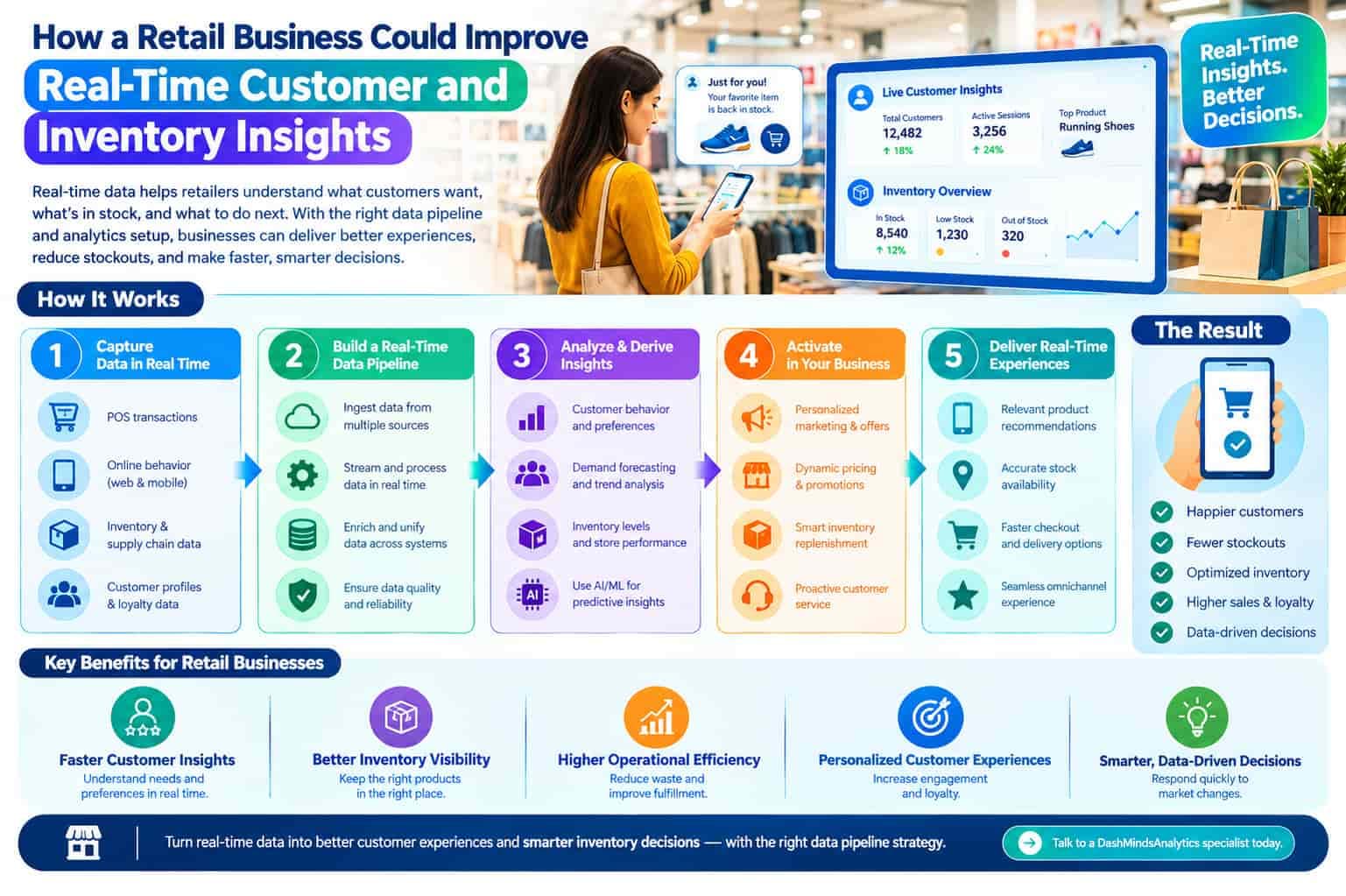
How a Retail Business Could Improve Real-Time Customer and Inventory Insights
Business Challenge
A growing retail enterprise could be managing customer, inventory, order, and transaction data across multiple systems, including e-commerce platforms, point-of-sale systems, inventory applications, customer platforms, and operational databases.
Much of this information was processed through batch-oriented workflows. As a result, business teams could experience delays between an operational event and when that information became available for analytics or reporting.
For example, inventory changes might not immediately appear across connected systems, while customer activity and transaction data could take significant time to reach analytical environments. Fragmented integrations and unreliable data workflows could further complicate access to current operational information.
At the same time, the business was exploring real-time analytics and AI applications that required faster access to relevant data. The organization needed to determine which workloads genuinely required real-time processing and which could continue using scheduled or batch workflows.
The retailer therefore explored real-time data pipelines to modernize its data processing architecture without introducing unnecessary technical complexity.
Approach

DashMindsAnalytics began by evaluating the organization’s existing data architecture, business workflows, data sources, latency requirements, and downstream applications. Rather than assuming every workload needed real-time processing, the assessment focused on identifying where faster data availability could provide meaningful operational value.
Identifying Real-Time Requirements
Different workloads were evaluated based on factors such as business urgency, acceptable data latency, event frequency, dependencies, and downstream use cases. Customer activity, inventory changes, order events, and selected operational processes could potentially benefit from near-real-time or real-time processing, while historical reporting and some analytical workloads could remain batch-based. This workload-based approach helped avoid adding streaming infrastructure where it was not necessary.
Solution
DashMindsAnalytics could design a real-time data architecture based on the retailer’s specific requirements and existing technology environment.
Streaming Data Ingestion
Relevant events from transactional and operational systems could be captured through streaming ingestion mechanisms. Instead of waiting for scheduled extraction jobs, selected business events could flow continuously into downstream processing systems.
Event-Driven Architecture
An event-driven architecture could allow systems to respond to important business events as they occur. For example, inventory updates, order activity, or customer interactions could trigger downstream processing and make relevant information available to analytics applications more quickly.
Real-Time Data Processing
Streaming data processing could transform, validate, enrich, and route events according to business requirements. The architecture could support different processing patterns depending on the use case, while maintaining appropriate separation between real-time workloads and workloads that are better suited to batch processing.
Enterprise System Integration
DashMindsAnalytics could connect relevant retail systems to the data pipeline architecture, creating controlled data flows between operational platforms and analytical environments. The integration strategy would consider existing systems, APIs, databases, event sources, and downstream consumers.
Scalability, Monitoring, and Reliability
The architecture could be designed to handle changing event volumes and business requirements without creating unnecessary operational complexity. Monitoring and observability would provide visibility into processing performance, pipeline failures, latency, and system health. Reliability mechanisms could include appropriate error handling, retry strategies, and recovery processes. Data quality controls could also be incorporated to validate incoming events and help prevent unreliable information from reaching downstream systems.
Security
Security would be considered throughout the architecture, including access controls, authentication, authorization, data protection, and appropriate handling of sensitive customer and operational information.
DashMindsAnalytics vs. Generalist Data Engineering Providers
A generalist data engineering provider may recommend streaming technology broadly without first determining whether real-time processing is necessary for each workload. DashMindsAnalytics takes a data-driven and engineering-disciplined approach to real-time data pipeline services, first evaluating business requirements and latency needs before selecting an architecture. This helps organizations avoid unnecessary streaming complexity while ensuring genuinely time-sensitive workloads receive the infrastructure they require.
Expected Business Value
A properly designed real-time data environment could help the retailer establish faster access to operational information and create a stronger foundation for real-time analytics and AI applications.
Potential business value could include:
- Faster access to relevant customer and inventory information
- Improved visibility into operational events
- More responsive analytics workflows
- Better support for selected real-time AI use cases
- Improved pipeline monitoring and reliability
- Greater scalability for event-driven workloads
- Stronger data quality and security controls
- A balanced architecture combining real-time and batch processing
Actual outcomes would depend on the retailer’s existing systems, data volumes, latency requirements, technology environment, and implementation strategy.
Conclusion
Real-time data processing can provide significant value for retail organizations, but not every workload needs to operate in real time. Attempting to stream everything can increase architectural complexity, operational overhead, and costs without delivering proportional business value.
DashMindsAnalytic’s real-time data pipeline services focus on understanding business requirements first, then designing an appropriate combination of streaming, event-driven, and batch processing architectures.

Have a technical challenge worth discussing?
Our practice leads are happy to talk through your specific situation with no sales pitch required.
Talk to an Expert →