
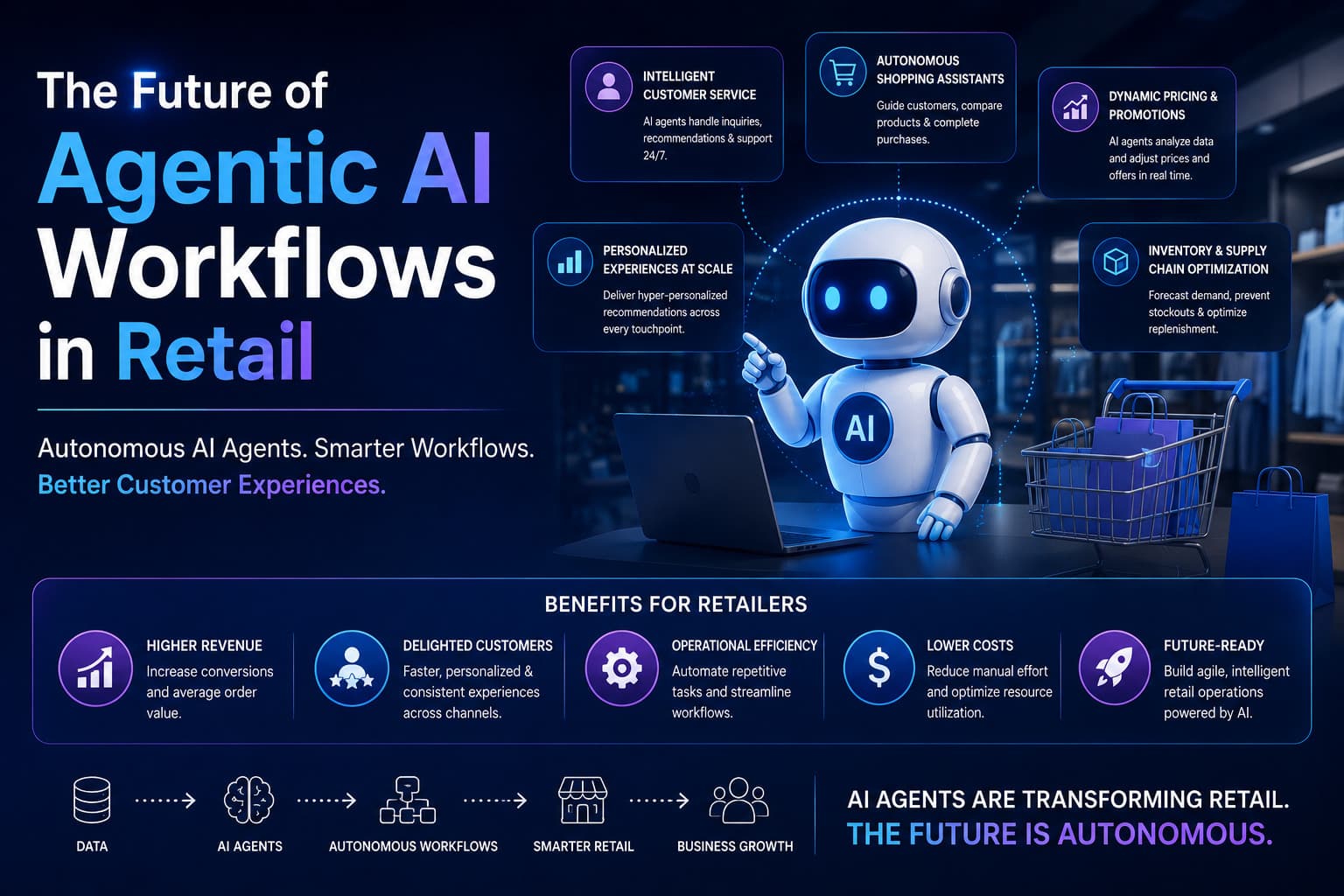
The Future of Agentic AI Workflows in Retail
Retail is becoming increasingly data-driven, automated, and customer-centric. From inventory management and personalized recommendations to customer service and supply chain optimization, artificial intelligence is changing how retailers operate. The next major development is agentic AI workflows retail, where AI agents can understand goals, make decisions, use business tools, and complete multi-step tasks with limited human intervention. Unlike traditional automation, which generally follows predefined rules, agentic AI can dynamically determine the next action based on changing conditions. As retailers look for faster and more intelligent operations, agentic AI workflows are expected to become an important part of modern retail technology strategies.
What Are Agentic AI Workflows in Retail?

Agentic AI workflows combine AI agents, business data, automation tools, and enterprise systems to complete complex retail processes. For example, a traditional inventory system may alert a retailer when stock falls below a specific threshold. An agentic AI workflow can go further. It may identify the inventory shortage, analyze sales trends, check supplier availability, recommend an order quantity, initiate a purchase request, and notify the appropriate employee. This ability to reason across multiple steps makes agentic AI workflows retail applications particularly useful for dynamic business environments.
Common Retail Problems Agentic AI Can Solve
Retailers deal with several operational and customer-related challenges.
1. Complex Inventory Management
Managing inventory across stores, warehouses, and ecommerce channels can be difficult. Overstocking increases holding costs, while stockouts can result in lost sales. Agentic AI can analyze:
- Historical sales
- Current inventory
- Customer demand
- Seasonal patterns
- Supplier information
- Promotional campaigns
Based on this information, AI agents can recommend or initiate appropriate inventory actions.
2. Slow Customer Support
Customers expect quick and personalized responses. Traditional customer service systems may struggle when requests involve multiple steps or require information from different systems. Agentic AI can understand customer intent, retrieve information, check order status, process eligible requests, and escalate complex cases to human employees.
3. Fragmented Retail Operations
Retailers often use separate systems for ecommerce, CRM, inventory, logistics, marketing, and customer service. When these systems are disconnected, employees spend considerable time moving information between platforms. AI agents can connect different business tools and coordinate workflows, helping create more integrated retail operations.
How Agentic AI Workflows Transform Retail
The future of retail AI is moving from simple task automation toward goal-oriented systems.
Intelligent Customer Service
AI agents can provide personalized assistance throughout the customer journey.
For example, an agent could:
- Understand a customer's question.
- Review their purchase history.
- Check current inventory.
- Recommend relevant products.
- Provide delivery information.
- Escalate the issue if necessary.
This can create faster and more context-aware customer experiences.
Automated Inventory Optimization
Inventory is one of the strongest areas for AI-powered retail automation. An agent can continuously monitor demand and identify potential inventory issues. Rather than simply sending an alert, it can recommend actions based on business rules, sales forecasts, supplier data, and current stock levels. This can help retailers reduce stockouts, minimize excess inventory, and improve inventory turnover.
Personalized Product Recommendations
Generative AI and machine learning already support recommendation systems, but agentic AI can make personalization more dynamic. An AI agent can consider customer preferences, browsing behavior, purchase history, product availability, and current promotions to create personalized recommendations. The result can be a more relevant ecommerce experience.
Benefits of Agentic AI Workflows in Retail
Implementing agentic AI can provide several potential benefits.
Improved Operational Efficiency
AI agents can automate repetitive, multi-step processes and reduce the amount of manual coordination required from employees.
Faster Decision-Making
Retail environments change quickly. Agentic AI can process large amounts of information and support faster operational decisions.
Better Customer Experiences
AI-powered personalization and intelligent customer service can make interactions faster and more relevant.
Reduced Operational Costs
Automating repetitive processes can reduce manual effort and help employees focus on higher-value responsibilities.
Scalable Automation
Unlike isolated automation scripts, agentic AI workflows can potentially coordinate multiple systems and processes, making them suitable for larger retail environments.
Agentic AI vs Traditional Retail Automation
Traditional automation typically follows predefined instructions: Trigger → Rule → Action
Agentic AI introduces a more flexible approach: Goal → Analyze → Plan → Act → Evaluate
For example, traditional automation might automatically send a low-stock notification. An agentic workflow could identify the low-stock situation, analyze expected demand, review supplier information, determine the appropriate response, and request approval for replenishment. However, this does not mean every retail process should become fully autonomous. Simple, predictable processes may still be better suited to traditional automation.
Practical Tips for Implementing Agentic AI in Retail
Retailers should take a structured approach when adopting this technology.
Start With a Clear Business Problem
Do not implement agentic AI simply because it is a current technology trend. Identify a specific problem with measurable business value. Good starting points may include customer service, inventory monitoring, order management, or internal knowledge workflows.
Connect Reliable Data Sources
Agentic AI requires access to relevant and trustworthy information. Retailers should evaluate:
- Product data
- Customer data
- Inventory information
- Order information
- Supplier data
- Pricing information
Strong data governance is essential for reliable AI decision-making.
Establish Human Oversight
Not every AI decision should happen without human review. Retailers should define which actions AI agents can perform independently and which actions require employee approval. For example, an AI agent might automatically recommend a purchase order but require approval before placing a high-value order.
Monitor AI Performance
Retail businesses should continuously measure agentic AI workflows using appropriate KPIs. Important metrics can include:
- Task completion rate
- Response time
- Automation rate
- Customer satisfaction
- Error rate
- Cost savings
- Employee productivity
- Conversion rate
Monitoring helps organizations identify problems and improve workflows over time.
Security and Governance Challenges
The adoption of agentic AI also introduces new risks. Because AI agents may interact with business systems and execute actions, retailers need strong security controls.
Important considerations include:
- Data privacy
- Identity and access management
- API security
- Audit trails
- Human approval controls
- AI governance
- Regulatory compliance
- Model monitoring
Retailers should follow the principle of least privilege, giving AI agents only the access they need to perform their assigned tasks.
What Is the Future of Agentic AI Workflows in Retail?
The future is likely to involve increasingly connected AI agents working across different retail functions. Instead of having separate AI tools for customer service, inventory, marketing, and supply chain management, retailers may develop interconnected agentic workflows. For example, a change in customer demand could trigger coordinated actions across several departments. An AI agent could identify the trend, notify inventory systems, adjust recommendations, inform marketing workflows, and support supply chain planning. DashMinds Analytics helps organizations explore agentic AI, data engineering, and intelligent workflow solutions that connect enterprise systems and turn AI capabilities into practical business outcomes. This evolution could move retail organizations toward more autonomous and adaptive operations. However, successful adoption will depend on more than AI capabilities. Retailers will also need high-quality data, strong system integration, clear governance, security controls, and well-defined business objectives. DashMindsAnalytics can help businesses build the data and AI foundations needed to support secure, scalable, and connected agentic workflows.
Frequently Asked Questions
What are agentic AI workflows in retail?
Agentic AI workflows use AI agents to understand goals, analyze information, make decisions, and complete multi-step retail tasks across connected business systems.
How can agentic AI improve retail operations?
Agentic AI can support inventory management, customer service, order processing, product recommendations, supply chain coordination, and other business workflows.
What is the difference between AI agents and traditional automation?
Traditional automation generally follows predefined rules, while AI agents can interpret goals, reason through multiple steps, adapt to changing information, and take actions within authorized systems.
Is agentic AI suitable for every retail process?
No. Simple and predictable processes may be better handled by traditional automation. Agentic AI is particularly useful for complex workflows involving multiple decisions or systems.
How should retailers prepare for agentic AI?
Retailers should start with clear business use cases, improve data quality, integrate relevant systems, establish security and governance controls, and define human oversight requirements.
Conclusion
The future of agentic AI workflows retail is centered on intelligent, connected, and increasingly autonomous business operations. AI agents can help retailers address challenges such as fragmented systems, inventory complexity, slow customer support, and manual workflows. The greatest value will come from using agentic AI strategically rather than automating everything. Retailers that combine reliable data, strong governance, human oversight, and measurable business objectives can build AI workflows that improve efficiency while delivering better customer experiences. As agentic AI technology continues to evolve, its role in retail is likely to expand from individual automated tasks toward coordinated workflows that support entire business processes.