
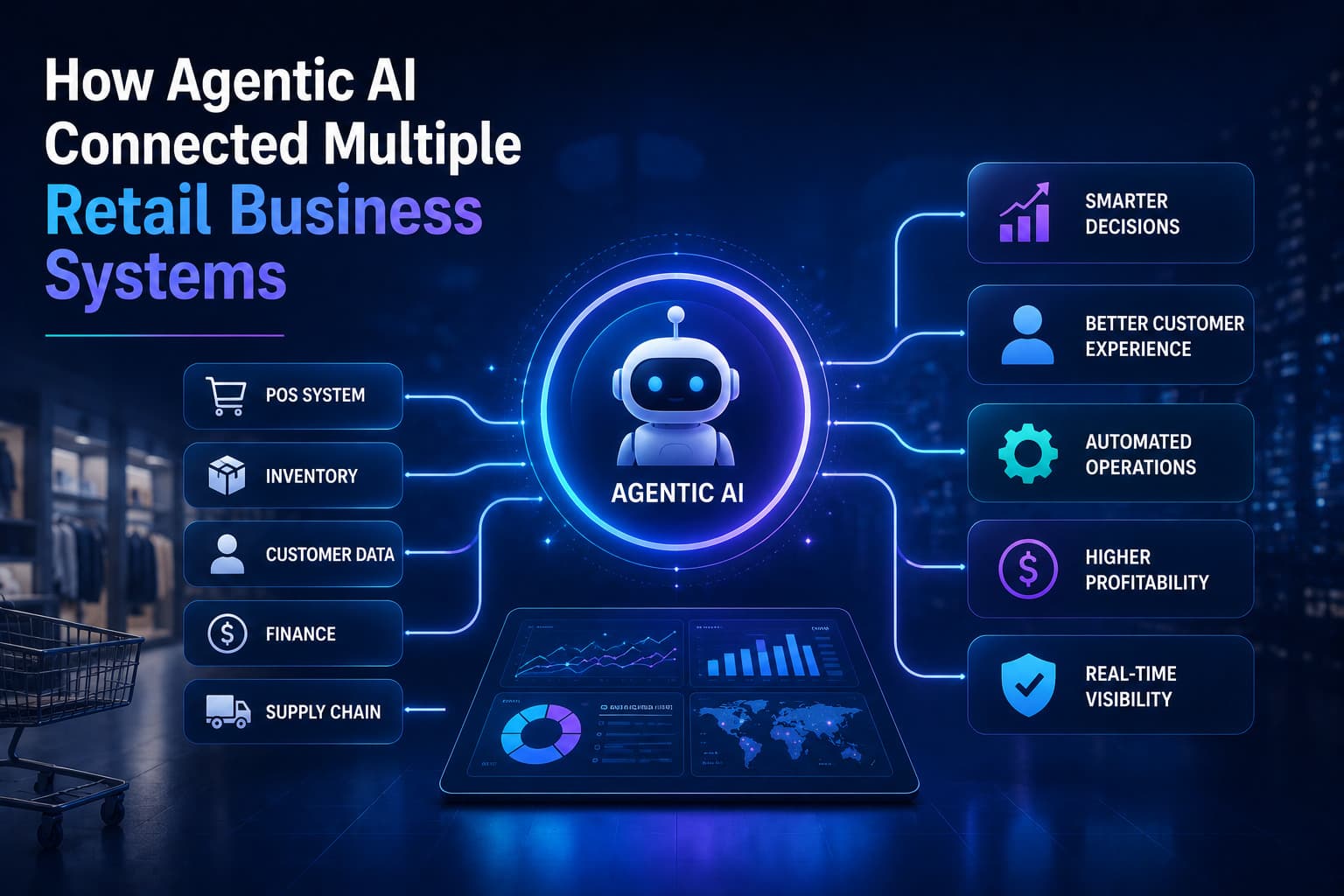
How Agentic AI Connected Multiple Retail Business Systems
Retail businesses increasingly rely on multiple digital systems to manage sales, inventory, customer relationships, orders, marketing, and supply chain operations. While these systems provide valuable functionality, operating them separately can create data silos and inefficient workflows. This case study explores how a retail business addressed disconnected systems by adopting an agentic AI workflow approach. Client-specific information and measurable results are not provided, so unsupported statistics and claims have been avoided.
Business Challenge: Disconnected Retail Systems

The retailer was using separate platforms for ecommerce, CRM, inventory management, order processing, customer support, and marketing. Although each system performed its individual function, information did not always move efficiently between them. Employees often had to manually retrieve information, check multiple platforms, and coordinate actions across departments. The business wanted to improve operational efficiency while creating a more connected customer experience. This challenge became particularly relevant as Agentic AI Workflows Retail solutions emerged as an approach for coordinating complex, multi-step business processes.
Options Considered
The business considered several possible approaches.
Traditional System Integration
APIs and middleware could connect individual platforms. This would improve data exchange but still require predefined workflows for many business processes.
Conventional Automation
Rule-based automation could handle predictable tasks such as sending notifications or updating records. However, it would be less suitable for workflows requiring contextual decisions across multiple systems.
Agentic AI Workflows
Agentic AI offered a more flexible approach. AI agents could interpret business goals, retrieve information from authorized systems, determine appropriate next steps, and coordinate actions across connected platforms. For workflows involving multiple decisions and systems, this approach offered greater potential than simply connecting applications through fixed rules.
Why Agentic AI Was the Chosen Approach
The retailer selected an agentic AI approach because the primary challenge was not simply data transfer. The business needed better coordination between systems. For example, an order-related workflow could require information from the ecommerce platform, inventory system, CRM, and customer support platform.
An agentic workflow could coordinate these steps: Customer request → Data retrieval → Context analysis → Decision → System action → Confirmation Human approval could remain part of the workflow for sensitive or high-value actions.
Implementation Approach
1. Mapping Existing Workflows
The first step was identifying repetitive processes that required employees to interact with multiple systems. Potential workflows included order inquiries, inventory checks, customer service requests, and product availability.
2. Connecting Business Systems
Relevant systems were connected through APIs and approved integration mechanisms. The objective was to allow AI agents to securely retrieve and exchange necessary information without giving unrestricted access.
3. Defining Agent Responsibilities
Each AI workflow was given a clearly defined purpose and boundaries. The system was configured to determine which actions could be automated and which required human review.
4. Adding Governance and Security
Access controls, authentication, monito ring, audit trails, and data protection requirements were incorporated into the implementation. This was particularly important because agentic AI can interact with business systems and potentially trigger actions.
5. Testing and Optimization
The workflows were tested against different scenarios before broader deployment. Performance, accuracy, exceptions, and human escalation requirements were reviewed and refined.
Business Value
Connecting retail systems through agentic AI workflows can create value in several areas.
Reduced manual coordination: Employees can spend less time moving between platforms and gathering information.
Faster workflows: AI agents can coordinate multiple steps without requiring employees to manually initiate every action.
Better information access: Employees can receive relevant information from connected systems within a single workflow.
Improved customer experience: Faster access to order, inventory, and customer information can support more responsive service.
Scalable automation: Once proven, successful workflows can potentially be expanded to additional retail processes.
Actual improvements such as [time saved], [cost reduction], or [customer satisfaction improvement] should be added when verified business data is available.
Key Takeaways for Retail Decision-Makers
The case demonstrates that Agentic AI Workflows Retail initiatives should begin with business problems rather than technology. Retailers should identify workflows involving multiple systems, repetitive coordination, and frequent decision-making. They should then determine where agentic AI and DashMinds Analytics can add value while maintaining appropriate human oversight. Security, governance, data quality, and integration capabilities should also be considered before deployment.
Conclusion
Disconnected retail systems can create operational complexity even when individual platforms work effectively. Agentic AI provides an opportunity to connect these systems through intelligent, goal-oriented workflows that can retrieve information, coordinate processes, and support decisions. For retailers evaluating AI automation, the strongest approach is to start with a specific high-value workflow, establish clear boundaries, integrate systems securely, and measure business outcomes.
Ready to Connect Your Retail Systems With AI?
DashMindsIQ can help your business identify high-value agentic AI opportunities, connect existing systems, and design intelligent workflows aligned with your operational goals. Contact DashMindsAnalytics to explore your agentic AI strategy.

Have a technical challenge worth discussing?
Our practice leads are happy to talk through your specific situation with no sales pitch required.
Talk to an Expert →